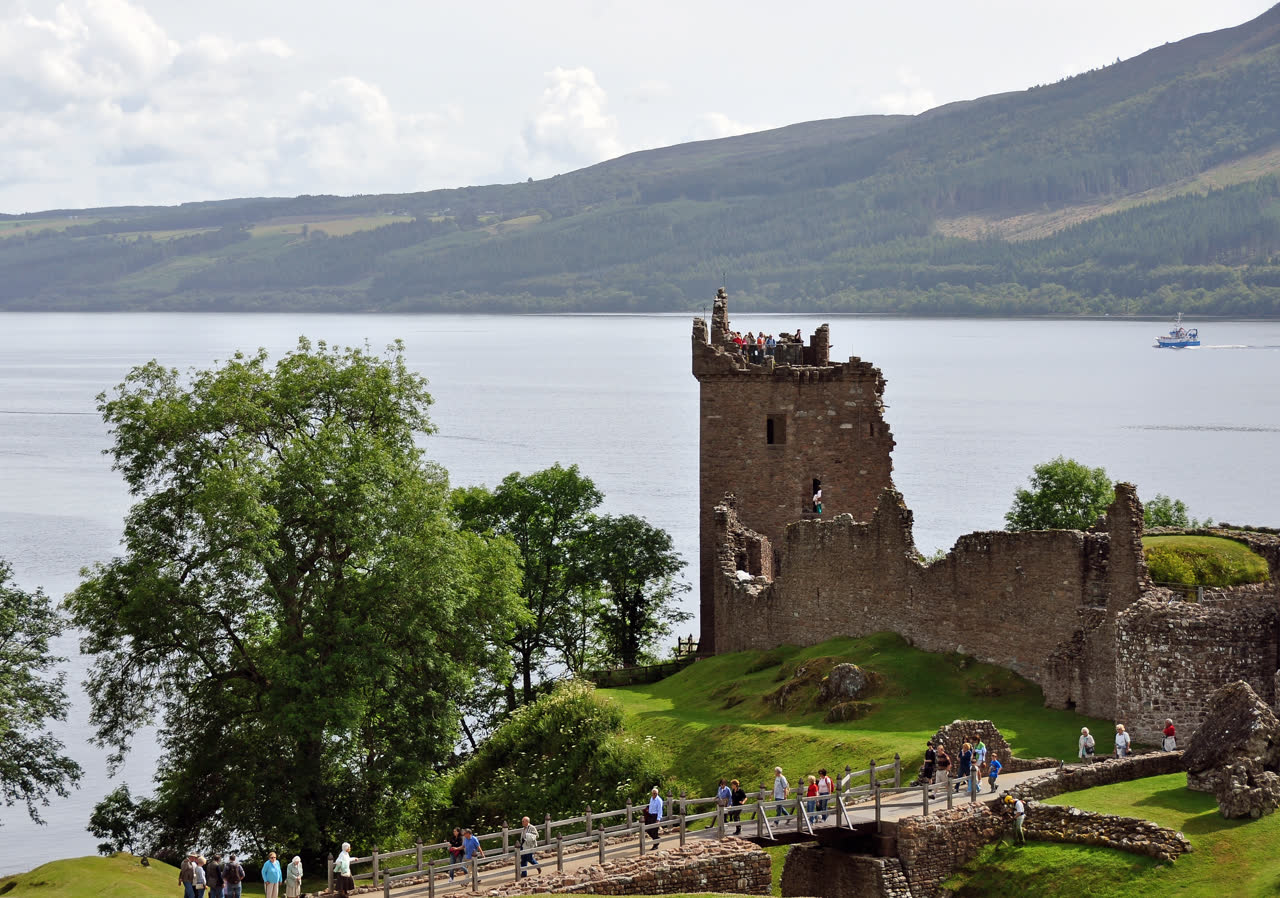
Loch Ness from Orbit: Three Elongated Shapes
A planned Inverness trip, Google Earth’s east shore, and three arcs under review — not confirmed Nessie, not dismissed either.
Sources Inverness Courier (18 Sep 2026); IBTimes UK (21 Sep 2026); New York Post (20 Sep 2026); Official Loch Ness Sightings Register (as reported)
Locale map
In mid-September 2026, Julie Fraser of north-east England opened Google Earth to scout the Clan Fraser cemetery on Loch Ness’s east shore ahead of a planned Inverness visit. What she enlarged instead were three elongated shapes in the water — a “little family,” she later called them — and she filed the find with the Official Loch Ness Sightings Register.
What the public record says
Local and national coverage (Inverness Courier, IBTimes UK, New York Post) recounts the same skeleton of facts. Fraser compared the shapes to a nearby pleasure boat that left a visible wake; the three forms, she said, showed none, and carried an arc suggesting backs rather than hulls. Imagery carried a 2026 year mark and trees in full leaf, which she took as a cue that the capture was recent leaf-on season — not a precise day stamp.
The register, by her account, contacted her and undertook a review. At the time of the reports, the shapes had not been confirmed as the legendary animal. Listing a report, the outlets note, is not the same as verifying a creature.
Archivist’s margin
Satellite and aerial pixels are generous with ambiguity: wakes, wave trains, submerged debris, sensor stretch, and wishful zoom all live in the same grey. Fraser’s own quotes stress significance without claiming laboratory proof. For this ledger the file is open: a documented digital report under review, cited from public press, with no independent confirmation that the arcs are biological, let alone Nessie. The hero image here is lake geography only — not a rehosted news screenshot of the Google Earth crop.
Evidence ledger
Each claim in this file, the source it rests on, and how well it holds up: 3 corroborated · 1 disputed · 5 unverified. What the labels mean.
| Claim | Source | Type · date | Status |
|---|---|---|---|
| Julie Fraser found three elongated shapes in Google Earth imagery of Loch Ness and reported them to the sightings register. | Inverness Courier; New York Post; IBTimes UK | press · 18–21 Sep 2026 | corroborated |
| The shapes are animals — a Nessie ‘family.’ | Fraser, as quoted by the Inverness Courier and others | press · 18 Sep 2026 | unverified |
| The register is reviewing the report and has published no assessment.Absent from both 2026 lists as of 1 Oct; not a rejection. | Inverness Courier; Official Loch Ness Sightings Register lists (checked 1 Oct 2026) | primary record · 1 Oct 2026 | corroborated |
| The register's 2026 lists show 15 in-person reports (latest 21 Aug) and 2 webcam reports. | Official Loch Ness Sightings Register | primary record · 1 Oct 2026 | corroborated |
| The 14-vs-15 count mismatch comes from one in-person entry added around 19 Sep.We can't see the register's edit history. | Ledger inference from Inverness Courier (18 Sep) and IBTimes UK (21 Sep) tallies | ledger analysis | unverified |
| The shapes measure about 6.8–7.1 m each, ~12 m apart, ~185 m off the south-east shore.One person's on-screen measurements; not replicated. | Loch Ness Mystery blog, ‘An Interesting Satellite Photograph’ | secondary · 19 Sep 2026 | unverified |
| The shapes can't be boats because, unlike a nearby pleasure boat, they leave no wake.The boat and shapes may come from different imaging passes. | Fraser via press; Loch Ness Mystery blog on stitched satellite passes | secondary · 18–19 Sep 2026 | disputed |
| The imagery is recent (2026 year mark, trees in leaf).Capture date still unknown. | Fraser, as reported by the Inverness Courier | press · 18 Sep 2026 | unverified |
| The three shapes are canoes with two paddlers each.One experienced local observer's reading of the screen image; no measurement or imagery date yet. | Steve Feltham on NewsNation (syndicated by BANG Showbiz, 28 Sep and 17 Oct 2026) | press · Sep 2026 | unverified |
Updates
-
As of 21 Sep reporting, Julie Fraser’s three elongated Google Earth shapes remain under Official Loch Ness Sightings Register review with no published assessment. IBTimes UK notes the register’s 2026 list (updated 19 Sep) shows fifteen reports — figures that do not line up cleanly with earlier Courier tallies. Press recirculation continues; pixels under review are not a specimen confirmation. Status stays open.
Sources Inverness Courier (18 Sep 2026) · IBTimes UK (21 Sep 2026) · Official Loch Ness Sightings Register (lochnesssightings.com)
-
Register re-check, 1 Oct 2026 (about 1:50 a.m. AZ time): the Official Loch Ness Sightings Register's 2026 in-person list reads 'Total for the year - 15', the most recent entry dated 21 August, and its separate webcam list shows two 2026 entries (5 March and 9 July). Julie Fraser's three Google Earth shapes appear in neither list, roughly two weeks after the register said it would look. That is not a rejection, and no assessment has been published. Those figures also likely explain the earlier count mismatch: the Inverness Courier (18 Sep) wrote of 14 in-person plus two webcam reports, while IBTimes UK (21 Sep) cited 15 as of a 19 Sep update. The most likely reading is that one in-person entry was added in between; we can't see the register's edit history, so that is our inference. The first independent measurement has also appeared. On 19 Sep the Loch Ness Mystery blog, whose author believes in the animal and says so, measured the shapes in Google Maps at roughly 6.8 to 7.1 m each, about 12 m apart and about 185 m off the south-east (Dores–Whitefield) shore, the same side Fraser called the east shore. He weighed kayaks, logs, lines of birds and wave effects without settling on one, and called the result a conundrum. He also notes the loch's satellite view is stitched together from separate passes, so the pleasure boat with a wake that Fraser compared the shapes against may not have been photographed at the same time. These are one person's on-screen ruler measurements and haven't been replicated. The imagery capture date is still unknown. Status stays open.
Sources Official Loch Ness Sightings Register: Sightings from 2021 on; Webcam images 2021 on (both checked 1 Oct 2026) · Inverness Courier (18 Sep 2026) · IBTimes UK (21 Sep 2026) · Loch Ness Mystery blog, 'An Interesting Satellite Photograph' (Glasgow Boy, 19 Sep 2026), lochnessmystery.blogspot.com
-
A first named-expert reading of the image. Steve Feltham, a full-time Nessie hunter who has lived at Dores since 1991, told NewsNation that the three shapes look like three Canadian canoes: each shows a small protrusion and a splash he reads as paddle action, with two people per canoe. He still believes something lives in the loch, and said part of his work is ruling out false alarms. The quote was syndicated by BANG Showbiz (28 Sep) and reprinted again on 17 Oct alongside register founder Gary Campbell's general view (to the Press and Journal) that a 'family' of animals lives deep in the loch. Campbell's remark isn't an assessment of Fraser's image, and the register still lists no verdict. One observer's opinion from a screen image, not a measurement; status stays open, now leaning prosaic.
Sources NewsNation, 'Loch Ness Monster sighting? New Google Maps image fuels debate' (Feltham on Hot Takes with Jesse Weber): https://www.newsnationnow.com/us-news/strange/loch-ness-monster-photo-cryptid-scotland/ · Bang Bizarre / BANG Showbiz, 28 Sep 2026: https://bangbizarre.com/index.php/2026/09/28/loch-ness-monster-hunter-explains-sighting-from-space/ · PerthNow (BANG Showbiz), 17 Oct 2026: https://www.perthnow.com.au/news/world/loch-ness-has-a-family-of-monsters-living-deep-down-c-23034700
Discussion
Discussions activating. Per-case threads will embed here once the Giscus GitHub App is installed on the public satellite repo.
Meanwhile, join the conversation on GitHub Discussions: https://github.com/dclewis21/anomaly-ledger-community/discussions
CoS / D.C.: see Community guidelines and
SETUP.mdin the site repo for the one-click Giscus install.