Tunguska, 30 June 1908: The Siberian Blast Without a Crater
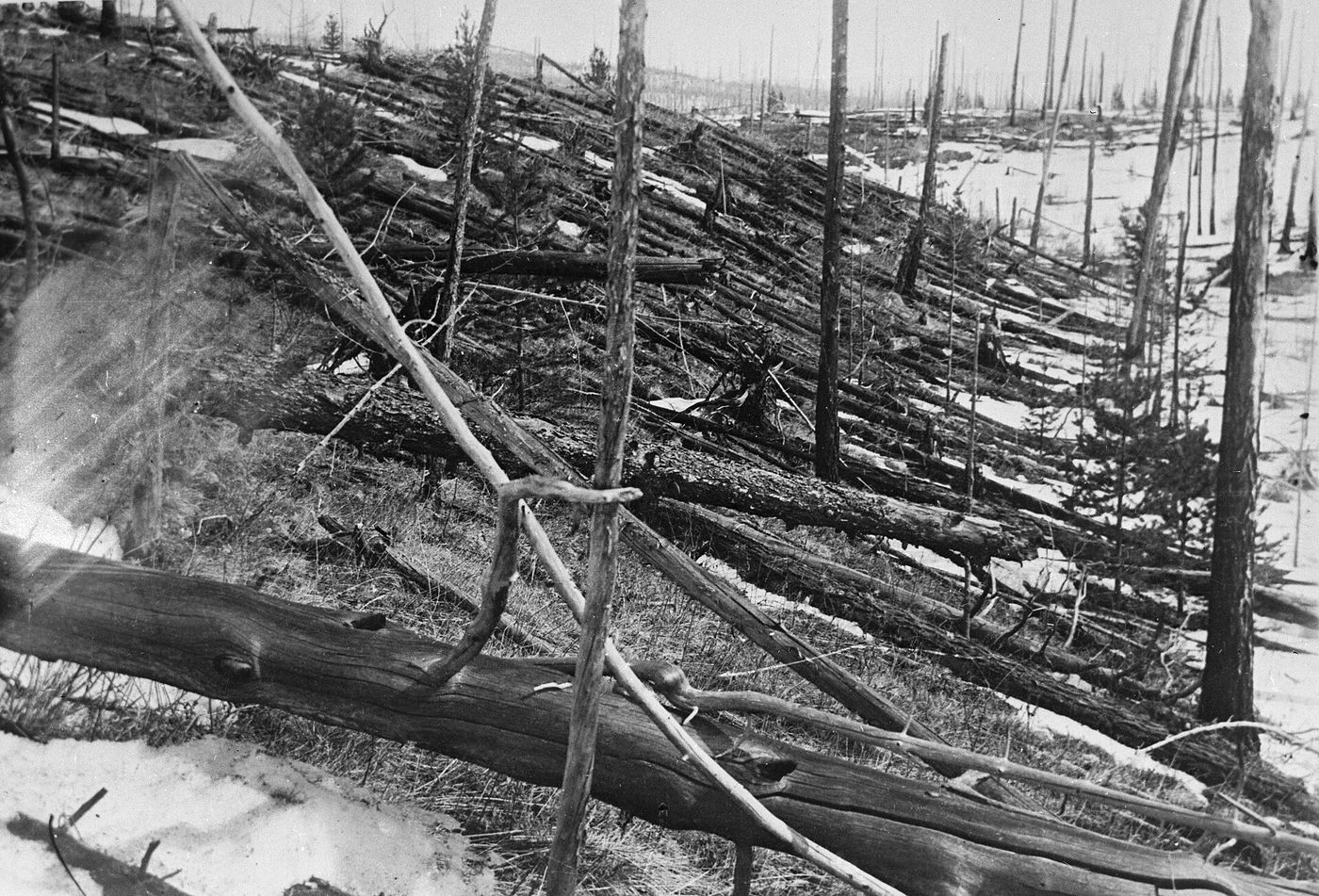
A cosmic body exploded over the Podkamennaya Tunguska River in Siberia and flattened about 2,000 square kilometres of forest. The first scientific expedition arrived nearly 20 years later and found no crater. Today it is accepted as an airburst of a small asteroid or comet.
Sources Leonid Kulik expedition reports (1927 onward); P. Jenniskens et al., 'Tunguska eyewitness accounts, injuries, and casualties', Icarus 327 (2019) 4, doi 10.1016/j.icarus.2019.01.001; Wikipedia, 'Tunguska event'
Early on 30 June 1908, Evenk herders and Russian settlers near the Podkamennaya Tunguska River in central Siberia saw a column of blue-white light cross the sky, followed by a flash and a blast that knocked people off their feet 60 km away. Seismographs across Eurasia recorded it, and night skies in Europe glowed for days.
Kulik’s forest
The remoteness of the site, and war and revolution, meant the first scientific expedition arrived only in 1927. Leonid Kulik found a vast area of flattened trees pointing outward from a centre, but no crater or meteorite. That absence fed a century of theories, from black holes to alien reactors.
The answer
Scientists now agree it was an airburst: a stony asteroid or comet perhaps 50–60 m across that broke up 5–10 km above the ground with the energy of several megatons. A 2019 study by Peter Jenniskens and colleagues collected eyewitness accounts and found records of at least three deaths. Tunguska shaped modern planetary defence; the 2013 Chelyabinsk event looked like its small cousin.
Ledger status
Marked cited. Map position is the blast centre region, a nature reserve.
Sources
- Jenniskens, P., et al. (2019), Icarus 327, 4 — doi:10.1016/j.icarus.2019.01.001
- Wikipedia, “Tunguska event” — en.wikipedia.org
- Wikipedia, “Тунгусский метеорит” — ru.wikipedia.org
Part of the World Ledger, batch 1. Original text; no images are used.
Evidence ledger
Each claim in this file, the source it rests on, and how well it holds up: 3 corroborated · 1 disputed · 1 debunked. What the labels mean.
| Claim | Source | Type · date | Status |
|---|---|---|---|
| A huge explosion occurred over the Tunguska region on 30 Jun 1908 and flattened about 80 million trees. | Kulik expeditions; Wikipedia | scholarly | corroborated |
| No impact crater was found. | Kulik (1927); later studies | scholarly · 1927 | corroborated |
| The explosion was an airburst of a stony asteroid or comet tens of metres across. | Scientific consensus; Jenniskens et al. (2019) | scholarly · 2019 | corroborated |
| Eyewitness accounts record at least three deaths.Records are sparse. | Jenniskens et al., Icarus 2019 | scholarly · 2019 | disputed |
| A nuclear spaceship or antimatter caused it. | Fringe proposals | secondary | debunked |
Discussion
Discussions activating. Per-case threads will embed here once the Giscus GitHub App is installed on the public satellite repo.
Meanwhile, join the conversation on GitHub Discussions: https://github.com/dclewis21/anomaly-ledger-community/discussions
CoS / D.C.: see Community guidelines and
SETUP.mdin the site repo for the one-click Giscus install.