2008 TC3: The First Asteroid Caught Before It Hit
On 6 October 2008 astronomers spotted a small asteroid 19 hours before impact and predicted where it would fall. It exploded over the Nubian Desert in northern Sudan. Students and staff of the University of Khartoum walked the desert and recovered about 600 fragments, named Almahata Sitta.
Sources P. Jenniskens et al., 'The impact and recovery of asteroid 2008 TC3', Nature 458 (2009) 485, doi 10.1038/nature07920; NASA Astronomy Picture of the Day, 28 Mar 2009; Wikipedia, '2008 TC3'
On 6 October 2008 Richard Kowalski at the Catalina Sky Survey near Tucson picked up a faint object that turned out to be on a collision course with Earth. It was only a few metres across. Within hours, the Minor Planet Center and NASA’s Jet Propulsion Laboratory had worked out where it would hit: over northern Sudan, early on 7 October. It was the first time an asteroid had been found before impact.
The fall
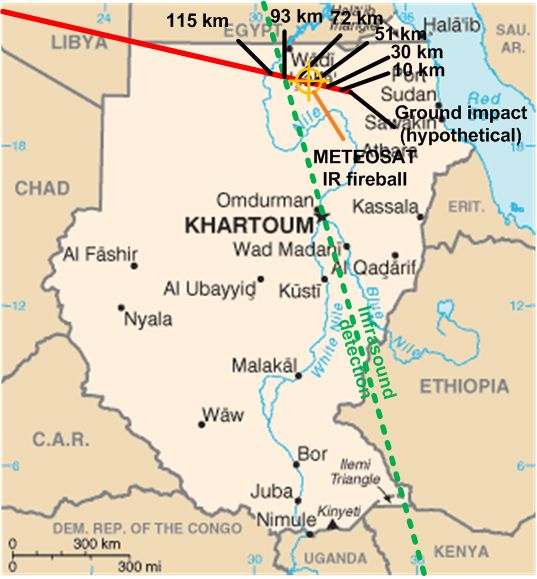
At 02:46 UTC the asteroid entered the atmosphere and exploded about 37 km up. A KLM airliner crew saw a flash; weather satellites and infrasound stations recorded the blast. Below lay the Nubian Desert near Station Six on the railway from Wadi Halfa to Khartoum.
The search
In December, Peter Jenniskens of the SETI Institute and NASA Ames and Muawia Shaddad of the University of Khartoum led students and staff in walking lines across the desert. They found the first stone within hours and about 600 fragments in all, weighing roughly 10 kg. The meteorite was named Almahata Sitta, Arabic for “Station Six.” It turned out to be a rare and mixed ureilite. The results were published in Nature in March 2009.
Ledger status
Marked cited. Map position is the strewn field region in the Nubian Desert.
Sources
- Jenniskens, P., et al. (2009), Nature 458, 485 — doi:10.1038/nature07920
- NASA, Astronomy Picture of the Day, 28 Mar 2009 — apod.nasa.gov
- Wikipedia, “2008 TC3” — en.wikipedia.org
Part of the World Ledger, batch 1. Original text; no images are used.
Evidence ledger
Each claim in this file, the source it rests on, and how well it holds up: 4 corroborated. What the labels mean.
| Claim | Source | Type · date | Status |
|---|---|---|---|
| 2008 TC3 was discovered by the Catalina Sky Survey on 6 Oct 2008, about 19 hours before impact. | Jenniskens et al., Nature 2009 | scholarly · 2009 | corroborated |
| It entered the atmosphere over northern Sudan on 7 Oct 2008 and exploded high above the Nubian Desert. | Jenniskens et al. (2009) | scholarly · 2009 | corroborated |
| About 600 fragments were recovered by a University of Khartoum team led with Peter Jenniskens. | Jenniskens et al. (2009); APOD | scholarly · 2009 | corroborated |
| The meteorite, Almahata Sitta, is a rare ureilite with mixed fragments of other types. | Jenniskens et al. (2009) | scholarly · 2009 | corroborated |
Discussion
Discussions activating. Per-case threads will embed here once the Giscus GitHub App is installed on the public satellite repo.
Meanwhile, join the conversation on GitHub Discussions: https://github.com/dclewis21/anomaly-ledger-community/discussions
CoS / D.C.: see Community guidelines and
SETUP.mdin the site repo for the one-click Giscus install.