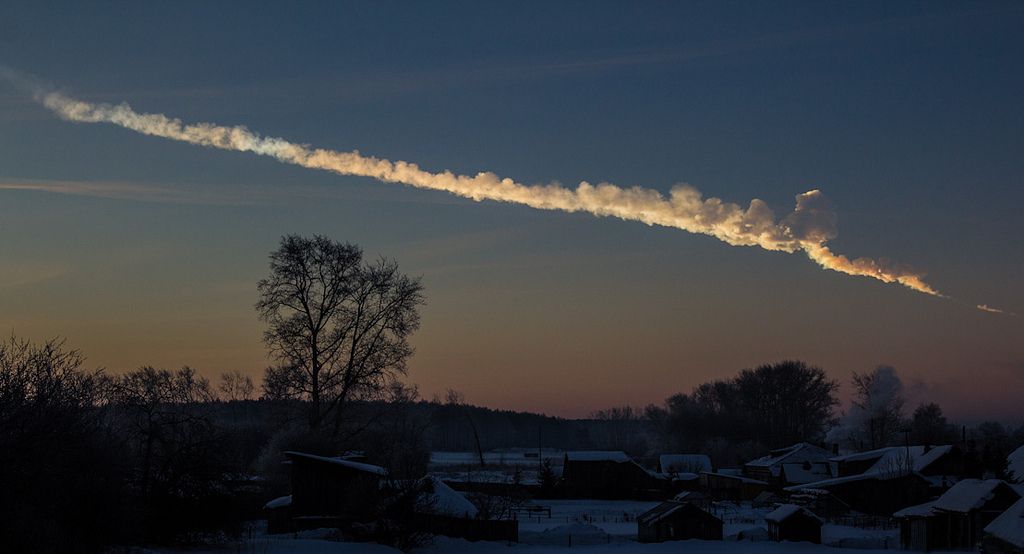
Chelyabinsk, 15 February 2013: The Fireball Everyone Filmed
A 20-metre asteroid exploded over the southern Urals, brighter than the Sun. The shock wave blew out windows in six cities and injured about 1,500 people, mostly from flying glass. Dashcams recorded it from every angle.
Sources O. P. Popova et al., 'Chelyabinsk airburst, damage assessment, meteorite recovery, and characterization', Science 342 (2013) 1069, doi 10.1126/science.1242642; P. G. Brown et al., Nature 503 (2013) 238, doi 10.1038/nature12741; NASA; Wikipedia
At 9:20 a.m. on a clear winter morning, people across the southern Urals saw a fireball cross the sky, outshining the Sun and casting moving shadows. Russians drive with dashcams, so hundreds of videos captured it. About a minute and a half later the shock wave arrived and blew in windows across Chelyabinsk and nearby towns.
The numbers
Studies in Science and Nature reconstructed it: an ordinary chondrite about 20 m across, moving at about 19 km/s, burst roughly 30 km up with around 400–500 kilotons of energy. About 1,500 people sought medical help, most cut by glass after going to their windows to look at the flash. A large fragment, about 570 kg, was lifted from Lake Chebarkul in October.
The lesson
The asteroid came from the direction of the Sun and was not detected beforehand. It became the best-documented airburst in history and a push for better sky surveys.
Ledger status
Marked cited. Map position is city level.
Sources
- Popova, O. P., et al. (2013), Science 342, 1069 — doi:10.1126/science.1242642
- Brown, P. G., et al. (2013), Nature 503, 238 — doi:10.1038/nature12741
- Wikipedia, “Chelyabinsk meteor” — en.wikipedia.org
Part of the World Ledger, batch 1. Original text; no images are used.
Evidence ledger
Each claim in this file, the source it rests on, and how well it holds up: 4 corroborated · 1 debunked. What the labels mean.
| Claim | Source | Type · date | Status |
|---|---|---|---|
| A roughly 20 m asteroid exploded about 30 km above the Chelyabinsk region on 15 Feb 2013. | Popova et al., Science 2013; Brown et al., Nature 2013 | scholarly · 2013 | corroborated |
| About 1,500 people were injured, mainly by broken glass, and some 7,200 buildings damaged. | Popova et al. (2013) | scholarly · 2013 | corroborated |
| The energy was about 400–500 kilotons of TNT. | Brown et al. (2013) | scholarly · 2013 | corroborated |
| A large fragment was recovered from Lake Chebarkul in October 2013. | Popova et al.; press | scholarly · 2013 | corroborated |
| A UFO shot the meteor down.The 'UFO' was a fragment and a camera artefact. | Viral video claims | social · 2013 | debunked |
Discussion
Discussions activating. Per-case threads will embed here once the Giscus GitHub App is installed on the public satellite repo.
Meanwhile, join the conversation on GitHub Discussions: https://github.com/dclewis21/anomaly-ledger-community/discussions
CoS / D.C.: see Community guidelines and
SETUP.mdin the site repo for the one-click Giscus install.