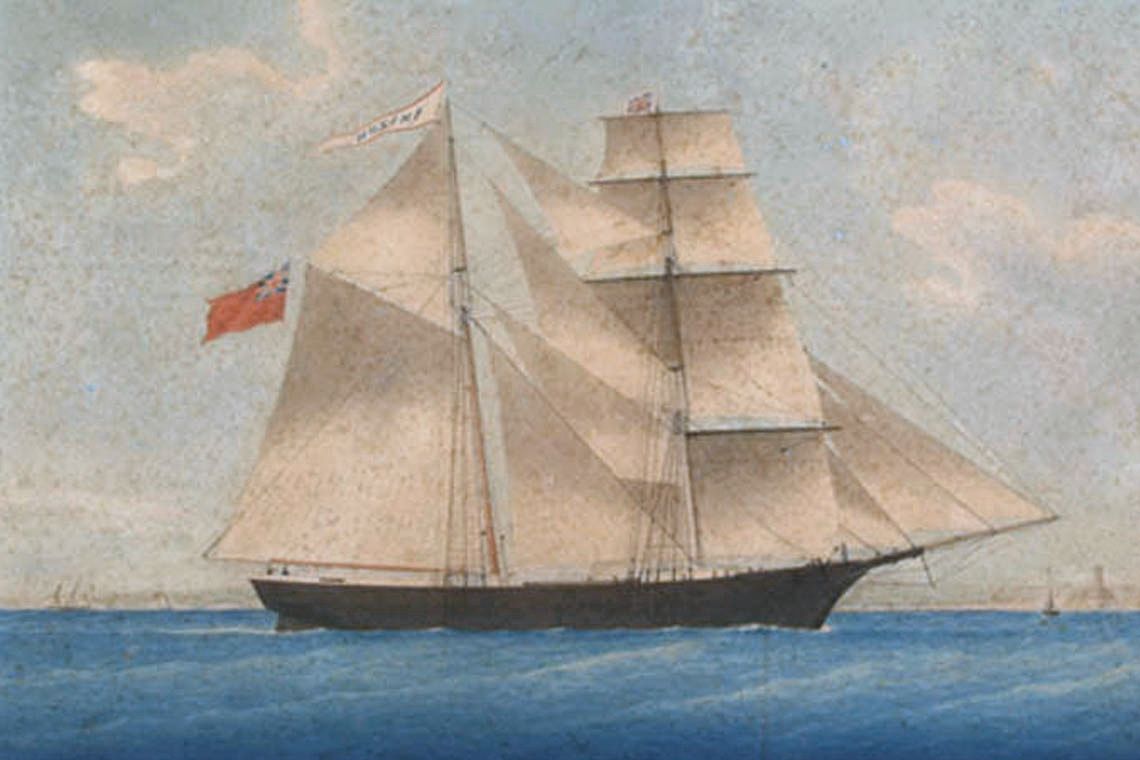
Mary Celeste, December 1872: The Ship Found Sailing With No One Aboard
A Nova Scotia-built brigantine was found drifting between the Azores and Portugal, seaworthy, with its cargo intact and its crew of ten gone. The Gibraltar inquiry found no foul play. A rushed abandonment in fear of the alcohol cargo exploding or the ship sinking is the leading theory.
Sources New York Times, 25 March 1873 (Gibraltar inquiry); Smithsonian Magazine, 'Abandoned Ship: The Mary Celeste'; Wikipedia, 'Mary Celeste'
The Mary Celeste was built at Spencers Island, Nova Scotia, in 1861 as the Amazon, then sold, renamed and registered in the United States. On 7 November 1872 she left New York for Genoa under Captain Benjamin Briggs, with his wife, their two-year-old daughter and seven crew, carrying 1,701 barrels of industrial alcohol.
The discovery
On 4 December the Canadian brigantine Dei Gratia, which had left New York a week later, found her drifting between the Azores and Portugal. A boarding party found her sound, with six months’ food and water, personal belongings untouched, and the cargo nearly intact. The lifeboat was gone, and the last log entry was ten days old.
The inquiry and the theories
At salvage hearings in Gibraltar the British official suspected foul play, but none was found, and the Dei Gratia crew were paid a reduced award. Popular theories have included mutiny, pirates, waterspouts and sea monsters. Historians favour a hurried abandonment: fumes from leaking barrels, a jammed pump or a false reading of water in the hold may have convinced Briggs to take to the boat, which was then lost. Arthur Conan Doyle’s 1884 short story, pure fiction, made the case world-famous.
Ledger status
Marked open. Map position is the approximate area where she was found, open sea.
Sources
- New York Times, 25 March 1873 — timesmachine.nytimes.com (PDF)
- Smithsonian Magazine, “Abandoned Ship: The Mary Celeste” — smithsonianmag.com
- Wikipedia, “Mary Celeste” — en.wikipedia.org
Part of the World Ledger, batch 1. Original text; no images are used.
Evidence ledger
Each claim in this file, the source it rests on, and how well it holds up: 3 corroborated · 1 disputed · 1 debunked. What the labels mean.
| Claim | Source | Type · date | Status |
|---|---|---|---|
| The Canadian brigantine Dei Gratia found Mary Celeste adrift and abandoned on 4 Dec 1872. | Gibraltar salvage hearings; NYT (1873) | period press · 1873 | corroborated |
| The ship was seaworthy, provisioned and its cargo of alcohol largely intact; the lifeboat was missing. | Gibraltar hearings; Smithsonian | press | corroborated |
| No one aboard — Captain Briggs, his wife, daughter and seven crew — was ever found. | Wikipedia; Smithsonian | secondary | corroborated |
| The crew abandoned ship in fear of an explosion or sinking. | Leading historical theory | secondary | disputed |
| Arthur Conan Doyle's story records the facts.His 1884 story was fiction and spread errors such as the name 'Marie Celeste'. | Popular belief | secondary · 1884 | debunked |
Discussion
Discussions activating. Per-case threads will embed here once the Giscus GitHub App is installed on the public satellite repo.
Meanwhile, join the conversation on GitHub Discussions: https://github.com/dclewis21/anomaly-ledger-community/discussions
CoS / D.C.: see Community guidelines and
SETUP.mdin the site repo for the one-click Giscus install.