The evidence: The original Big Ear printout with 6EQUJ5 circled
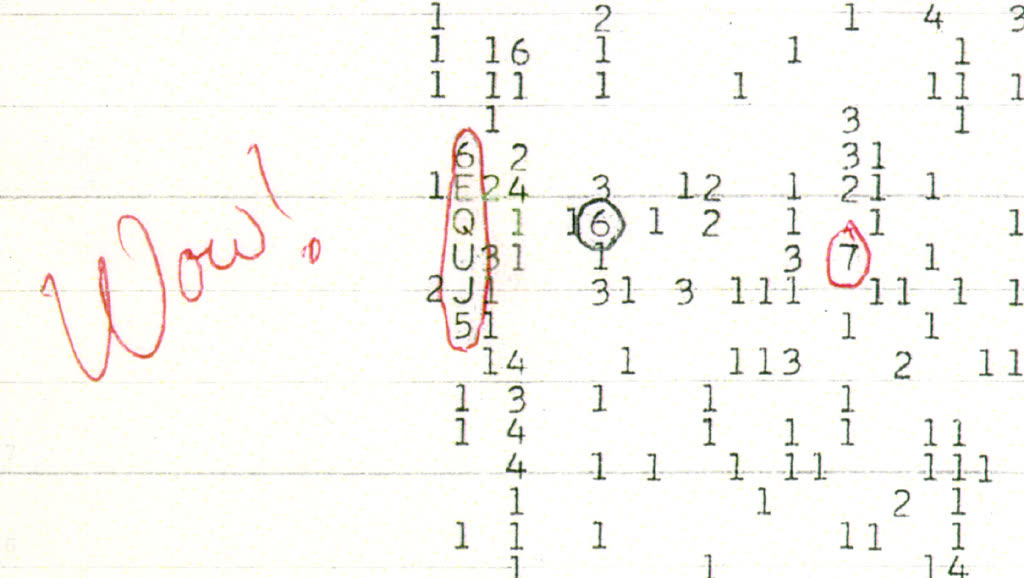
The Wow! Signal, 15 August 1977: 72 Seconds From Sagittarius
Last reviewed Next review
We review and update every article weekly. When the record changes, so does the article. How we review
A narrowband radio signal hit Ohio State's Big Ear telescope once and never came back.
Verdict: A real, strong, narrowband signal was recorded once; every ordinary source checked so far fits badly, and with one detection we cannot say more.
Original sources: Ehman, 30th Anniversary Report (bigear.org) · Kawa, Plain Dealer 1994 (bigear.org reprint)
Sources Jerry R. Ehman, 'The Big Ear Wow! Signal (30th Anniversary Report)', bigear.org (2007, rev. 2010); Barry Kawa, Cleveland Plain Dealer Sunday Magazine, 18 Sep 1994, reprinted at bigear.org
Most nights the Big Ear radio telescope in Delaware, Ohio, ran with nobody there. An IBM 1130 sampled 50 narrow radio channels, each 10 kHz wide, and printed one character per channel every 12 seconds. A few days after the run that began on 15 August 1977, volunteer astronomer Jerry Ehman was reading the printout at home when he saw “6EQUJ5” in channel 2. He circled it in red and wrote “Wow!” in the margin.
What the code means
The program printed signal strength as a multiple of the background noise: digits for 1 to 9, then letters for 10 and up. “U” is 30, so at its peak the signal was about 30 times the noise. The six readings rose and fell in the shape you get when a fixed point in the sky drifts through the telescope’s beam as Earth turns. Ehman’s later fits matched that beam shape to better than 99 percent.
It came in at about 1420.456 MHz, a hair above the natural radio line of hydrogen, a band set aside internationally so nobody transmits there. Ehman puts the source in Sagittarius.
The problem
Big Ear had two feed horns side by side. A real fixed source should show up in one horn and then, a few minutes later, in the other. Wow! appeared once. The computer did not record which horn, so there are two possible positions, and the signal could not have lasted more than about two and a half minutes without showing up twice.
The team checked planets, asteroids, satellites, aircraft and spacecraft and found nothing in the beam. Ehman once suspected an Earth signal bouncing off space debris, but later wrote that debris would have to be metallic, not tumbling and almost fixed against the stars, which he judged unlikely. They watched that strip of sky for about 60 more days. In 1994 the Plain Dealer reported more than 100 observations at or near that declination. It never came back.
Where we land
Ehman’s own conclusion was that the origin is still open and that one detection is too little data. We agree. Wow! is a well-documented single event with no explanation that fits every feature, and no repeat to test.
Sources
- Jerry R. Ehman, “The Big Ear Wow! Signal (30th Anniversary Report)”, 2007, revised 2010: bigear.org
- Barry Kawa, Cleveland Plain Dealer Sunday Magazine, 18 Sep 1994, reprinted: bigear.org
- Printout scan: Wikimedia Commons

Every image on this page is credited where it appears.
Verdict
Open A real, strong, narrowband signal was recorded once; every ordinary source checked so far fits badly, and with one detection we cannot say more.
Evidence ledger
Each claim in this file, the source it rests on, and how well it holds up: 6 corroborated · 1 unverified. What the labels mean.
| Claim | Source | Type · date | Status |
|---|---|---|---|
| The signal peaked about 11:16 p.m. EDT on 15 Aug 1977 and lasted about 72 seconds (six 12-second readings). | Ehman (2007/2010) | primary record · 2010 | corroborated |
| The printout code 6EQUJ5 means a peak about 30 times the background noise. | Ehman (2007/2010) | primary record · 2010 | corroborated |
| Frequency was 1420.4556 +/- 0.005 MHz, close to the hydrogen line, in one 10 kHz channel. | Ehman (2007/2010) | primary record · 2010 | corroborated |
| The telescope's dual horns should have seen any steady source twice within about 5 minutes; it was seen only once. | Ehman (2007/2010) | primary record · 2010 | corroborated |
| Planets, known satellites, aircraft and spacecraft were checked and ruled out.Ruled out in the observers' own analysis; no independent re-analysis read yet. | Ehman (2007/2010) | primary record · 2010 | corroborated |
| It has not been detected again in more than 100 later looks from Big Ear. | Kawa (1994) with bigear.org editor's note; Ehman (2007/2010) | period press · 1994 | corroborated |
| Later proposals (comets, hydrogen clouds) explain it.UNSOURCED here; left out of the body until the papers are read. | Not read this cycle | scholarly | unverified |
Update log
-
We added this case file.
-
Weekly re-check of sources; no change to the record since filing. Next check November 9, 2026.
Discussion
Discuss this case on the on-site Community board — no GitHub account required. Prefer a private tip for the editorial team? Submit a Sighting.
House rules: Community guidelines.