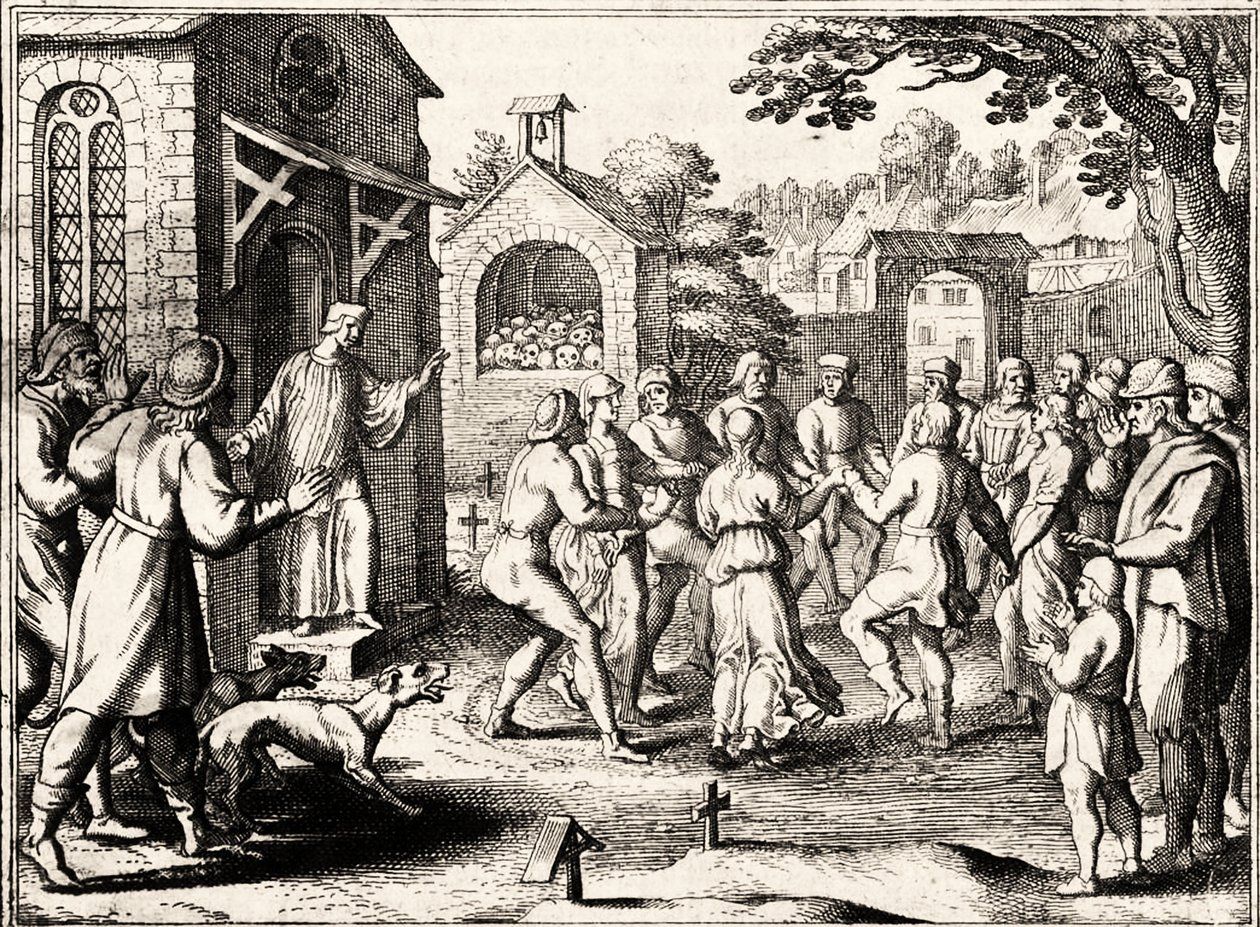
Strasbourg, 1518: The Summer People Danced Until They Dropped
In July 1518 a woman began dancing in a Strasbourg street and did not stop. Within weeks dozens, perhaps hundreds, had joined her. The city council's records survive, and historians still argue about why it happened.
Sources Strasbourg city council records and chronicles, 1518, as analysed by John Waller, 'A forgotten plague: making sense of dancing mania', The Lancet 373 (2009), doi 10.1016/S0140-6736(09)60386-X; Waller, A Time to Dance, a Time to Die (2008); Wikipedia, 'Dancing plague of 1518'
In mid-July 1518 a woman known in the sources as Frau Troffea began dancing in a street in Strasbourg, then a free city of the Holy Roman Empire. She kept going for days. Others joined. By August the city was dealing with a crowd of dancers that the sources number anywhere from about 50 to 400.
What the city did
The council’s response is the best-documented part. Advised that the dancers had “hot blood,” it first gave them space, including guild halls and a stage, and even hired musicians, on the theory they needed to dance it out. When that made things worse, it banned public music and dancing and sent the afflicted to a shrine of St Vitus in the hills.
Why it happened
The historian John Waller, who has worked through the council records, argues for a mass psychogenic illness: a population hit by famine and disease, and steeped in the belief that St Vitus could curse people with dancing, fell into a shared trance. Ergot poisoning from mouldy rye is the other common idea, but it causes convulsions and restricted blood flow, not days of coordinated movement. How many people died is not settled.
Ledger status
Marked disputed on the cause. That the outbreak happened is well documented in city records.
Sources
- John Waller, “A forgotten plague: making sense of dancing mania,” The Lancet 373 (2009) — doi:10.1016/S0140-6736(09)60386-X
- Wikipedia, “Dancing plague of 1518” — en.wikipedia.org
- BBC Radio 4 Today, report on the dancing plague — news.bbc.co.uk
Part of the World Ledger, batch 1. Original text; no images are used.
Evidence ledger
Each claim in this file, the source it rests on, and how well it holds up: 2 corroborated · 2 disputed · 1 unverified. What the labels mean.
| Claim | Source | Type · date | Status |
|---|---|---|---|
| A dancing epidemic broke out in Strasbourg in July 1518 and lasted into September. | Contemporary council records and chronicles, per Waller (Lancet 2009) | scholarly · 2009 | corroborated |
| Somewhere between 50 and 400 people danced for days or weeks.Sources disagree on the number. | Waller; Wikipedia | secondary | disputed |
| The authorities encouraged dancing at first, providing space and musicians, before banning it and sending dancers to a shrine. | Waller, Lancet 2009 | scholarly · 2009 | corroborated |
| Many dancers died.The death toll is not established. | Later chronicles | secondary | unverified |
| Stress-induced mass psychogenic illness, in a population that believed in St Vitus's curse, explains the outbreak.The leading theory; ergot poisoning has also been proposed but fits poorly. | John Waller | scholarly · 2009 | disputed |
Discussion
Discussions activating. Per-case threads will embed here once the Giscus GitHub App is installed on the public satellite repo.
Meanwhile, join the conversation on GitHub Discussions: https://github.com/dclewis21/anomaly-ledger-community/discussions
CoS / D.C.: see Community guidelines and
SETUP.mdin the site repo for the one-click Giscus install.