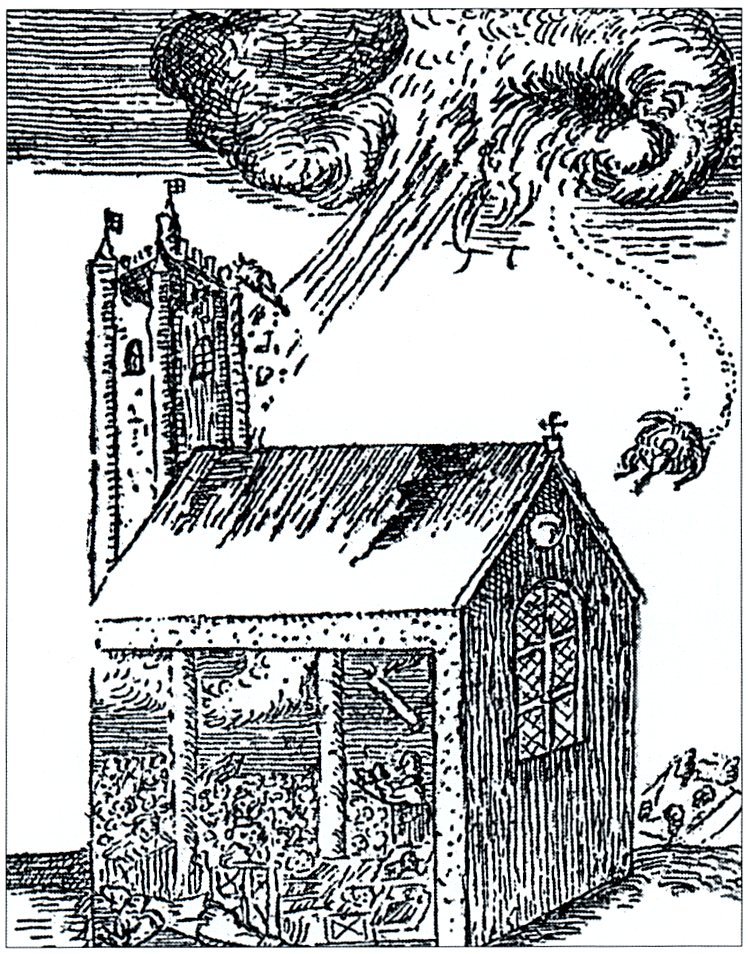
Widecombe, 1638: The "Great Fiery Ball" in the Church
On Sunday afternoon, October 21, 1638, a violent thunderstorm struck the parish church at Widecombe-in-the-Moor on Dartmoor during the service. Witnesses said a 'great fiery ball' came in at the window. It's often listed as one of the earliest accounts of ball lightning, and it was also one of the first big news stories in English print.
Sources Ralph Harford, A true relation of those sad and lamentable accidents… (London, Nov 1638; two editions), as analysed by Piers Mucklejohn, Early Modern Scribbling (6 Feb 2023); Met Office National Meteorological Library and Archive, METDLA/1/1 “Wydecombe Storm 1638”
On the afternoon of Sunday, October 21, 1638, the parish church of St Pancras at Widecombe-in-the-Moor, high on Dartmoor in Devon, was full for the afternoon service. A storm came over the moor. What happened next was printed in London within a month, reprinted, revised, versified and preached about for years.
What the pamphlets described
The London publisher Ralph Harford put out the story in November 1638 as A true relation of those sad and lamentable accidents…. It sold well enough that he issued several impressions and then a second, expanded edition. As summarized by the historian Piers Mucklejohn, who has worked through the surviving copies:
- A sudden, deep darkness fell over the church, so thick that people couldn’t see their neighbors. It came with violent thunder and “terrible strange lightning” that filled the building with fire, smoke and a choking, sulphurous smell.
- Some witnesses said they “saw a great fiery ball come in at the window.” The second edition adds that the ball seemed to split, with one part leaving by a window and the other going into the chancel, where it threw a group of boys from their seats without hurting them.
- Many people were burned. Some had skin badly scorched while their clothes were untouched. Stones were thrown from the building across the churchyard, and a beam fell between the minister and the clerk.
- People died. The pamphlets name several of them, including a gentleman sitting by the chancel and a gamekeeper. The second edition gives the congregation as about 300 and the injured as “fiftie or sixtie.”
The ledger doesn’t give a total death count. The pamphlets and later retellings don’t agree on a single number, and we haven’t checked the original scans ourselves.
A news story, not just a weather event
Mucklejohn reads the Widecombe pamphlets as an early case study in how news got made. Harford registered the first version 27 days after the storm and rushed it out. Later printings added a sermon-like preface about God’s warnings. The text says it was compiled from letters by ministers and “men of quality,” plus witnesses who had come to London, and the writer sometimes questions his own sources. He doubts, for example, that the fireball went back into the nave, because the damage didn’t support it. Within five years the story had been turned into verse and used in at least four religious tracts as an example of divine judgment.
The Met Office’s National Meteorological Library holds a contemporary account in its archive (METDLA/1/1). Its catalog entry calls Widecombe one of the earliest accounts of ball lightning, and notes that people at the time blamed a visit from the devil to collect gamblers’ souls. Mucklejohn mentions a local legend that parishioners were playing cards during the service.
Ball lightning, or an ordinary strike?
- Ball lightning. Ball lightning is a real phenomenon that is rarely recorded by instruments. A glowing ball entering through a window and moving through a building matches what is usually reported as ball lightning. That’s why Widecombe makes so many lists.
- A severe ordinary lightning strike. A direct hit on the tower, with falling masonry, flash burns, smoke and the smell of ozone and burning, could produce most of the injuries and damage described. In a dark, smoke-filled church, a flash at a window could easily be remembered as a “ball.”
- Printing and retelling. The details we have passed through letters, a London compiler and a commercial publisher with a religious message to sell. Mucklejohn shows that the account was edited and expanded between printings.
Ledger status
Disputed. A deadly storm really struck the church that day, and witnesses really described a fiery ball. Whether that was ball lightning or a violent ordinary strike remembered through terror and print can’t be settled from the surviving record. It’s part of the October Ledger and is the historic-testimony anchor for the Ball Lightning series.
St Pancras is a working parish church. If you visit, treat it as a place of worship, not a haunt.
Sources
- Piers Mucklejohn, “Widecombe-in-the-Moor’s 1638 Thunderstorm: A Case Study in 17th-Century News Reporting,” Early Modern Scribbling, 6 Feb 2023 (analysis of Ralph Harford’s pamphlets, London, Nov 1638, and later printings) — earlymodernscribbling.com
- Met Office National Meteorological Library and Archive, “Wydecombe Storm 1638,” METDLA/1/1 — digital.nmla.metoffice.gov.uk
Evidence ledger
Each claim in this file, the source it rests on, and how well it holds up: 4 corroborated · 1 disputed. What the labels mean.
| Claim | Source | Type · date | Status |
|---|---|---|---|
| A violent storm struck St Pancras, Widecombe-in-the-Moor, during afternoon service on 21 Oct 1638, killing and injuring members of the congregation. | Ralph Harford's pamphlets (London, 1638), per Piers Mucklejohn; Met Office archive METDLA/1/1 | primary record · 1638 | corroborated |
| Witnesses saw “a great fiery ball come in at the window.”The witnesses' description, as printed; not proof of the mechanism. | Harford's pamphlets, per Mucklejohn | primary record · 1638 | corroborated |
| The fiery ball was ball lightning.A severe ordinary strike could explain most of the damage and injuries. | Met Office METDLA/1/1 catalog (calls it one of the earliest ball-lightning accounts) | museum / archive · n.d. | disputed |
| The second edition gives a congregation of about 300 and “fiftie or sixtie” injured.The ledger doesn't give a death total; versions disagree. | Harford, second edition, per Mucklejohn | primary record · 1638 | corroborated |
| The account was edited and expanded between printings. | Piers Mucklejohn, Early Modern Scribbling | secondary · 6 Feb 2023 | corroborated |
Discussion
Discussions activating. Per-case threads will embed here once the Giscus GitHub App is installed on the public satellite repo.
Meanwhile, join the conversation on GitHub Discussions: https://github.com/dclewis21/anomaly-ledger-community/discussions
CoS / D.C.: see Community guidelines and
SETUP.mdin the site repo for the one-click Giscus install.