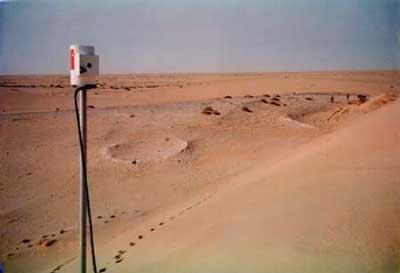
The evidence: Two of the Wabar craters seen from a sand dune: the small 11-meter crater on the left and Philby's crater A, about 64 meters across, on the right
The Wabar Craters, 1932: Philby Went Looking for a Lost City and Found a Meteorite Strike
Last reviewed Next review
We review and update every article weekly. When the record changes, so does the article. How we review
In 1932 Harry St John Philby crossed the Empty Quarter to find Wabar, a city burned by fire from heaven. He found meteorite craters. We trace how old they are.
Verdict: The ruins of Wabar are meteorite craters blasted into the sand by a falling iron mass about three centuries ago; there was no city, and the exact day of the impact is still uncertain.
Original sources: H. St J. B. Philby, The Empty Quarter (London, 1933), chapter on Wabar, full text on the Internet Archive · Jeffrey C. Wynn and Eugene M. Shoemaker, 'The Day the Sands Caught Fire', Scientific American, November 1998, pp. 64 to 71 (USGS copy, archived) · J. R. Prescott, G. B. Robertson, C. Shoemaker, E. M. Shoemaker and J. Wynn, 'Luminescence dating of the Wabar meteorite craters, Saudi Arabia', Journal of Geophysical Research: Planets 109 (2004), USGS Publications Warehouse record · Omar Basurah, 'Estimating a new date for the Wabar meteorite impact', Meteoritics & Planetary Science 38, supplement (2003), University of Arizona repository · E. Gnos and others, 'The Wabar impact craters, Saudi Arabia, revisited', Meteoritics & Planetary Science 48 (2013), abstract via DOI · Wikimedia Commons, file page for the USGS photograph of the Wabar craters

Sources H. St J. B. Philby, The Empty Quarter (1933), Internet Archive; Jeffrey C. Wynn and Eugene M. Shoemaker, 'The Day the Sands Caught Fire', Scientific American (November 1998); J. R. Prescott and others, 'Luminescence dating of the Wabar meteorite craters, Saudi Arabia', Journal of Geophysical Research: Planets (2004); Omar Basurah, 'Estimating a new date for the Wabar meteorite impact', Meteoritics & Planetary Science (2003); E. Gnos and others, Meteoritics & Planetary Science (2013)
Arab tradition told of Wabar, a rich city somewhere in the great southern sands of Arabia. Its king ignored the warnings of the prophet Hud and lived for pleasure, so the story goes, until fire came down from heaven and burned the place to ashes. The Bedouin said its ruins could still be found far out in the Rub’ al Khali, the Empty Quarter, and that iron and black “pearls” lay among them.
In early 1932 the British explorer Harry St John Philby set out to find it. What he found was real, and stranger than a ruin. The photograph at the top of this case shows two of the craters he reached, as they looked when American geologists mapped them more than sixty years later.
What Philby saw
We read Philby’s own account in The Empty Quarter, his 1933 book about the crossing. His guide, ‘Ali, led the party across the dunes toward a place the Bedouin called Al Hadida, “the iron”, steering by a tall sandhill. Philby writes that he first glimpsed “a thin low line of ruins” riding on the sand. Then he climbed a low ridge before sunset and looked down, as he put it, not on an ancient city but into “twin craters, half filled with drifted sand”, ringed with what looked like slag and lava.
His first thought was a volcano. His companions had a different idea. They came running up with lumps of slag, flakes of rusted iron and small shiny black pellets, which they took to be the pearls of the ladies of the city, blackened in the fire. Philby told them the place was “the work of God not man”. ‘Ali disagreed: these were the burned castles of the ancients, he said, and the pellets proved it. Another guide, Salim, had promised Philby a lump of iron “big as a camel”, but when he went to look he said it was buried under the sand.
Philby photographed the craters and gathered samples before moving on. The one issue of the Geographical Journal he had with him happened to carry an article on a crater at Bosumtwi, in what is now Ghana, thought to have been made by a meteorite, and he noted in his journal that the Wabar hollows were “perhaps depressions created by the fall of meteorites”. Back in London, the British Museum examined his finds. The iron was meteoritic, and the black glass was sand that had melted. Wabar became one of only a handful of meteorite craters known anywhere in the world at the time.
What the geologists found
Few outsiders reached Wabar for decades. Between 1994 and 1995 Jeffrey Wynn and Eugene Shoemaker of the U.S. Geological Survey made three expeditions there and wrote them up in Scientific American in 1998. We read their article in the USGS copy kept by the Internet Archive.
They describe a site roughly half a kilometer by one kilometer, with three craters: about 116 meters and 64 meters across (the two Philby saw, which they call Philby B and Philby A) and a third of about 11 meters that Wynn recognized in December 1994. Around them lay white “impactite”, sand squeezed into rock by the shock, and the black glass, which they describe as mostly melted sand mixed with a little iron and nickel from the meteorite. The impactite contains coesite, a form of silica made only under enormous pressure.
From the spread of the debris they worked out the story. An iron and nickel body came in from the northwest at a shallow angle, broke apart in the air, and hit the sand in at least four pieces at about five to seven kilometers per second. They estimate the largest piece was eight to nine and a half meters across and struck with the energy of nine to 13 kilotons of TNT, comparable to the Hiroshima bomb. The impact never reached bedrock; the whole crater field was punched into sand. The biggest piece of iron ever recovered there, a 2,200-kilogram lump called the Camel’s Hump, was hauled out in 1965. Wynn and Shoemaker wrote that it was on display at King Saud University in Riyadh, so Salim’s camel-sized iron was not just a story.
The sand is also taking the craters back. Wynn and Shoemaker describe a creeping dune that had almost buried Philby A, which you can see on the right of the photograph. When a team from Swiss museums and the Saudi Geological Survey, led by E. Gnos of the Natural History Museum of Geneva, visited in March 2008, their paper says, only Philby B and the small crater could still be seen, and Philby A was completely covered.
How old is it?
This is the part that is still argued over. An early estimate from glass samples in the 1970s put the impact about 6,400 years ago. Wynn and Shoemaker doubted that. They pointed to the “Nejd” meteorites, iron masses sold in the nineteenth century with a story that a fireball had passed over the Riyadh region in 1863 or 1891, heading in the direction of Wabar, and they suggested the impact might be only about 135 years old. “Perhaps the grandfathers of Philby’s guides saw the explosion from a long way off,” they wrote.
A more direct test followed. John Prescott and colleagues at the University of Adelaide, working with Wynn and the Shoemakers, dated the craters by luminescence, which measures how long ago sand grains were last heated or exposed to light. Their 2004 paper gives an age of 290 years, give or take 38. That rules out an impact in 1863 or 1891 and puts it at roughly 1700.
In 2003 the Saudi astronomer Omar Basurah offered a candidate date from written history. He drew on two Arabic poems about a fireball seen from Tarim, in the Hadhramaut of Yemen, roughly 600 kilometers southwest of Wabar. He worked out the date they give as a Saturday in the year 1116 of the Islamic calendar, which falls on 1 September 1704 in ours. That fits inside the luminescence range, and Prescott’s paper compares its result with historical dates like this one. Still, a fireball seen hundreds of kilometers away cannot be pinned to Wabar for certain, so we treat 1704 as a possible match rather than a proven one.
If the dating holds, the legend may carry a real memory. A blast that lit the sky over southern Arabia, scattered iron and glass across the dunes and left smoking pits where nothing had been before would be easy to remember as fire from heaven. We cannot prove that link, but it is a reasonable guess, and it is the kind of story the Ledger keeps coming back to. The “lost city” itself was never there. For the other famous search for a lost city in these sands, see our case on Ubar and Shisr.
Our map pin sits on the crater field, deep in one of the largest sand deserts on Earth, far from roads and water. It is not a place to visit casually, and the iron and glass there should stay where they lie.
Sources
- H. St J. B. Philby, The Empty Quarter (London, 1933), chapter on Wabar: full text on the Internet Archive (read 2 Nov 2026)
- Jeffrey C. Wynn and Eugene M. Shoemaker, “The Day the Sands Caught Fire”, Scientific American, November 1998, pp. 64 to 71: USGS copy, archived (read 2 Nov 2026)
- J. R. Prescott, G. B. Robertson, C. Shoemaker, E. M. Shoemaker and J. Wynn, “Luminescence dating of the Wabar meteorite craters, Saudi Arabia”, Journal of Geophysical Research: Planets 109 (2004): USGS Publications Warehouse record and abstract (read 2 Nov 2026)
- Omar Basurah, “Estimating a new date for the Wabar meteorite impact”, Meteoritics & Planetary Science 38, supplement (2003): University of Arizona repository (read 2 Nov 2026)
- E. Gnos and others, “The Wabar impact craters, Saudi Arabia, revisited”, Meteoritics & Planetary Science 48 (2013): abstract via DOI (read 2 Nov 2026)
- U.S. Geological Survey photograph of the Wabar craters: Wikimedia Commons file page (read 2 Nov 2026)
Weighing it
The physical case is closed. Philby’s samples, the British Museum’s tests and the USGS expeditions all show the same thing: iron meteorite fragments, shock-made rock and melted sand around craters that were punched into the dunes from above. Nobody who has studied the site thinks a city ever stood there.
What remains open is the date. The luminescence age of about 290 years is the best measurement anyone has, and it rules out the nineteenth-century fireball stories. The 1704 fireball over Yemen fits that age, but it was seen far away and nothing ties it to Wabar directly. We mark the craters explained, with the exact day of the impact still unknown.
Every image on this page is credited where it appears.
Verdict
Explained The ruins of Wabar are meteorite craters blasted into the sand by a falling iron mass about three centuries ago; there was no city, and the exact day of the impact is still uncertain.
Update log
-
We added this case file.
-
Weekly re-check of sources; no change to the record since filing. Next check November 9, 2026.
Discussion
Discuss this case on the on-site Community board — no GitHub account required. Prefer a private tip for the editorial team? Submit a Sighting.
House rules: Community guidelines.