The evidence: Hans Glaser's 1561 broadsheet: the colored woodcut of the sun ringed by crescents, spheres, crosses, tubes and a black spear over Nuremberg
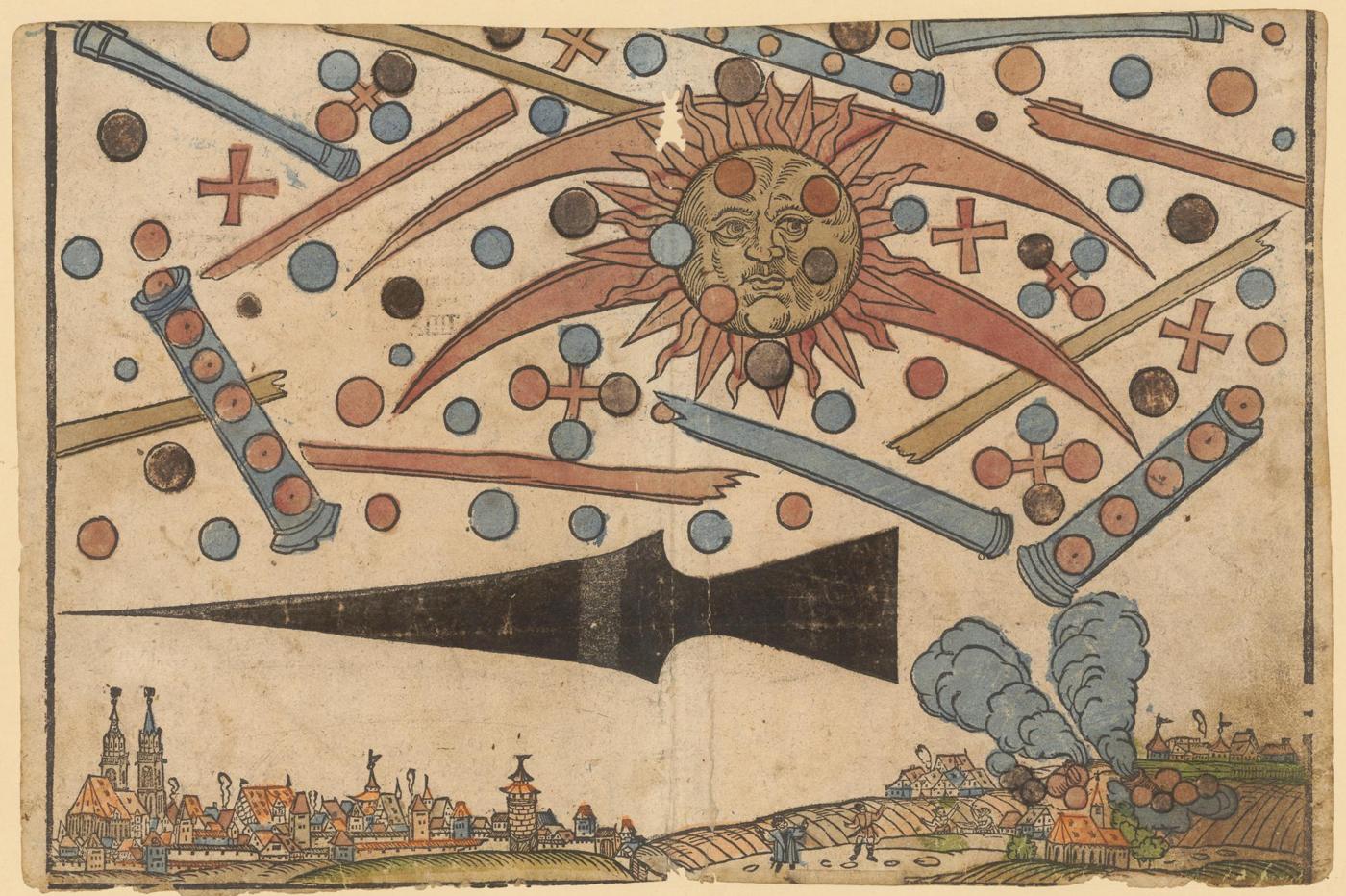
The Nuremberg Sky Battle, 1561: Spheres, Crosses and Tubes Around the Rising Sun
Last reviewed Next review
We review and update every article weekly. When the record changes, so does the article. How we review
At sunrise on 14 April 1561, a Nuremberg broadsheet says, red, blue and black balls fought around the sun for an hour. We read the original print.
Verdict: A real sky event, most likely a bright display of sun halos at sunrise, probably lies behind the 1561 Nuremberg broadsheet, but its omen-style text and picture cannot be reconstructed exactly and point to no craft of any kind.
Original sources: Hans Glaser, broadsheet on the sky sign over Nuremberg, 14 April 1561, Zentralbibliothek Zürich PAS II 1/12 and 1/13, e-manuscripta · Ulrich Magin, 'Ein Ufo im Jahr 1561?', ufo-information.de (2012), archived copy · Dirk Lorenzen, 'Vor 460 Jahren: Beängstigendes Himmelsspektakel über Nürnberg', Deutschlandfunk (14 April 2021) · Georg Merckel, broadsheet on the sky sign over Eggolsheim (Nuremberg, 1561), Zentralbibliothek Zürich PAS II 1/16, e-manuscripta · Samuel Coccius, broadsheet on the sky signs over Basel (Basel, 1566), Zentralbibliothek Zürich PAS II 6/5, e-manuscripta
Sources Hans Glaser, broadsheet printed in Nuremberg, 1561, Zentralbibliothek Zürich PAS II 1/12 and 1/13 (Wickiana collection); Ulrich Magin, 'Ein Ufo im Jahr 1561?', ufo-information.de (2012); Dirk Lorenzen, 'Vor 460 Jahren: Beängstigendes Himmelsspektakel über Nürnberg', Deutschlandfunk (14 April 2021); comparison broadsheets from Nuremberg (1561) and Basel (1566), Zentralbibliothek Zürich
On the morning of 14 April 1561, according to a single printed sheet sold in Nuremberg, the sun rose with company. Blood-red crescents cut across it. Balls of red, blue and black gathered in and around it, with crosses, long colored streaks and two great tubes full of more balls. Then, the sheet says, everything began to fight.
The woodcut that goes with this text has become one of the best-known images in UFO writing, often captioned as an aerial battle of spacecraft over a Renaissance city. We went back to the sheet itself, which survives in the Zentralbibliothek Zürich, and read its German text line by line. We also read what a German researcher of historical sightings and a German halo specialist have said about it, and compared it with other sky-sign prints from the same years. The woodcut shown at the top of this case is the original. Translations from the German are ours.
The broadsheet
The sheet measures about 26 by 38 centimeters. The top half is a hand-colored woodcut and the bottom half is printed text. The last line names the printer: Hans Glaser, Briefmaler in Nuremberg, a trade that printed and colored single-sheet pictures for sale. The date is printed as ANno M. D. LXI, 1561.
It survives because a Zürich clergyman, Johann Jakob Wick, who lived from 1522 to 1588, spent decades collecting reports of wonders, monsters, comets and disasters into a huge scrapbook chronicle. Glaser’s sheet was pasted into it. The pages were later removed and are now kept as single prints by the Zentralbibliothek Zürich, which has put them online with a public domain mark. The library holds a second copy of the same sheet in another part of the collection.
What the text says
The text opens by dating the event to 14 April 1561, in the morning between four and five o’clock, at sunrise. It says the sight was seen in the city of Nuremberg, before the gate and out in the country, by many men and women.
First, two blood-red strokes, half round like a waning moon, appeared through the middle of the sun. In the sun, above and below it and on both sides, stood blood-red balls, some bluish or iron-colored, some black. Some were arranged three in a row, some four in a square, some stood alone. Between them were blood-red crosses, and blood-red streaks that were thick at the back and thinner at the front, the text says, like the barrels of arquebuses, the hand guns of the day. Among these were two large tubes, one on the right and one on the left, holding three, four or more balls each.
Then all of it began to fight. The balls flew into the sun and out of it and from one side to the other, and the text says this went on for a good hour. After that, as shown in the picture, it all fell from the sun and the sky to the earth as though it were burning, and wasted away on the ground with a great vapor. Last came a black spear, its shaft toward the east and its point toward the west.
The remaining third of the text is a sermon. What such signs mean, it says, God alone knows. Because so many signs have appeared in the sky one after another, and people mock them, readers should expect punishment unless they repent and pray. The sheet ends with an amen and the printer’s name.
How the picture works
Seen beside the text, the woodcut is a careful illustration of the words rather than a view from a window. The sun has a face. The crescents, balls, crosses, streaks and tubes are all there, along with the spear, which takes up the middle of the picture. Nuremberg sits along the bottom left, with its church towers. On the right, smoke rises from a hill where balls lie on the ground, which matches the text’s line about things falling and vanishing in vapor.
Some of what it shows could not have been seen at once. The text describes a sequence lasting more than an hour, from the first crescents to the fight to the fall to the spear. The picture puts all of it into one frame.
The prodigy tradition
The researcher Ulrich Magin, writing on the German site ufo-information.de in 2012, traces the image’s modern fame to the psychologist C. G. Jung, who included it in his 1958 book on flying saucers. Magin argues that the sheet belongs to a long tradition of prints about armies and battles seen in the sky, which were read as warnings from God. He points to a broadsheet about Plech, a village near Nuremberg, in 1554, which describes riders, blue stars or balls fighting for about two hours and things falling to earth.
He also makes a point about language. In sixteenth-century German, he says, “Rohr” (tube or pipe) was used for the barrel of a gun or cannon. Read that way, the tubes and the gun-barrel streaks in the text are the war imagery the prodigy genre expected, not descriptions of machinery. And Magin notes that Nuremberg’s own printers produced similar sheets that same year: a print by Georg Kreydlein about an aurora seen over Eisleben in February 1561 shows columns of smoke, a rod and a crucifix in the sky.
We checked two more prints in the same Zürich collection. A sheet by Georg Merckel, also printed in Nuremberg in 1561, reports a sign in the sky over Eggolsheim near Forchheim on 28 December 1560, which the library catalogs as an aurora and which the print reads as a warning from God. A sheet printed in Basel in 1566, with text by Samuel Coccius, reports red skies and black balls around the sun at sunrise and sunset in late July and early August 1566 and treats them as a divine sign, closing with a prayer against the Turks. The Nuremberg sheet fits in with these. Magin’s own conclusion is careful: whether anything at all was seen over Nuremberg that morning, we do not know.
A halo display?
For the natural explanation most often given, Dirk Lorenzen of Deutschlandfunk talked to Claudia Hinz, who chairs the Arbeitskreis Meteore, a German association that records atmospheric optics, for a calendar piece marking the event’s 460th anniversary in 2021. Hinz explains that halos form when sunlight passes through ice crystals in thin, high clouds about 8 to 10 kilometers up. The most common is a ring around the sun at 22 degrees. Next come parhelia, bright spots on either side of the sun at the same distance, often colored. More than fifty kinds of halo are known, bright displays turn up on roughly ten days a year, and they can last for hours.
That fits several things in the text: colored crescents and arcs through and around the sun, bright spots beside it, and a display that went on for more than an hour around sunrise. Hinz also gives the main caveat. People who saw such things often had draftsmen record them, and the artists interpreted what they were told or combined a whole day’s sightings into one picture. So, she says, it is hard to know what was really seen. She adds that most questions she now gets about the print come from people who believe in chemtrails.
Sources
- Hans Glaser, broadsheet describing the sign in the sky over Nuremberg on 14 April 1561, colored woodcut and printed text, Nuremberg, 1561, Zentralbibliothek Zürich, PAS II 1/12 (picture) and PAS II 1/13 (text), from the Wickiana collection: e-manuscripta, DOI 10.7891/e-manuscripta-91897 (read 5 Nov 2026)
- Ulrich Magin, “Ein Ufo im Jahr 1561?”, ufo-information.de, 2012: archived PDF (read 5 Nov 2026; the original address no longer loads)
- Dirk Lorenzen, “Vor 460 Jahren: Beängstigendes Himmelsspektakel über Nürnberg”, Deutschlandfunk, Kalenderblatt, 14 April 2021: deutschlandfunk.de (read 5 Nov 2026)
- Georg Merckel, broadsheet on the sign in the sky over Eggolsheim, 28 December 1560, Nuremberg, 1561, Zentralbibliothek Zürich, PAS II 1/16: e-manuscripta (read 5 Nov 2026)
- Samuel Coccius, broadsheet on the signs in the sky over Basel, July and August 1566, printed by Samuel Apiarius, Basel, 1566, Zentralbibliothek Zürich, PAS II 6/5: e-manuscripta (read 5 Nov 2026)
Weighing it
The record is thin. There is one source, a commercial print made to be sold, and it names no witness. It claims many people saw the sight, but no diary, council minute or second account from Nuremberg has turned up in what we read. The text and picture are also shaped from start to finish by the purpose of the sheet, which was to warn readers that God was angry.
Still, the details in the text are specific in a way that matches real sky optics: the time at sunrise, colored crescents through the sun, bright spots around it, a show that lasted over an hour. A strong halo display, read by frightened people and written up in the language of battle omens, explains most of it. The fighting, the falling and burning, and the spear are harder to place and may be interpretation, borrowed imagery or other events folded in. We mark the case disputed because no one can now say exactly what rose with the sun that morning. Nothing in the record suggests anything other than the sky doing something unusual.
Every image on this page is credited where it appears.
Verdict
Disputed A real sky event, most likely a bright display of sun halos at sunrise, probably lies behind the 1561 Nuremberg broadsheet, but its omen-style text and picture cannot be reconstructed exactly and point to no craft of any kind.
Update log
-
We added this case file.
-
Weekly re-check of sources; no change to the record since filing. Next check November 9, 2026.
Discussion
Discuss this case on the on-site Community board — no GitHub account required. Prefer a private tip for the editorial team? Submit a Sighting.
House rules: Community guidelines.