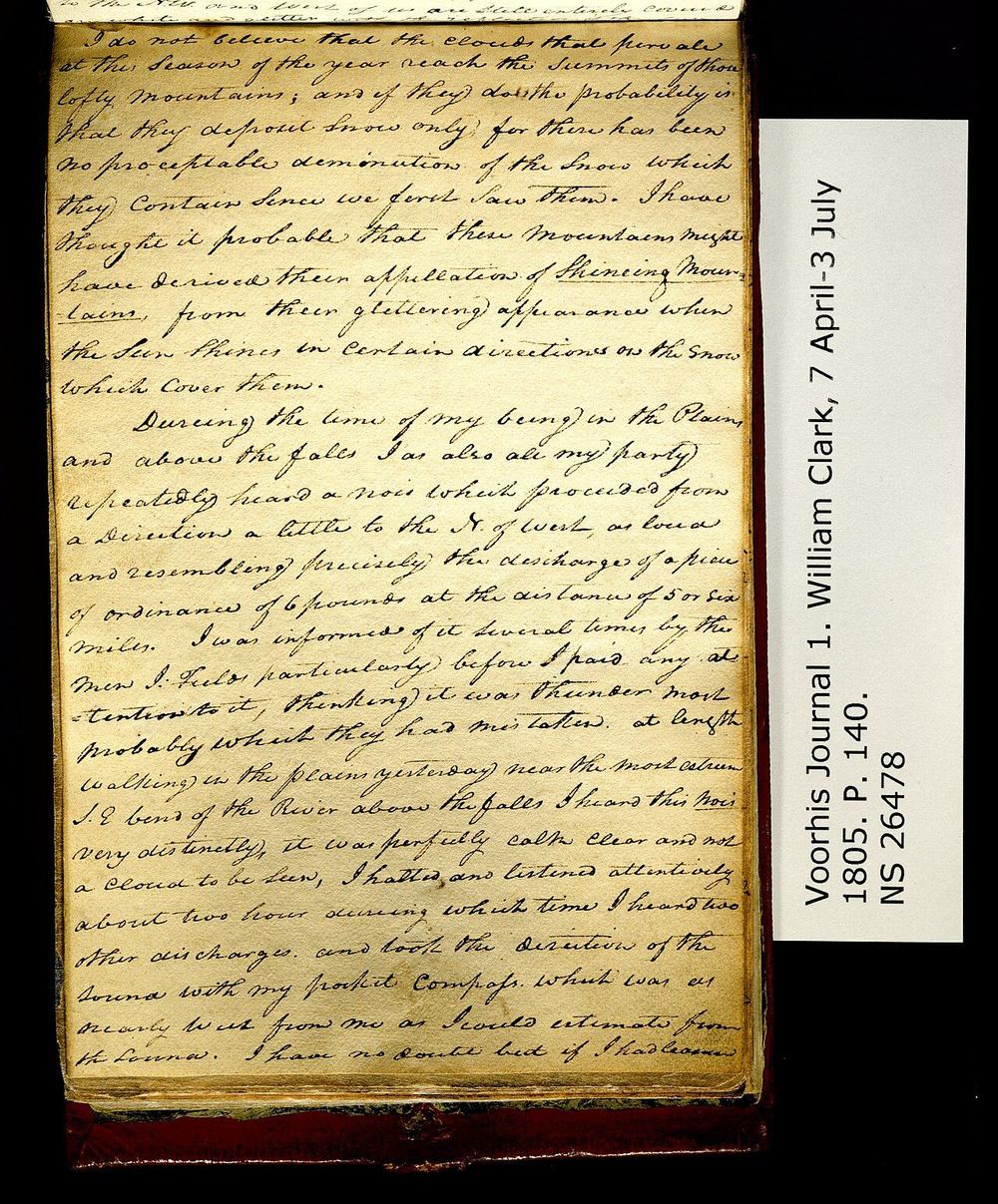
The evidence: William Clark's own handwritten account of the booms, page 140 of his Voorhis Journal No. 1
The Missouri Booms, 1805: The 'Artillery of the Rocky Mountains' Lewis and Clark Could Not Explain
Last reviewed Next review
We review and update every article weekly. When the record changes, so does the article. How we review
At the Great Falls of the Missouri in 1805, Lewis and Clark kept hearing booms like distant cannon under clear skies. They never found the cause.
Verdict: Lewis, Clark and their men clearly heard repeated cannon-like booms near the Great Falls in the summer of 1805, but the source was never found, and distant thunder carried by unusual layers of air remains a reasonable guess rather than a proven answer.
Original sources: Journals of the Lewis and Clark Expedition, 4 July 1805 (Lewis and Clark entries), University of Nebraska-Lincoln · Journals of the Lewis and Clark Expedition, 11 July 1805 (Lewis entry), University of Nebraska-Lincoln · Journals of the Lewis and Clark Expedition, 20 June 1805 (Clark entry and editor's notes), University of Nebraska-Lincoln · Joseph A. Mussulman, 'Unaccountable Artillery of the Rockies', Discover Lewis & Clark, Lewis and Clark Trail Heritage Foundation · National Park Service, 'Artillery Sounds Heard By Lewis and Clark'
Sources Meriwether Lewis, journal entries for 4 and 11 July 1805, and William Clark, entries for 20 June and 4 July 1805, Journals of the Lewis and Clark Expedition (University of Nebraska-Lincoln edition); William Clark, Voorhis Journal No. 1, p. 140 (Missouri Historical Society); Joseph A. Mussulman, 'Unaccountable Artillery of the Rockies', Discover Lewis & Clark (Lewis and Clark Trail Heritage Foundation); National Park Service, 'Artillery Sounds Heard By Lewis and Clark'
In June 1805 the Lewis and Clark expedition reached the Great Falls of the Missouri, in what is now Montana, and spent about a month dragging its canoes and baggage around them. While they were there, the men kept hearing something nobody could explain: deep booms from the west, like a cannon fired a few miles off, on days when there was no storm in sight.
We read the captains’ own words in the University of Nebraska-Lincoln edition of the expedition journals, and we looked at the original page in William Clark’s handwriting, shown at the top of this case.
What Lewis wrote
Meriwether Lewis wrote it up on 4 July 1805, the day the party used up the last of its whiskey celebrating Independence Day. Since arriving at the falls, he wrote, they had “repeatedly witnessed a nois” coming from a little north of west, sounding exactly like a six-pound cannon fired about three miles away. The men told him about it several times before he paid attention. He assumed they were hearing thunder.
Then he heard it himself. Walking on the plains, he said, it was perfectly calm and clear, with not a cloud to be seen. He stopped and listened for about an hour, heard two more of the booms, and took a compass bearing on them. He was sure that with time he could find where the sound came from.
Lewis tried out one idea: water running through caverns in the mountains, like the “blowing caves” of Virginia. He dropped it himself. A cave would make a regular, repeating sound, and this did not. Sometimes there was a single boom and sometimes six or seven in quick succession, at different times of the day and night. “I am at a loss to account for this phenomenon,” he wrote.
A week later, on 11 July, just before sunset, he heard two more “discharges of this unaccounable artillery of the Rocky Mountains” from the same direction. Only then did he remember that the Minnetarees (the Hidatsa, whom the party had wintered near) had told him the Rocky Mountains made a noise like thunder. He had brushed that off at the time as false or superstitious. He added that the French boatmen said the Pawnee and Arikara told the same story about the Black Hills far to the east, and that the boatmen had their own explanation: the bursting of rich silver mines inside the mountains.
What Clark wrote
William Clark’s entry for 4 July is short. Among his notes on the strange local weather, he wrote that “a rumbling like Cannon at a great distance is heard to the west of us; the Cause we Can’t account.”
Clark also wrote a longer version, and that is the page we show. It sits in his Voorhis Journal No. 1, now at the Missouri Historical Society in St. Louis, filed under the entry dated 20 June. The Nebraska editors point out that it was really copied from Lewis’s notes of 4 and 11 July, with Clark reworking it in his own voice. His version differs in small ways. He puts the imagined cannon five or six miles away rather than three, names Joseph Field as the man who kept reporting the sound, and says he listened for about two hours. He also offers a guess of his own: the river just above the falls, which ran toward the noise, might have been called the Medicine River because of it, since tribes along the Missouri called anything they could not account for “medicine”. That river is today’s Sun River, which joins the Missouri at the city of Great Falls.
The editors add a note we find telling. The captains never found an explanation, and the sound, they write, is still heard in the region. Years later, in a letter of 20 December 1810, Clark reminded his editor Nicholas Biddle that Biddle had blamed avalanches, like those of the Alps.
What came after
Joseph Mussulman, writing for the Lewis and Clark Trail Heritage Foundation, gathered later reports. Wilson Price Hunt, who led John Jacob Astor’s overland fur expedition west in 1810 and 1811, reported similar booms near the Black Hills, and Washington Irving retold Hunt’s account in Astoria (1836). In August 1872 Thomas P. Roberts, surveying the Missouri for the Northern Pacific railroad, was camped at the mouth of the Sun River when his party heard sounds like the ones Lewis and Clark described. Roberts called it a strange coincidence. The National Park Service’s own article on the booms says trappers and settlers in later years reported hearing the same kind of sound around Great Falls.
Booms like this are not unique to Montana. They have been reported around the world under local names, including the Seneca guns of New York (see our case on the Seneca guns), the Barisal guns of Bangladesh and the mistpoeffers of the Netherlands and Belgium.
Possible explanations
Avalanches. Biddle’s idea, and a real source of thunder-like noise in high mountains. Explorers crossing the Canadian Rockies in 1807 and after described snowslides that roared like thunder. Lewis noted on 4 July that the mountains to the west were still white with snow, so the idea is not absurd. But those peaks lay far off across the plains, and Biddle himself left the idea out of the published History of the expedition in 1814.
Earthquakes. Small, shallow quakes can make a boom with little or no shaking. Mussulman notes that a 1936 study of earthquakes at Helena first tied such sounds to earthquake waves, but that the Great Falls area has a low potential for earthquakes, which makes this a weaker fit there than in more active parts of Montana.
Distant thunder bent by the air. This is the explanation Mussulman favors. Thunder normally fades out within about 15 miles. But when a layer of warm air sits over cooler air, sound heading upward can bend back down and be heard far away, while places in between hear nothing. Civil War observers recorded the same effect with gunfire, and the physicist Jearl Walker described it for thunder in 1977. The country around Great Falls has frequent summer storms over the mountains, and Lewis and Clark both wrote that clouds there rose suddenly and dumped rain and hail in patches. Thunder from a storm beyond the horizon, carried to a camp under a clear sky, would fit what they heard.
Gas, solar storms and the rest. The Park Service article lists other ideas people have floated, from gas escaping from the ground to solar activity. None has been tested against the Great Falls reports.
The weakness of every theory is the same. Nobody recorded the booms with instruments, the dates and directions are rough, and the conditions in 1805 cannot be rebuilt. What we can say is what the journals show: these were experienced travelers, used to gunfire and thunder, who heard the sound many times, took bearings on it, rejected their own first guesses and wrote it down honestly as unexplained.
Our map pin is on the city of Great Falls. The expedition’s camps were along the river nearby, much of it now changed by dams and the city itself.
Sources
- Meriwether Lewis and William Clark, entries for 4 July 1805, Journals of the Lewis and Clark Expedition, ed. Gary E. Moulton, University of Nebraska-Lincoln online edition: lc.jrn.1805-07-04 (read 3 Nov 2026)
- Meriwether Lewis, entry for 11 July 1805, same edition: lc.jrn.1805-07-11 (read 3 Nov 2026)
- William Clark, entry dated 20 June 1805, with the editors’ notes on its date, Biddle’s avalanche suggestion and the sound still being heard: lc.jrn.1805-06-20 (read 3 Nov 2026)
- William Clark, Voorhis Journal No. 1 (7 April to 3 July 1805), page 140, Missouri Historical Society: page scan on Wikimedia Commons and collection record (read 3 Nov 2026)
- Joseph A. Mussulman, “Unaccountable ‘Artillery’ of the Rockies”, Discover Lewis & Clark, Lewis and Clark Trail Heritage Foundation, based on his article in We Proceeded On 21, no. 4 (November 1995): lewis-clark.org (read 3 Nov 2026)
- National Park Service, Lewis and Clark National Historic Trail, “Artillery Sounds Heard By Lewis and Clark”: nps.gov (read 3 Nov 2026)

Weighing it
The record is unusually good for a mystery this old. Two commanders wrote about the sound, Lewis on two separate days, and both say the men heard it often. Lewis heard it under a clear sky, timed it and took a compass bearing. Clark’s handwritten page survives. Later travelers in 1810 and 1872 reported something similar, and the journals’ modern editors say it is still heard there. We have no reason to doubt that the booms were real.
The cause is another matter. Mussulman’s case for thunder carried by layered air is the most sensible explanation we have read, because it fits a stormy summer landscape and a sound that came and went without pattern. But it has never been tested against these reports, and it does not rule out the other ideas. We leave the Missouri booms open.
Every image on this page is credited where it appears.
Verdict
Open Lewis, Clark and their men clearly heard repeated cannon-like booms near the Great Falls in the summer of 1805, but the source was never found, and distant thunder carried by unusual layers of air remains a reasonable guess rather than a proven answer.
Update log
-
We added this case file.
-
Weekly re-check of sources; no change to the record since filing. Next check November 9, 2026.
Discussion
Discuss this case on the on-site Community board — no GitHub account required. Prefer a private tip for the editorial team? Submit a Sighting.
House rules: Community guidelines.