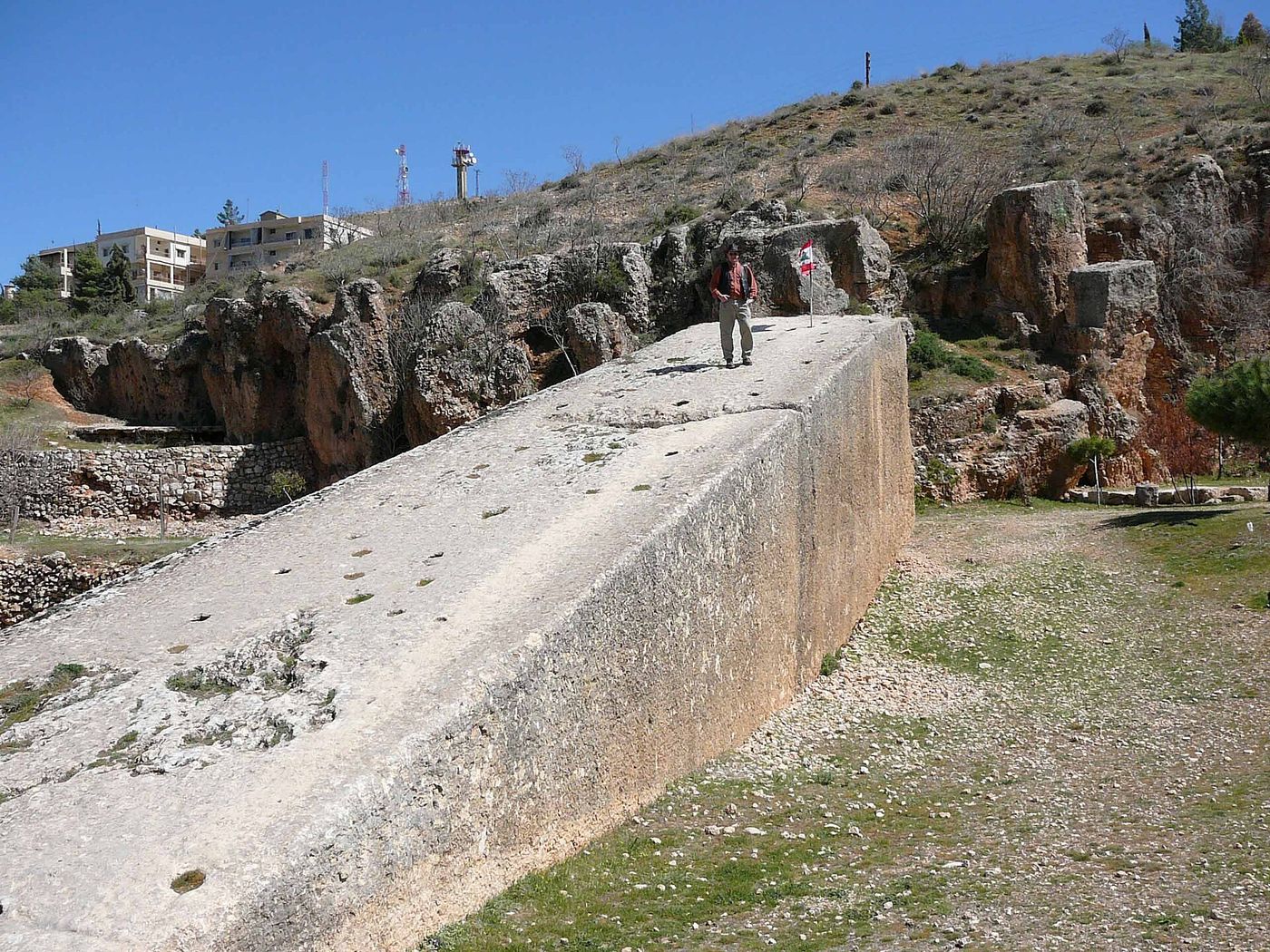
Baalbek: The Biggest Stones Ever Quarried
At Baalbek in Lebanon's Beqaa Valley, Roman builders set three 800-tonne blocks into a temple platform, and left even larger ones in the quarry. 'Ancient aliens' writers say no human could have moved them. Archaeologists show how the Romans did.
Sources German Archaeological Institute (DAI) excavations at Baalbek, incl. 2014 discovery of a block of about 1,650 t; Jean-Pierre Adam, 'À propos du trilithon de Baalbek', Syria 54 (1977); Wikipedia, 'Baalbek' and 'Stone of the Pregnant Woman'
Baalbek, the ancient Heliopolis, holds one of the largest Roman temple complexes ever built. Under the Temple of Jupiter, a row of three limestone blocks known as the Trilithon, each about 19 m long and weighing around 800 tonnes, sits several metres above the ground.
Bigger still
In the quarry a short distance away lie even larger stones, never moved. The best known, the “Stone of the Pregnant Woman,” weighs around 1,000 tonnes. In 2014 the German Archaeological Institute uncovered another beneath it estimated at about 1,650 tonnes.
How it was done
Writers on “ancient astronauts” cite Baalbek as proof of lost technology. Archaeologists disagree. The quarry is uphill from the temple, and the French architect Jean-Pierre Adam calculated in 1977 that the blocks could be moved on rollers or sledges with capstans and a few hundred workers. Tool marks, unfinished blocks and Roman construction records place the work firmly in the Roman period.
Ledger status
Marked cited. A public heritage site; map position is town level. Check travel advisories before any visit.
Sources
- Wikipedia, “Baalbek” — en.wikipedia.org
- Wikipedia, “Stone of the Pregnant Woman” — en.wikipedia.org
- Jean-Pierre Adam, “À propos du trilithon de Baalbek,” Syria 54 (1977) — persee.fr
Part of the World Ledger, batch 1. Original text; no images are used.
Evidence ledger
Each claim in this file, the source it rests on, and how well it holds up: 3 corroborated · 1 debunked. What the labels mean.
| Claim | Source | Type · date | Status |
|---|---|---|---|
| The Temple of Jupiter platform at Baalbek includes three blocks (the Trilithon) of about 800 t each. | Wikipedia; DAI | scholarly | corroborated |
| Larger blocks remain in the nearby quarry, one found in 2014 estimated at about 1,650 t. | German Archaeological Institute (2014) | scholarly · 2014 | corroborated |
| The Romans could move such blocks with ramps, levers and capstans. | Adam, Syria 54 (1977) | scholarly · 1977 | corroborated |
| The stones are pre-Roman or alien work. | 'Ancient astronaut' writers | secondary | debunked |
Discussion
Discussions activating. Per-case threads will embed here once the Giscus GitHub App is installed on the public satellite repo.
Meanwhile, join the conversation on GitHub Discussions: https://github.com/dclewis21/anomaly-ledger-community/discussions
CoS / D.C.: see Community guidelines and
SETUP.mdin the site repo for the one-click Giscus install.