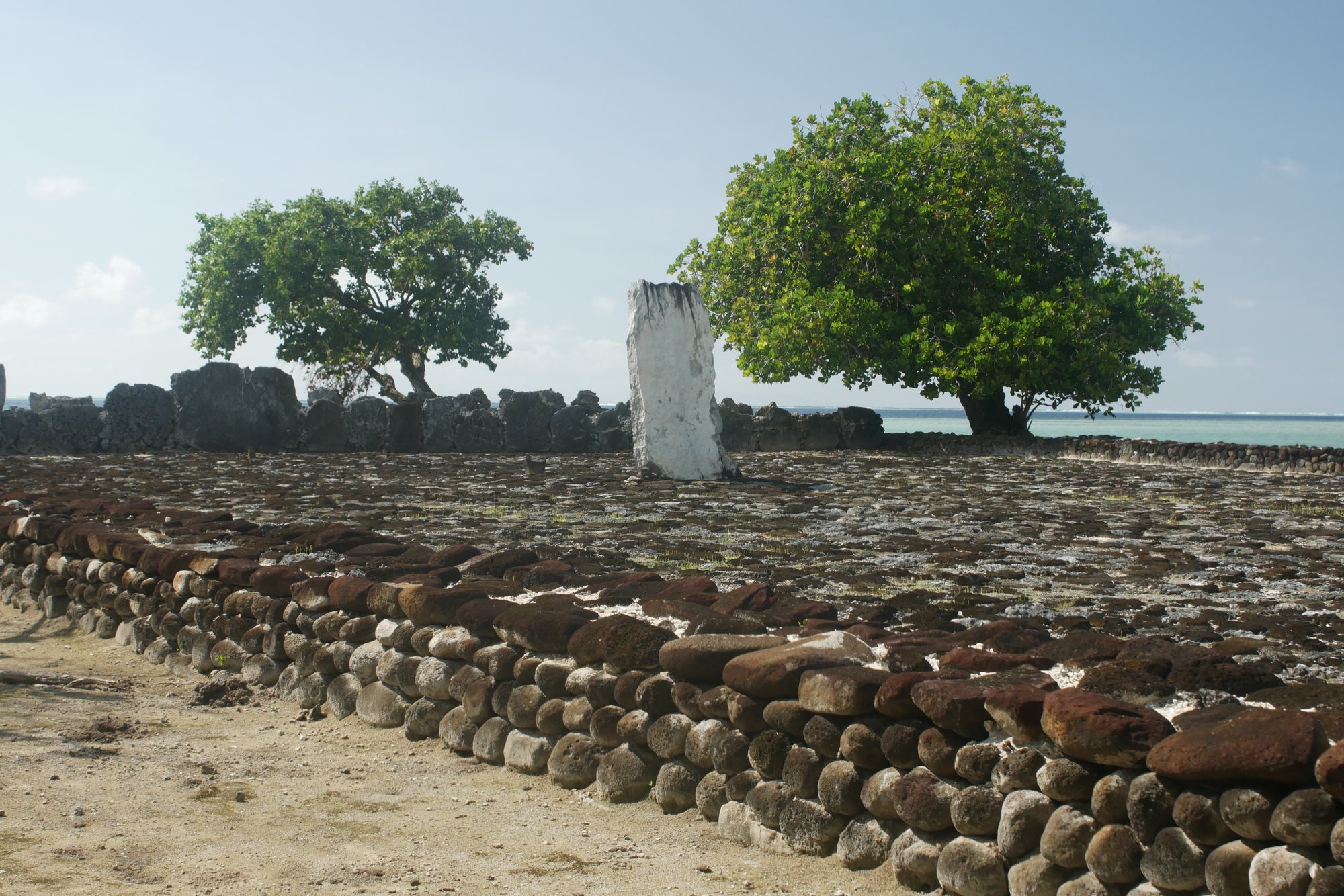
Taputapuātea Marae
Last reviewed: not yet Next review
A great marae complex on Raiatea, once the religious centre of Eastern Polynesia and now a UNESCO World Heritage Site.
Access
We haven't checked access for this place. Check the land manager's or local tourism site for hours, fees and closures, and stay off private or closed land.
Safety & respect
Stay on marked paths and behind barriers. Ground near caves, sinkholes, geysers and cliffs can be unstable or hot. Sacred site: cultural warning. Respect religious use, dress and behave as local custom asks, and photograph people or rites only with permission.
Lore note
Taputapuātea stands at the tip of a peninsula on Raiatea's east coast. Its central marae is a courtyard paved with basalt, about 44 by 60 m, with a ceremonial platform of basalt and coral at the east end, and other marae nearby include Hauviri, where chiefs were named. The cape itself is held to be Te Po, where the gods live. The marae was first dedicated to Taʻaroa, the creator, before the cult of ʻOro took over, and legend says ʻOro's descendant Hiro built it. It may date from around AD 1000 and became the hub of a wide voyaging network. UNESCO inscribed it in 2017.
Sources
- Wikipedia, Taputapuatea marae (CC BY-SA 4.0; read 12 Nov 2026): https://en.wikipedia.org/wiki/Taputapuatea_marae
- Wikidata, Q3287362 (coordinate location P625, country P17; read 12 Nov 2026): https://www.wikidata.org/wiki/Q3287362
Taputapuātea stands at the tip of a peninsula on Raiatea’s east coast. Its central marae is a courtyard paved with basalt, about 44 by 60 m, with a ceremonial platform of basalt and coral at the east end, and other marae nearby include Hauviri, where chiefs were named. The cape itself is held to be Te Po, where the gods live. The marae was first dedicated to Taʻaroa, the creator, before the cult of ʻOro took over, and legend says ʻOro’s descendant Hiro built it. It may date from around AD 1000 and became the hub of a wide voyaging network. UNESCO inscribed it in 2017.
This entry is part of our world atlas. The summary above is written in our own words from the Wikipedia article, with details checked against Wikidata. It is not shown on the site map. Sacred marae and UNESCO-listed ancestral site: no pin, by our sacred-site convention. We haven’t visited this place or checked current access.