Feature reference (not a verified entrance)
Petra tou Romiou
Last reviewed: not yet Next review
Petra tou Romiou (Greek: Πέτρα του Ρωμιού; lit.
Access
We haven't checked access for this place. Check the land manager's or local tourism site for hours, fees and closures, and stay off private or closed land.
Safety & respect
Stay on marked paths and behind barriers. Ground near caves, sinkholes, geysers and cliffs can be unstable or hot.
Lore note
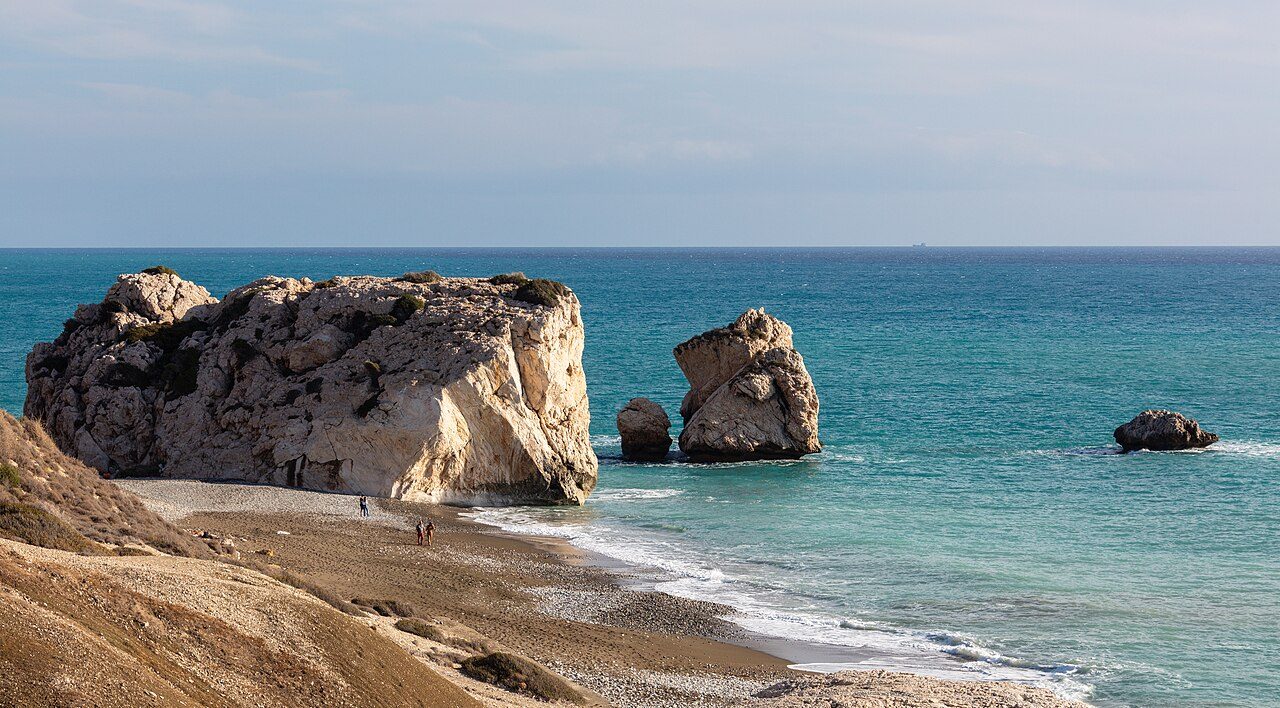
Petra tou Romiou (Greek: Πέτρα του Ρωμιού; lit. Rock of the Greek, also known as Aphrodite's Rock, is a sea stack in Kouklia, Cyprus, the site of ancient Palaepaphos and the Sanctuary of Aphrodite Paphia, founded in the 12th century BC. It is located off the shore along the main road between modern Paphos and Limassol. The scenic beauty of the area and its mythological tradition as the birthplace of Aphrodite makes it a popular tourist location.
Map links
Official / public map link · Approx. 34.6635, 32.6270: feature coordinate, not a checked entrance · Pin source: Wikipedia article coordinates, cross-checked against Wikidata Q2061165 P625 (within 2 km)
Sources
- Wikipedia, Petra tou Romiou (CC BY-SA 4.0; read 1 Nov 2026): https://en.wikipedia.org/wiki/Petra_tou_Romiou
- Wikidata, Q2061165 (coordinate location P625, country P17; read 1 Nov 2026): https://www.wikidata.org/wiki/Q2061165
Petra tou Romiou (Greek: Πέτρα του Ρωμιού; lit. Rock of the Greek, also known as Aphrodite’s Rock, is a sea stack in Kouklia, Cyprus, the site of ancient Palaepaphos and the Sanctuary of Aphrodite Paphia, founded in the 12th century BC. It is located off the shore along the main road between modern Paphos and Limassol. The scenic beauty of the area and its mythological tradition as the birthplace of Aphrodite makes it a popular tourist location.
This entry is part of our world atlas. The summary above is adapted from the Wikipedia article (CC BY-SA 4.0), and the map pin uses the coordinates published there, cross-checked against Wikidata. We haven’t visited this place or checked current access.