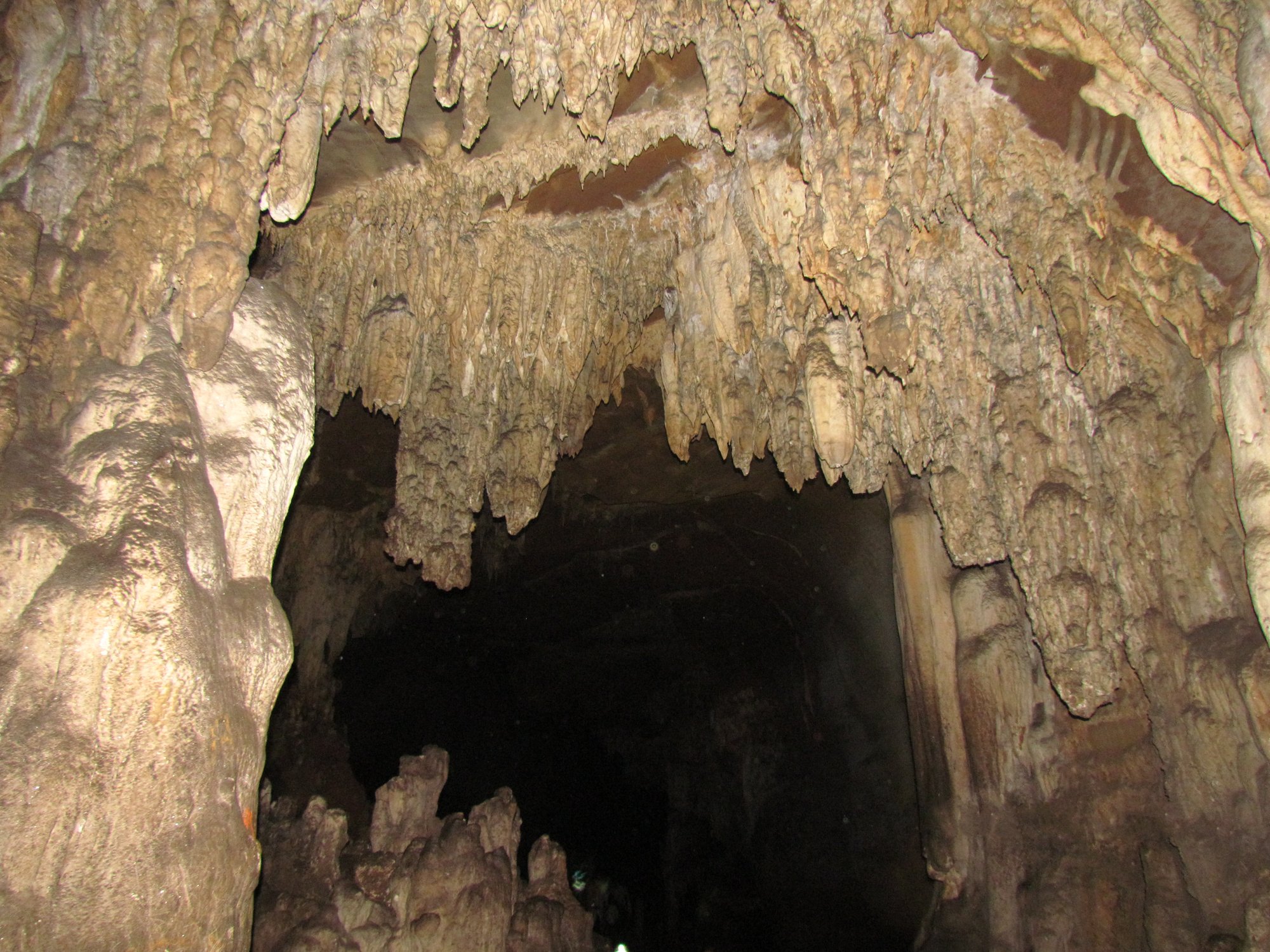
Kotumsar Cave
Last reviewed: not yet Next review
A limestone cave in the Kanger Valley where pilgrims worship a great stalagmite and a blind fish lives in the dark pools.
Access
We haven't checked access for this place. Check the land manager's or local tourism site for hours, fees and closures, and stay off private or closed land.
Safety & respect
Stay on marked paths and behind barriers. Ground near caves, sinkholes, geysers and cliffs can be unstable or hot. Sacred site: cultural warning. Respect religious use, dress and behave as local custom asks, and photograph people or rites only with permission.
Lore note
Kotumsar Cave formed in the Kanger limestone belt beside the Kanger River in Chhattisgarh and was once known as Gopansar, the hidden cave. Its main passage runs about 200 m, with side and lower galleries full of speleothems, and it floods during the monsoon. Pilgrims come to worship a large stalagmite in one chamber; the incense and camphor they once burned there harmed the cave's wildlife, and the practice was stopped. It is one of the most studied caves in India for its biology, home to a blind loach and to a cricket named after Shankar Tiwari, the geographer who explored it in the 1950s.
Sources
- Wikipedia, Kotumsar Cave (CC BY-SA 4.0; read 12 Nov 2026): https://en.wikipedia.org/wiki/Kotumsar_Cave
- Wikidata, Q24908612 (coordinate location P625, country P17; read 12 Nov 2026): https://www.wikidata.org/wiki/Q24908612
Kotumsar Cave formed in the Kanger limestone belt beside the Kanger River in Chhattisgarh and was once known as Gopansar, the hidden cave. Its main passage runs about 200 m, with side and lower galleries full of speleothems, and it floods during the monsoon. Pilgrims come to worship a large stalagmite in one chamber; the incense and camphor they once burned there harmed the cave’s wildlife, and the practice was stopped. It is one of the most studied caves in India for its biology, home to a blind loach and to a cricket named after Shankar Tiwari, the geographer who explored it in the 1950s.
This entry is part of our world atlas. The summary above is written in our own words from the Wikipedia article, with details checked against Wikidata. It is not shown on the site map. Active place of worship: no pin, by our sacred-site convention. We haven’t visited this place or checked current access.