Feature reference (not a verified entrance)
Gweni-Fada crater
Last reviewed: not yet Next review
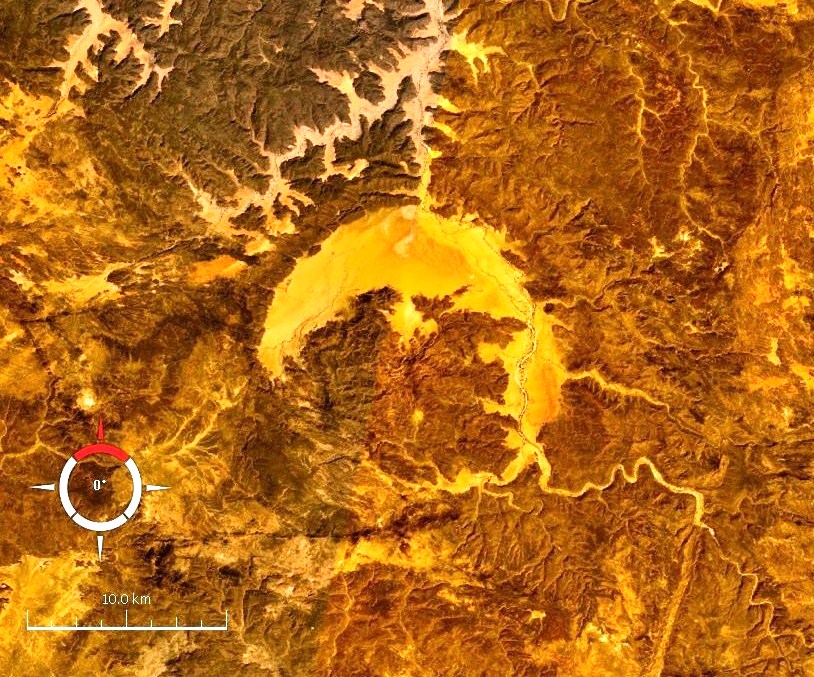
Gweni-Fada Crater is an impact crater in the Ennedi Plateau in Chad.
Access
We haven't checked access for this place. Check the land manager's or local tourism site for hours, fees and closures, and stay off private or closed land.
Safety & respect
Craters are often remote, with rough tracks and no shade or water. Tell someone your plans and don't collect rocks where it's forbidden.
Lore note
Gweni-Fada Crater is an impact crater in the Ennedi Plateau in Chad. The Gweni Fada structure was first noted on the map NE 34 X Fada of the IGN (National Geographic Institute France) and aerial photographs in the 1950s of IGN by Alain Beauvilain (Paris X- Nanterre University). In April 1995, at the initiative of CNAR (National Center to Help Research of Chad) a team of French geologists (Pierre Vincent, University of Clermont-Ferrand, Alain and Najia Beauvilain, CNAR Chad) visited the site and reported evidence of shock metamorphism within rock samples they had collected inside the structure.
Map links
Official / public map link · Approx. 17.4186, 21.7522: feature coordinate, not a checked entrance · Pin source: Wikipedia article coordinates, cross-checked against Wikidata Q1557855 P625 (within 2 km)
Sources
- Wikipedia, Gweni-Fada crater (CC BY-SA 4.0; read 1 Nov 2026): https://en.wikipedia.org/wiki/Gweni-Fada_crater
- Wikidata, Q1557855 (coordinate location P625, country P17; read 1 Nov 2026): https://www.wikidata.org/wiki/Q1557855
Gweni-Fada Crater is an impact crater in the Ennedi Plateau in Chad. The Gweni Fada structure was first noted on the map NE 34 X Fada of the IGN (National Geographic Institute France) and aerial photographs in the 1950s of IGN by Alain Beauvilain (Paris X- Nanterre University). In April 1995, at the initiative of CNAR (National Center to Help Research of Chad) a team of French geologists (Pierre Vincent, University of Clermont-Ferrand, Alain and Najia Beauvilain, CNAR Chad) visited the site and reported evidence of shock metamorphism within rock samples they had collected inside the structure.
This entry is part of our world atlas. The summary above is adapted from the Wikipedia article (CC BY-SA 4.0), and the map pin uses the coordinates published there, cross-checked against Wikidata. We haven’t visited this place or checked current access.