Feature reference (not a verified entrance)
Cave of the Crystals
Last reviewed: not yet Next review
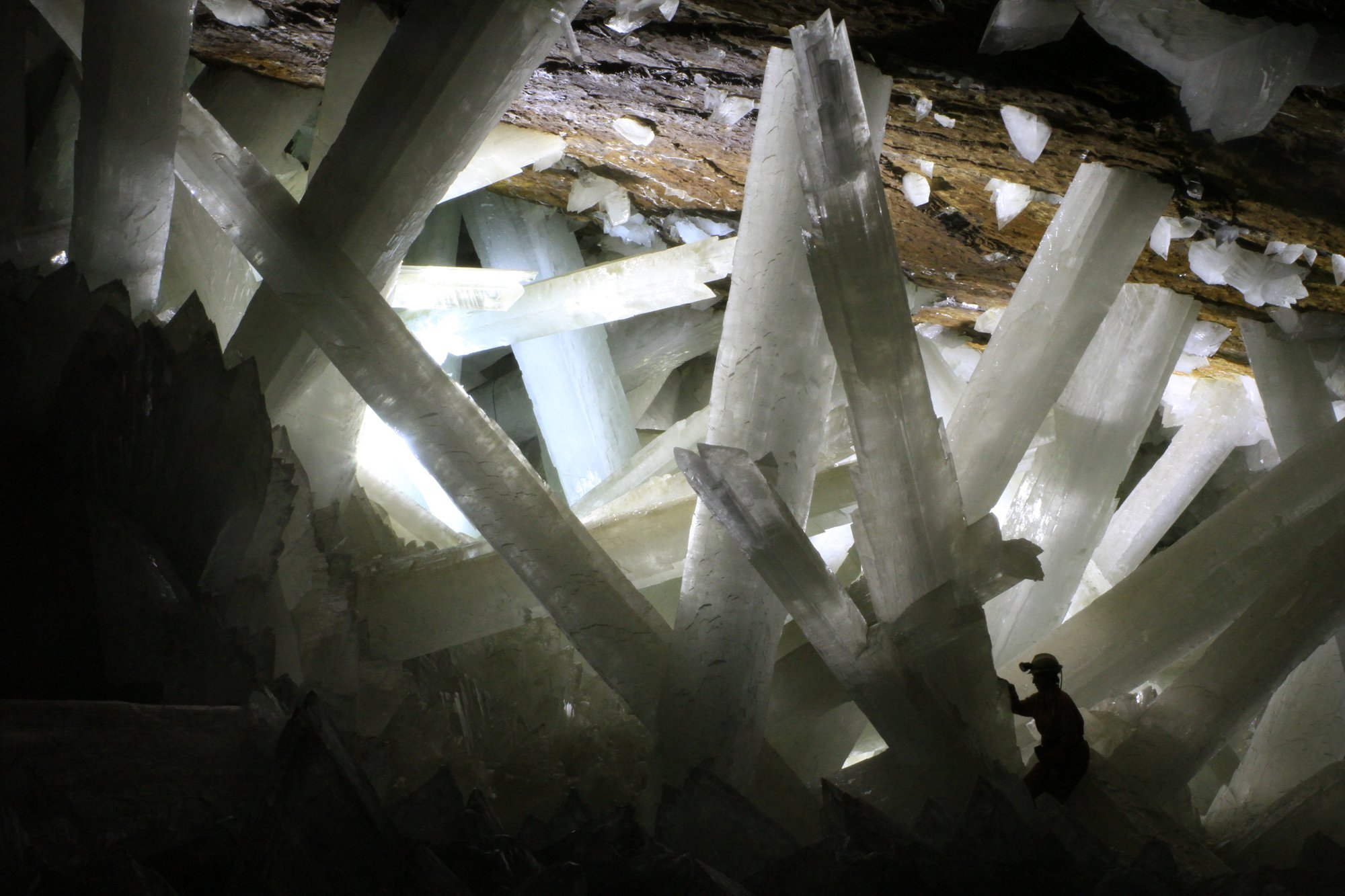
A chamber 300 m down in a Mexican mine holding some of the largest natural crystals ever found, in heat people can stand for only minutes.
Access
We haven't checked access for this place. Check the land manager's or local tourism site for hours, fees and closures, and stay off private or closed land.
Safety & respect
Stay on marked paths and behind barriers. Ground near caves, sinkholes, geysers and cliffs can be unstable or hot. This chamber is inside a working mine and is not open to the public.
Lore note
Miners drilling at Naica broke into this chamber in 2000 and found selenite gypsum beams up to about 11 m long and some 12 tonnes in weight. Water heated by magma a few kilometers below kept the cave flooded for a very long time, letting the crystals grow slowly. Drained, the air reached about 58 °C at near total humidity, too much for unprotected people to bear for more than about ten minutes. By 2015 the mine had flooded again, and the crystals are back under mineral-rich water.
Map links
Official / public map link · Approx. 27.8508, -105.4964: feature coordinate, not a checked entrance · Pin source: Wikipedia article coordinates, cross-checked against Wikidata Q1190524 P625 (within 2 km)
Sources
- Wikipedia, Cave of the Crystals (CC BY-SA 4.0; read 12 Nov 2026): https://en.wikipedia.org/wiki/Cave_of_the_Crystals
- Wikidata, Q1190524 (coordinate location P625, country P17; read 12 Nov 2026): https://www.wikidata.org/wiki/Q1190524
Miners drilling at Naica broke into this chamber in 2000 and found selenite gypsum beams up to about 11 m long and some 12 tonnes in weight. Water heated by magma a few kilometers below kept the cave flooded for a very long time, letting the crystals grow slowly. Drained, the air reached about 58 °C at near total humidity, too much for unprotected people to bear for more than about ten minutes. By 2015 the mine had flooded again, and the crystals are back under mineral-rich water.
This entry is part of our world atlas. The summary above is written in our own words from the Wikipedia article, and the map pin uses published coordinates cross-checked against Wikidata. We haven’t visited this place or checked current access.