Feature reference (not a verified entrance)
Borra Caves
Last reviewed: not yet Next review
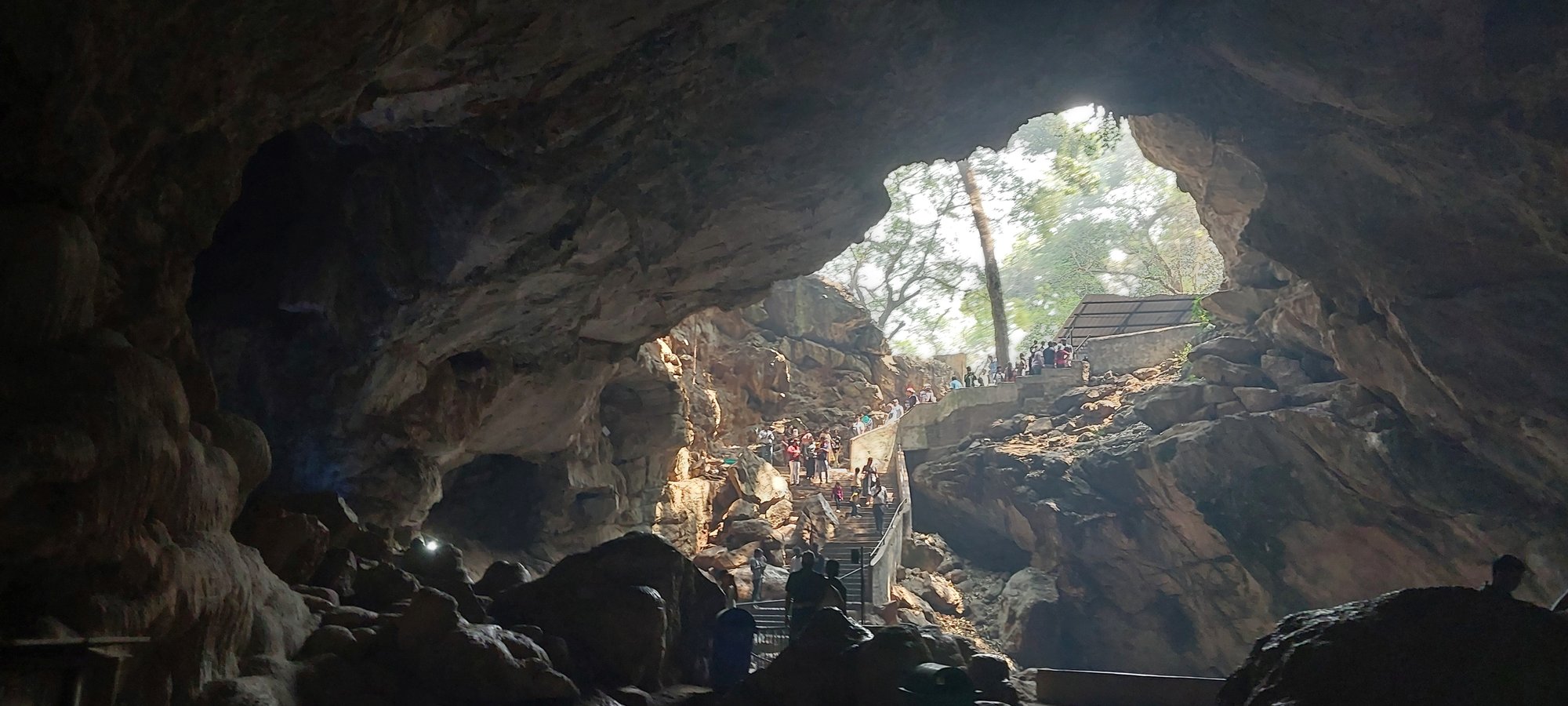
A limestone show cave in the Araku Valley hills of Andhra Pradesh, India, tied to a local miracle legend.
Access
We haven't checked access for this place. Check the land manager's or local tourism site for hours, fees and closures, and stay off private or closed land.
Safety & respect
Stay on marked paths and behind barriers. Ground near caves, sinkholes, geysers and cliffs can be unstable or hot. A stalagmite inside is worshipped as a Shiva lingam; treat it as a place of worship.
Lore note
Borra means hole in Telugu, and the caves hold large stalactites and stalagmites in limestone of the Ananthagiri hills. A local story tells of a cow that fell into the cave and survived, and of the herder who found a stalagmite shaped like a Shiva lingam while rescuing it, which people then began to worship. Stone tools from the Palaeolithic have been found inside, and the state tourism department lit the caves for visitors in the 2000s.
Map links
Official / public map link · Approx. 18.2939, 83.0597: feature coordinate, not a checked entrance · Pin source: OpenStreetMap cave entrance node for Borra Caves, which agrees with the OSM locality of the same name (within 0.3 km). Wikipedia and Wikidata publish a rounded point (18.1667, 83.0) about 14 km away, which we did not use
Sources
- Wikipedia, Borra Caves (CC BY-SA 4.0; read 12 Nov 2026): https://en.wikipedia.org/wiki/Borra_Caves
- Wikidata, Q4946548 (coordinate location P625, country P17; read 12 Nov 2026): https://www.wikidata.org/wiki/Q4946548
- OpenStreetMap, Borra Caves cave entrance (read 12 Nov 2026): https://www.openstreetmap.org/search?query=Borra%20Caves
Borra means hole in Telugu, and the caves hold large stalactites and stalagmites in limestone of the Ananthagiri hills. A local story tells of a cow that fell into the cave and survived, and of the herder who found a stalagmite shaped like a Shiva lingam while rescuing it, which people then began to worship. Stone tools from the Palaeolithic have been found inside, and the state tourism department lit the caves for visitors in the 2000s.
This entry is part of our world atlas. The summary above is written in our own words from the Wikipedia article, and the map pin uses published coordinates cross-checked against Wikidata. We haven’t visited this place or checked current access.