Feature reference (not a verified entrance)
Aokigahara
Last reviewed: not yet Next review
A reportedly haunted site in Fujikawaguchiko, Japan.
Access
We haven't checked access for this place. Check the land manager's or local tourism site for hours, fees and closures, and stay off private or closed land.
Safety & respect
Respect opening hours and posted rules, and leave if staff or owners ask. Don't enter closed areas at night looking for ghosts.
Lore note
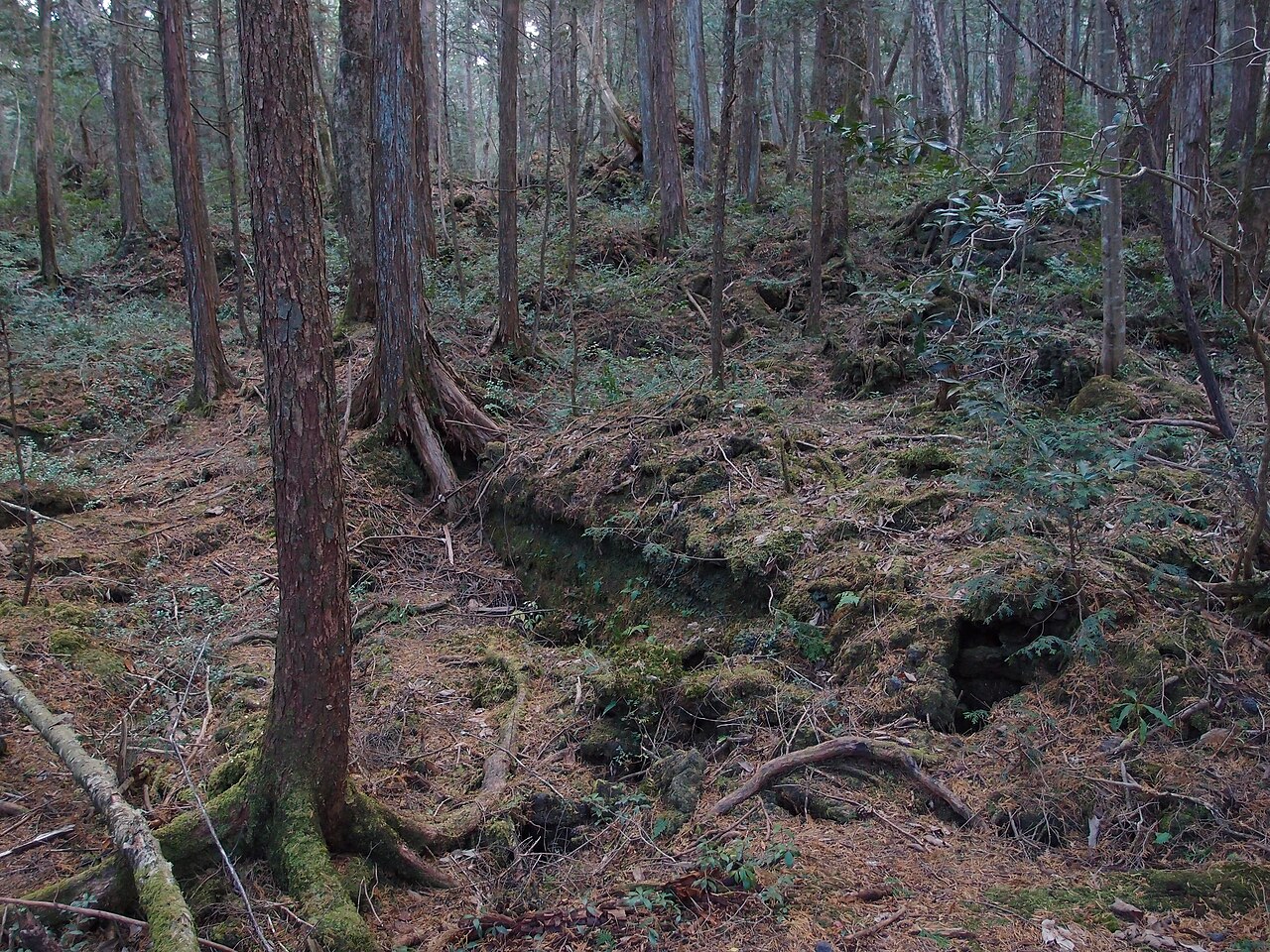
Aokigahara (青木ヶ原, 'Aucuba Tree Meadow'), also known as the Sea of Trees (樹海, Jukai), is a forest on the northwestern flank of Mount Fuji on the island of Honshu in Japan, thriving on 30 square kilometers (12 sq mi) of hardened lava laid down by the last major eruption of Mount Fuji in 864 AD. The western edge of Aokigahara, where there are several caves that fill with ice in winter, is a popular destination for tourists and school trips. Parts of Aokigahara are very dense, and the porous lava rock absorbs sound, contributing to a sense of solitude that some visitors attribute to the forest. The forest has a historical reputation as a home to yūrei: ghosts of the dead in Japanese mythology.
Map links
Official / public map link · Approx. 35.4700, 138.6197: feature coordinate, not a checked entrance · Pin source: Wikipedia article coordinates, cross-checked against Wikidata Q615767 P625 (within 2 km)
Sources
- Wikipedia, Aokigahara (CC BY-SA 4.0; read 1 Nov 2026): https://en.wikipedia.org/wiki/Aokigahara
- Wikidata, Q615767 (coordinate location P625, country P17; read 1 Nov 2026): https://www.wikidata.org/wiki/Q615767
Aokigahara (青木ヶ原, ‘Aucuba Tree Meadow’), also known as the Sea of Trees (樹海, Jukai), is a forest on the northwestern flank of Mount Fuji on the island of Honshu in Japan, thriving on 30 square kilometers (12 sq mi) of hardened lava laid down by the last major eruption of Mount Fuji in 864 AD. The western edge of Aokigahara, where there are several caves that fill with ice in winter, is a popular destination for tourists and school trips. Parts of Aokigahara are very dense, and the porous lava rock absorbs sound, contributing to a sense of solitude that some visitors attribute to the forest. The forest has a historical reputation as a home to yūrei: ghosts of the dead in Japanese mythology.
This entry is part of our world atlas. The summary above is adapted from the Wikipedia article (CC BY-SA 4.0), and the map pin uses the coordinates published there, cross-checked against Wikidata. We haven’t visited this place or checked current access.