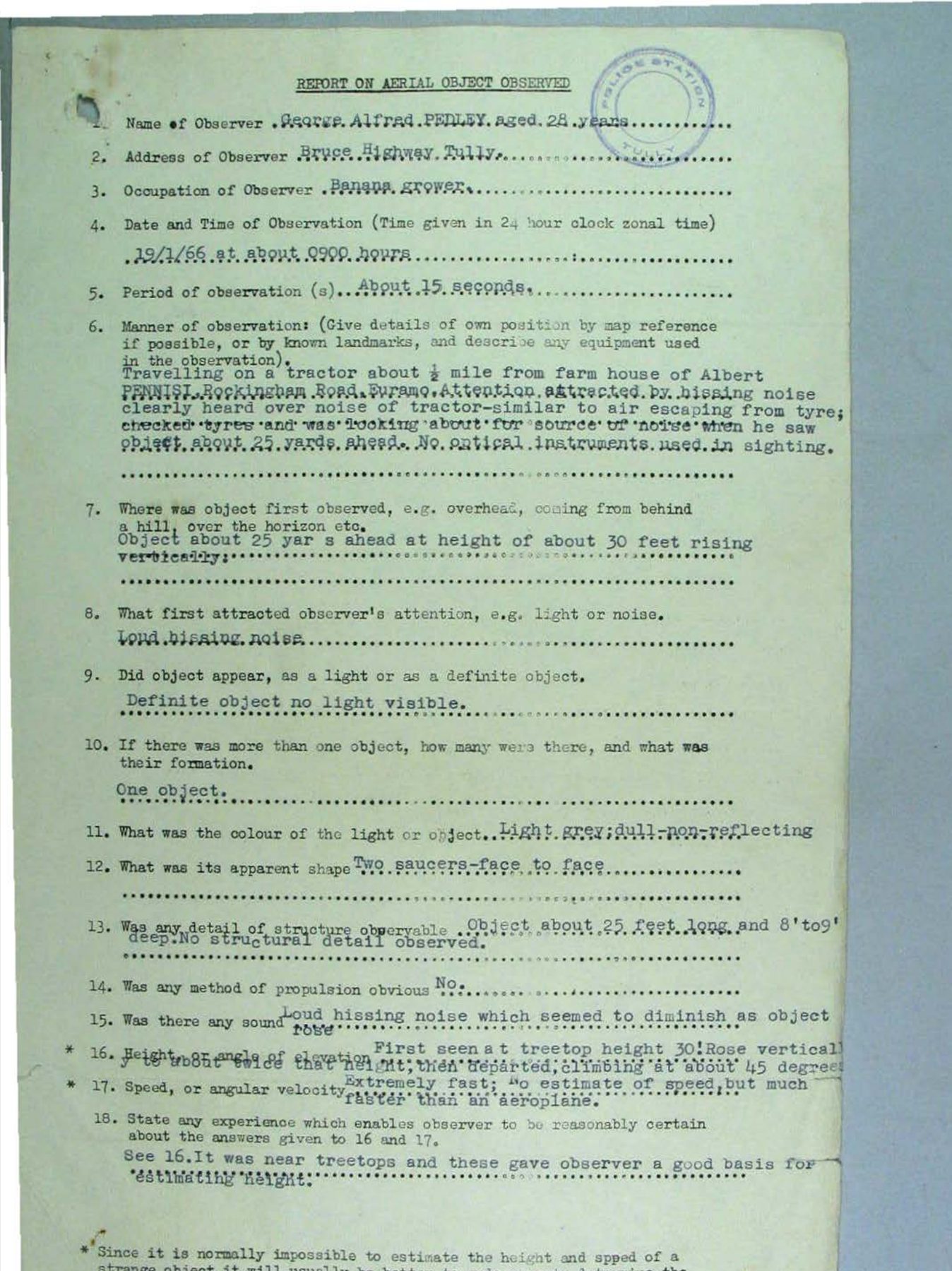
The evidence: Report on Aerial Object Observed: the RAAF sighting form filled in for George Pedley, page 1
The Tully Saucer Nest, 1966: A Farmer, a Lagoon and a Ring of Flattened Reeds
Last reviewed Next review
We review and update every article weekly. When the record changes, so does the article. How we review
In January 1966 a Queensland banana farmer said a gray saucer rose from a lagoon near Tully, leaving a ring of flattened reeds. We read the RAAF's own file.
Verdict: The flattened ring of reeds was real and showed nothing unnatural; a whirlwind or small waterspout is the likeliest cause, but nobody can show what George Pedley saw rise from the lagoon.
Original sources: National Archives of Australia, RAAF file A703, 580/1/1 Part 5 (item 645646), digitised copy mirrored by The Black Vault; the Tully papers are PDF pages 165 to 172 · Bill Chalker, 'The 1966 Tully Saucer Nest', from his Catalogue of Australian Physical Trace Cases, on UFO Evidence · B. Denton and C. A. Phillips, 'The Tully Saucer Nest 1966', extracted from The Tully Report, UFO Research Queensland · Chris Calcino and Danielle O'Neal, 'Tully's cane farm crop circles and an enduring 58yo UFO mystery', ABC News (24 November 2024)
Sources RAAF file A703, 580/1/1 Part 5 (National Archives of Australia, item 645646), as mirrored by The Black Vault; Bill Chalker, 'A Catalogue of Australian Physical Trace Cases' (UFO Evidence); B. Denton and C. A. Phillips, The Tully Report (UFO Research Queensland); Chris Calcino and Danielle O'Neal, ABC News (24 November 2024)
On the morning of Wednesday 19 January 1966, George Pedley, a 28-year-old banana grower, was driving his tractor across a neighbor’s cane farm at Euramo, near Tully in far north Queensland. It was the wet season. Pedley said he heard a loud hiss over the noise of the engine, like air escaping from a tire. Then, about 25 yards ahead, he saw a gray object rise out of the reeds of a small lagoon and shoot away.
Where it had been, he found a ring of reeds pressed flat on the water. The newspapers called it a “saucer nest”. It made Tully famous for a summer, and decades later two English pranksters named it as the idea behind the crop circles they faked. The page at the top of this case is the air force form that recorded Pedley’s story one week after it happened.
What the file says
The Royal Australian Air Force kept its UFO reports in a series of files that are now in the National Archives of Australia. We read the Tully papers in the digitized copy of file A703, 580/1/1 Part 5, which The Black Vault mirrors as a PDF. They run from page 165 to page 172.
According to a minute paper from the RAAF base at Townsville, signed by Flight Lieutenant Wallace, Sergeant A. V. Moylan of the Tully police telephoned the base on the morning of 20 January. The base mailed him a questionnaire, and Moylan filled it in from his talks with Pedley. On it, Pedley’s object was “Light grey; dull-non-reflecting”, shaped like “Two saucers-face to face”, about 25 feet long and 8 to 9 feet deep, with no lights and no structural detail. It was first seen at treetop height, about 30 feet up. It rose straight up to about twice that height, then left toward the southwest, climbing at about 45 degrees, “Extremely fast”, “much faster than an aeroplane”. He watched it for about 15 seconds.
Under physical evidence, the form describes a “Clearly defined near circular depression in swamp grass” about 32 feet long and 25 feet wide, with the grass flattened down to the surface of about four feet of water “in clockwise curves”. The word “anti” has been typed over in front of “clockwise”. That small correction matters later.
On the second page Moylan added his own notes. Pedley had reported to Tully police at 7.30 that evening, and at 7 the next morning he took the sergeant to the lagoon. Pedley said there was no smell of burning and no scorching of grass or trees, and that the flattened reeds were green when he first saw them but had turned brown by the afternoon. Moylan wrote that his own first opinion was that a small helicopter had made the depression, with sunlight on the rotor fooling Pedley. But he also noted the objection to that: about 200 yards of cleared land lay to the east, a much safer place to land than beside the trees. He then recorded that a Tully electrician told him he had seen similar markings in a swamp at Kurrimine Beach and was “quite certain” they were caused by a whirlwind sucking up water into a waterspout. At 3.30 p.m. on 21 January Moylan cut a sample of the grass and sent it to the air force.
Two more points from the file. The Townsville minute says that in both of the recent North Queensland reports “there were no Service or Civil aircraft operating in the areas at the time of the sighting”, which rules out the helicopter. And on 17 February 1966, RAAF Operational Command forwarded the whole investigation to the Department of Air in Canberra with one line of conclusion: “This headquarters believes that the depressions of the swamp grass were caused by small isolated waterspouts.”
What else the officials said
The Australian researcher Bill Chalker went through the RAAF files and quotes two more official letters that we did not find in the pages we read, so we report them as he gives them. On 11 February 1966 the Secretary of the Department of Air wrote that local residents had said such “nests” were “fairly common during the onset of the ‘wet’”, and that the University of Queensland found “nothing unnatural” in the samples and thought severe turbulence from tropical storms could explain them. The same letter admits: “There is no explanation for the visible phenomena reported”, and suggests downdrafts, “willy willies” or waterspouts. In 1973 the Department’s public relations director told a reporter from The Australian that the most probable answer was a “willy willy”, a small whirlwind that flattened the reeds and lifted debris about 30 feet into the air, looking like a flying saucer before it broke up. He added that hissing is known to go with willy-willies and that the clockwise swirl supported the idea.
Chalker also points out that one later theorist of crop circles built his explanation on the wrong time of day, placing the sighting at 9 p.m. instead of 9 a.m.
The farm’s side of the story
The lagoon belonged to the cane farmer Albert Pennisi. UFO Research Queensland’s account, taken from a report by B. Denton and C. A. Phillips, says Pennisi waded out to the floating mass of reeds and found he could swim right under it, in clear water. It also describes a short line of teardrop-shaped marks in a plowed field nearby, later trampled by sightseers. It also says more nests appeared in the lagoon in 1969, after a “UFO monitoring device” in the Pennisi home was triggered early one morning.
In 2024 ABC News spoke to Albert’s son Shane, who was seven in 1966. He remembers coming home from the beach to find Pedley waiting on their front steps, visibly agitated, and driving out to see a circle of flattened bulrushes about nine meters across, “floating like a pontoon”. Within days, crowds of sightseers were tramping across the farm. The ABC lists the theories that went around: helicopters, reed-eating grubs, whirlwinds, waterspouts, even ducks swimming in circles. Shane told the ABC that nests kept appearing on the farm until about ten years before the interview, “25, 30, more”. Pedley died in 2022, aged 85. The ABC reports that he felt ridiculed for the rest of his life.
The ABC piece also makes the link to crop circles: in 1991 the British artists Doug Bower and Dave Chorley admitted faking hundreds of crop circles since the 1970s, and they pointed to Tully’s Horseshoe Lagoon as their inspiration.
The lagoon is on private farmland, so our map pin marks the town of Tully only. Please don’t go looking for it.
Sources
- National Archives of Australia, RAAF file A703, 580/1/1 Part 5 (item 645646): digitised copy mirrored by The Black Vault, PDF pages 165 to 172: Operational Command letter of 17 February 1966, the two-page sighting form dated 26 January 1966, the Townsville minute paper and Sergeant Moylan’s covering letter (read 1 Nov 2026)
- Bill Chalker, “The 1966 Tully Saucer Nest”, from A Catalogue of Australian Physical Trace Cases: on UFO Evidence (read 1 Nov 2026)
- B. Denton and C. A. Phillips, “The Tully Saucer Nest 1966”, extracted from The Tully Report: UFO Research Queensland (read 1 Nov 2026)
- Chris Calcino and Danielle O’Neal, “Tully’s cane farm crop circles and an enduring 58yo UFO mystery”, ABC News, 24 November 2024: article (read 1 Nov 2026)
Weighing it
Two things happened at the lagoon, and they need separate answers. The nest itself is well documented: a police sergeant saw it the next morning, took a sample, and the air force and the University of Queensland looked at it. Nobody found burning, radiation or anything unnatural, and locals told officials that such rings were not rare at the start of the wet. A whirlwind or small waterspout over a reed bed fits the flattening, the clockwise swirl the sergeant recorded and the hiss.
The object is harder. Pedley gave a clear, consistent core story to the police within hours, and no aircraft were flying nearby. A spinning column of water and debris rising from the lagoon could look like a gray shape in bright morning sun, which is the official explanation, but no one has shown that this is what he saw. Some details also drifted as the story was retold. The 1966 form says about 15 seconds, no lights and a clockwise swirl; the later UFO Research Queensland account says about 4 seconds and an anticlockwise swirl; and the son of the farm’s owner remembered Pedley describing bright lights and blue vapor. We think the weather explanation is the most likely one for the nest and a reasonable one for the sighting, but it remains a judgment rather than a finding, so we mark this case disputed.
Every image on this page is credited where it appears.
Verdict
Disputed The flattened ring of reeds was real and showed nothing unnatural; a whirlwind or small waterspout is the likeliest cause, but nobody can show what George Pedley saw rise from the lagoon.
Update log
-
We added this case file.
-
Weekly re-check of sources; no change to the record since filing. Next check November 23, 2026.
Discussion
Discuss this case on the on-site Community board — no GitHub account required. Prefer a private tip for the editorial team? Submit a Sighting.
House rules: Community guidelines.