The evidence: The Hodges stone itself, on display in Tuscaloosa
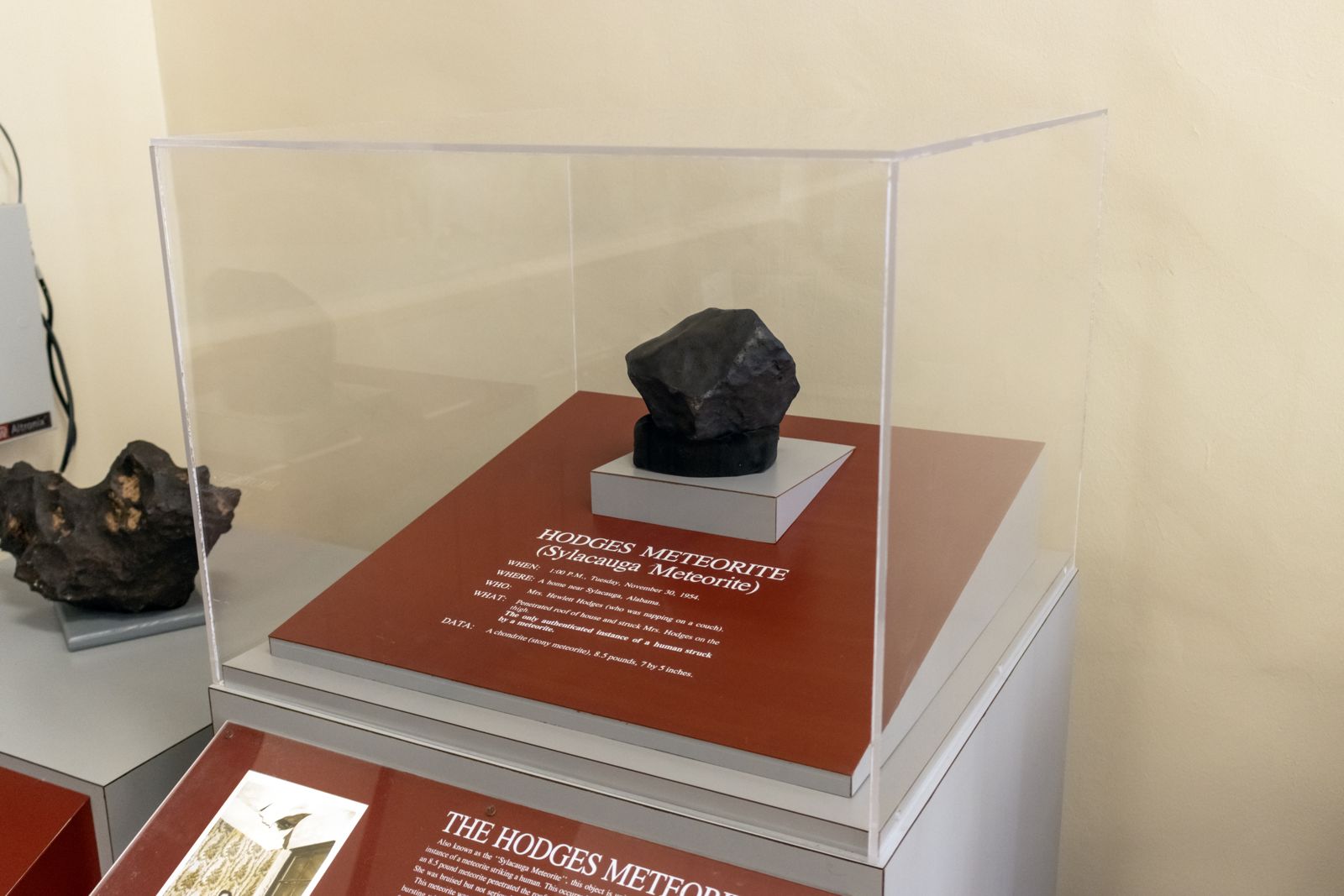
The Sylacauga Meteorite, 1954: The Stone That Came Through the Roof
Last reviewed Next review
We review and update every article weekly. When the record changes, so does the article. How we review
In November 1954 a stone crashed through a roof near Sylacauga, Alabama, and struck a woman on her couch. The Air Force took it away by helicopter.
Verdict: Explained: a stony meteorite fell near Sylacauga on 30 November 1954, and one piece came through a house roof and injured the woman inside.
Original sources: Swindel and Jones, 'The Sylacauga, Talladega County, Alabama, aerolite', Meteoritics (1954), Wiley abstract · Project Blue Book report: Sylacauga, Alabama, November 1954 (USAF, public domain scan)
Sources Swindel and Jones, Meteoritics 1(2) (1954), abstract; Project Blue Book report, Sylacauga, Alabama, November 1954 (USAF)
On the afternoon of 30 November 1954, hundreds of people in Alabama and neighboring states reported an explosion or a bright object in the sky. In the Oak Grove community, about three miles east of Sylacauga, a dark stone came through the roof of a house and hit the woman who was lying on the couch inside.
Two geologists, George W. Swindel Jr. of the U.S. Geological Survey and Walter B. Jones, the Alabama state geologist, wrote it up for the journal Meteoritics. Their abstract puts the fall at about 1:00 p.m. Central Standard Time. They report two stones: the larger, 8.5 pounds, “pierced the roof of a dwelling and injured a sleeping occupant”, and a smaller 3.75-pound stone fell into open ground. They describe a satiny black crust, flat faces with rounded edges, thumb-mark hollows called piezoglyphs, and one face with odd parallel bands of black and gray that they had not seen noted on a meteorite before.
The U.S. Air Force file, opened that same afternoon, reads very differently, because at first nobody knew what had fallen. Project Blue Book kept the investigation. It says Maxwell Air Force Base got reports of “aerial explosions, alleged aircraft crashes and unidentified flying objects”, and that an air rescue helicopter was sent to Sylacauga to collect the object. According to the report, the police chief said Mrs. Hewlett Hodges told him the stone fell between 12:45 and 1:00 p.m., while she was lying on the couch, and struck her on the body, and that it was not hot. The pilot described it as about nine pounds, black or charcoal in color. At Maxwell it was checked with Geiger counters “with negative results”. A geologist who was allowed only a quick look would say no more than that it was “either a stone meteorite or an earthly peridotite”. The report quotes local newspapers saying 35 or 40 planes searched three states for a crash, and no plane was missing.
The file also shows the stone becoming a local dispute. It notes “numerous and frequent protests” from her husband about the Air Force taking and holding the object, and says he hired a lawyer to get it back. The card at the front of the file closes the case plainly: the object was “definitely a meteorite.”
The stone is now on display at the Alabama Museum of Natural History in Tuscaloosa, which is where the photo at the top of this page was taken. We pin the town of Sylacauga, not the house.
Sources
- Swindel, G. W., Jr. and W. B. Jones, “The Sylacauga, Talladega County, Alabama, aerolite: a recent meteoritic fall that injured a human being”, Meteoritics 1(2): 125-132 (1954): abstract on Wiley (abstract read 27 Oct 2026; the full paper is paywalled and we did not read it)
- U.S. Air Force, Project Blue Book report, Sylacauga, Alabama, November 1954, including the OSI investigation and Inspector General synopsis: scan on Wikimedia Commons (public domain, read 27 Oct 2026; quotes are from the typed report)
Weighing it
The two sources come from opposite directions and agree on the essentials: the date, the early afternoon time, a stone of about eight to nine pounds through the roof, and a woman hurt on her couch. The Air Force went in expecting a crashed plane or something stranger and came out with a rock. The geologists’ paper settles what kind of rock it was. The only gaps are small ones, such as the half-pound difference between the pilot’s estimate and the weighed stone, and whether it was hot when found, which the mayor and the police chief told the Air Force differently.
Every image on this page is credited where it appears.
Verdict
Explained Explained: a stony meteorite fell near Sylacauga on 30 November 1954, and one piece came through a house roof and injured the woman inside.
Update log
-
We added this case file.
-
Weekly re-check of sources; no change to the record since filing. Next check November 9, 2026.
Discussion
Discuss this case on the on-site Community board — no GitHub account required. Prefer a private tip for the editorial team? Submit a Sighting.
House rules: Community guidelines.