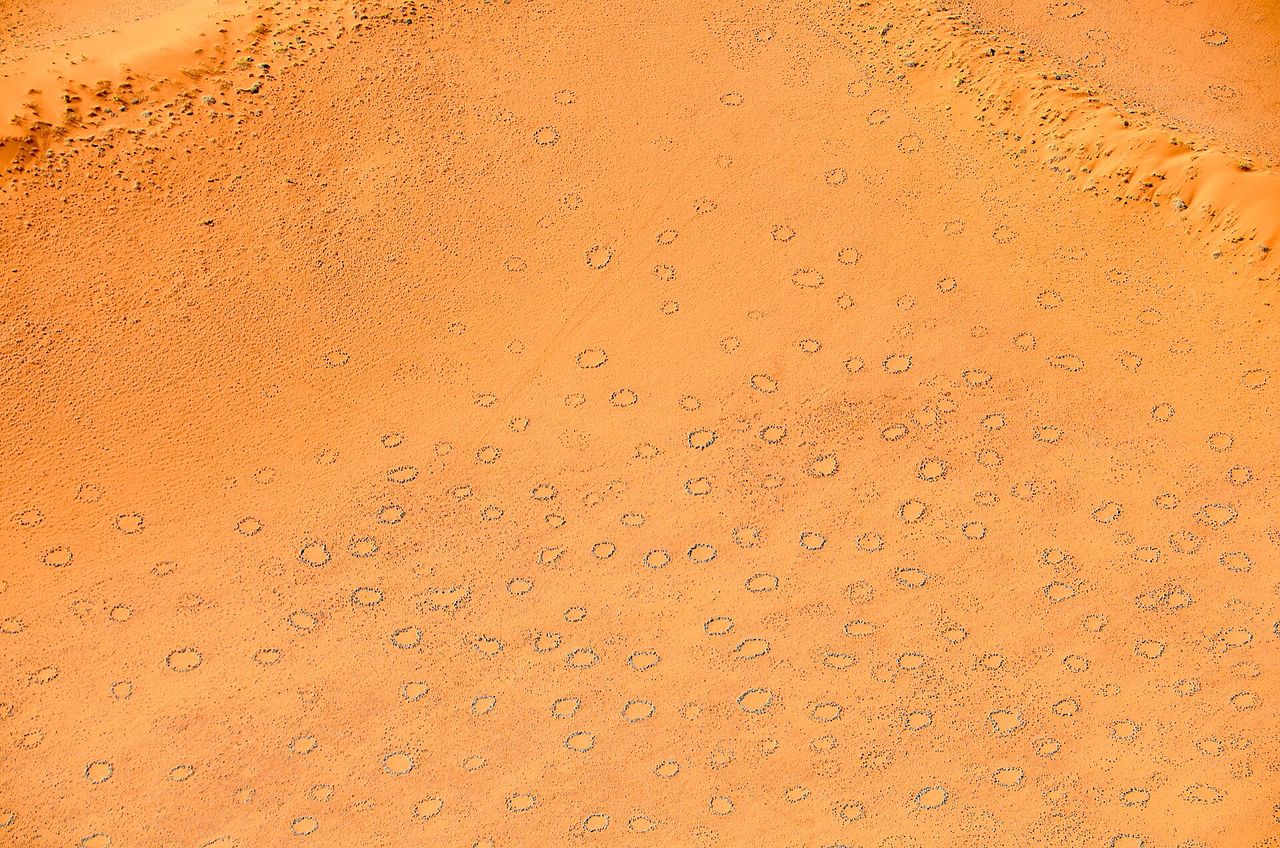
The evidence: Fairy circles from the air, Namib-Naukluft National Park


Namibia's Fairy Circles: Termites, Thirsty Grass, or Something Else?
Last reviewed Next review
We review and update every article weekly. When the record changes, so does the article. How we review
Millions of bare, evenly spaced rings dot the grass of the Namib Desert. Two research camps, termites versus thirsty grass, still can't agree what makes them.
Verdict: The circles are real and well mapped, but what makes them is still argued: the best field data now favor grasses competing for water, while the termite camp has not conceded, so we rate it disputed with the grass explanation ahead.
Original sources: Allgemeine Zeitung (Windhoek): 'Umstrittenes namibisches Naturwunder' (German, 28 Mar 2023) · University of Hamburg: 'Termiten als Ursache der Feenkreise in der Namib-Wüste bestätigt' (German, 11 Jul 2023) · University of Göttingen press release no. 149: the grass explanation (German, 20 Oct 2022)
Sources Allgemeine Zeitung, Windhoek (28 Mar 2023, German); University of Göttingen press release no. 149 (20 Oct 2022, German); University of Hamburg MIN faculty news (11 Jul 2023, German); Getzin & Thomson, Conservation Namibia (24 Apr 2023); Getzin et al., Landscape Ecology (25 Jun 2024); Tschinkel, PLOS ONE (2012); Wikipedia, 'Fairy circle (arid grass formation)'
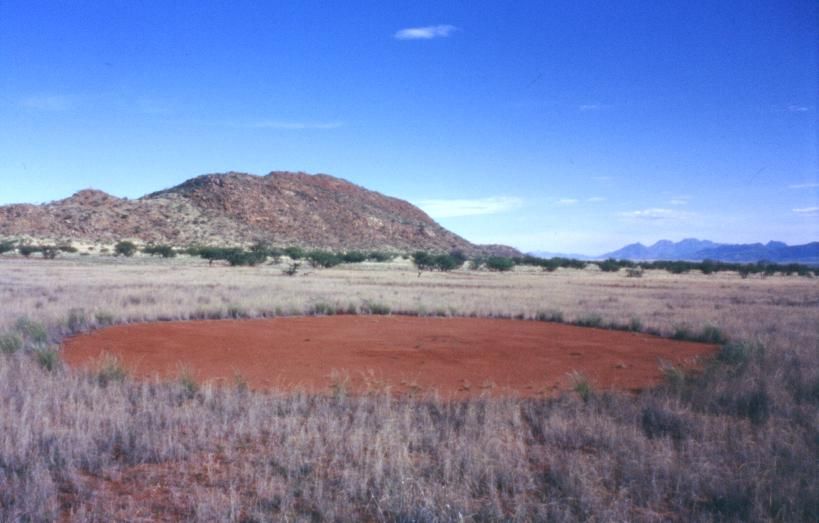
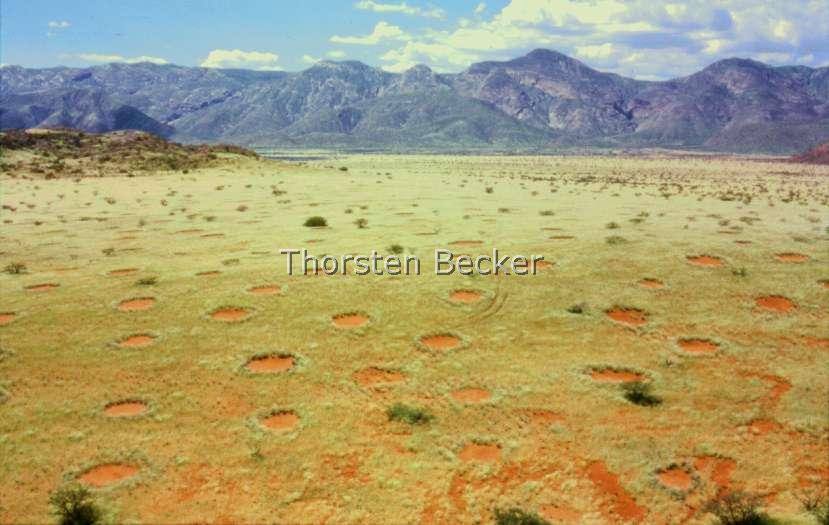
Fly over the Namib Desert after a little rain and the thin grass below looks like it has a rash. It is covered in bare, round patches, each a few meters across, each edged by a ring of slightly taller grass, and spaced so evenly that from the air they look almost like the cells of a honeycomb. Namibians call them fairy circles (Feenkreise in German, still widely spoken in the country). There are millions of them, in a band about 80 to 160 km inland that runs some 2,400 km, from southern Angola down to South Africa’s Northern Cape.
Nobody doubts they exist. You can walk into one. The mystery is what makes them, and it has turned into one of the longest, most bitter arguments in desert ecology.
Old circles, older stories
The circles turn up in technical writing as early as the 1920s, and they have been studied seriously for about half a century. The University of Göttingen put it at “almost half a century” in 2022, and the Namibian magazine Conservation Namibia at “over 50 years” in 2023. Over that time people have blamed poisonous gases, radioactive soil, ants, toxic residue from dead Euphorbia shrubs, and termites.
Older explanations are less scientific. In Himba oral tradition from northern Namibia, the patches are said to be the work of the gods or the footprints of spirits, and some tour guides like to tell visitors that a dragon lives under the ground and its poisonous breath kills the grass.
One thing the scientists agree on: the circles are not permanent. In a 2012 study, the American biologist Walter Tschinkel compared satellite photos of the NamibRand Nature Reserve taken in 2004 and 2008, then checked circles on the ground. He found circles being “born,” growing and slowly filling back in with grass. He estimated their lifespan at roughly 41 years on average, or about 60 years by a second method, with small circles dying younger than big ones.
Camp one: the sand termite
In March 2013 the Hamburg botanist Norbert Jürgens published a paper in Science that seemed to settle it. He reported that a small sand termite, Psammotermes allocerus, which lives entirely underground and builds no mounds, turned up in 80 to 100% of the circles he dug into. His idea: after rain, the termites eat the roots of the new grass and kill it, leaving a bare patch. Because nothing grows there, rainwater soaks deep into the sand and stays, which feeds the ring of taller grass around the edge and keeps the colony alive through long droughts. In his telling, the termites are engineers building their own oasis.
Critics said that was correlation, not cause. Finding termites in a circle shows they live there, not that they made it. Tschinkel said at the time that Jürgens had made “the common scientific error of confusing correlation (even very strong correlation) with causation.”
Jürgens has not backed down. In July 2023, the University of Hamburg announced (in German) that he and the soil scientist Alexander Gröngröft had “confirmed” termites as the cause, reporting the termites present at more than 1,700 fairy circles in Namibia, Angola and South Africa. Their main counterattack was physics. Once Namib sand dries below about 8% water by volume, they argued, the water clings only where sand grains touch and can barely flow. Water moving sideways “over meters in a few days,” as the rival theory needs, is “physically impossible according to current knowledge,” Jürgens said. In March 2023 he took journalists into the dunes near the Namib Desert Lodge to show them termites and damaged roots in person.
Camp two: the grass is thirsty
The rival theory, championed by the ecologist Stephan Getzin of Göttingen, says no animal is needed. In the Namib, the grasses compete hard for the little water there is. The bigger, established grasses around each circle suck water out of the surrounding sand, so seedlings inside the circle die of thirst. Repeated across a landscape, that competition sorts itself into evenly spaced gaps. Ecologists call this self-organization, and similar spaced patterns of plants and gaps are known from other dry regions of the world.
Two unusually wet seasons gave Getzin’s team the chance to test it. According to Göttingen’s October 2022 press release (also issued in English), they dug up about 500 grasses across ten regions of the Namib and put moisture sensors in and around circles, recording every 30 minutes from the 2020 dry season to the end of the 2022 rains. Grass inside the circles started dying about ten days after rain and was dead and yellow by day twenty. The roots of the dead grasses were as long as, or longer than, those of the healthy grass outside, the sign of a plant searching for water, and showed no sign of being eaten. Root damage only became obvious 50 to 60 days after the rain, on grass that was already dead. “The sudden absence of grass for most areas within the circles cannot be explained by the activity of termites because there was no biomass for these insects to feed on,” Getzin said. The sensors also showed water inside the circles disappearing fast once the grass outside was growing, even though almost nothing was growing inside.
A follow-up in 2024 mapped 2,432 mature circles by drone in three plots at NamibRand from 2020 to 2023. After a wet 2021 (81 mm of rain at the reserve’s Jagkop station, about double the 2012–2021 average of 40 mm), between 34% and 58% of the circles in those plots filled in with grass, 1,092 circles in all, while only 15 new ones appeared. If termites carve out new circles after rain, the team argued, a wet year should have made more circles, not fewer. They also answered the physics objection: inside the circles, soil moisture at 20 cm stayed between 8 and 18% during the first 20 days after rain, above the threshold where Jürgens says water stops moving.
Not just science
The Windhoek German-language daily Allgemeine Zeitung pointed out in March 2023 that the quarrel had become personal, and that there is money near it. The Namibian tourism company Gondwana Collection, on whose land Jürgens has done much of his work, supported his media trip and runs tours that explain the circles with the termite theory. Getzin, the paper noted, offers his own guided fairy-circle tours through Namibia Eco Tours, built on the grass theory.
The paper also asked scientists outside the fight. Tschinkel said that if sand termites really cause the circles, “removing termites should make the fairy circles disappear, while adding termites should make them appear” (our translation), and until someone runs that experiment, arguing over mechanisms makes little sense. Eugene Marais, research head at Namibia’s Gobabeb research institute and a termite specialist, was even more careful: “In my opinion a verdict on how and why fairy circles form is still pending, although I consider the vegetation self-organization explanation the least flawed” (our translation). He said he had examined hundreds of circles at dozens of sites without consistently finding Psammotermes, and asked why some places with the same termites and similar conditions have no circles at all.
Sources
- Katharina Moser, “Umstrittenes namibisches Naturwunder” (“Disputed Namibian natural wonder”), Allgemeine Zeitung, Windhoek, in German (28 Mar 2023): az.com.na
- University of Göttingen, press release no. 149, “Forschungsteam der Universität Göttingen entschlüsselt Geheimnis der Feenkreise in Namibia”, in German (20 Oct 2022), on Getzin et al., “Plant water stress, not termite herbivory, causes Namibia’s fairy circles”, Perspectives in Plant Ecology, Evolution and Systematics (2022), uni-goettingen.de; English version via ScienceDaily, “Secrets of Namibia’s fairy circles demystified: Plants self-organize” (20 Oct 2022), sciencedaily.com
- University of Hamburg, MIN faculty news, “Termiten als Ursache der Feenkreise in der Namib-Wüste bestätigt”, in German (11 Jul 2023), on Jürgens & Gröngröft, “Sand termite herbivory causes Namibia’s fairy circles – A response to Getzin et al. (2022)”, PPEES 60 (2023), min.uni-hamburg.de
- Stephan Getzin and Gail C. Thomson, “Solving the fairy circle mystery using scientific evidence”, Conservation Namibia (24 Apr 2023): conservationnamibia.com
- S. Getzin, S. Holch, J. M. Ottenbreit, H. Yizhaq and K. Wiegand, “Spatio-temporal dynamics of fairy circles in Namibia are driven by rainfall and soil infiltrability”, Landscape Ecology (25 Jun 2024, open access): link.springer.com
- W. R. Tschinkel, “The Life Cycle and Life Span of Namibian Fairy Circles”, PLOS ONE 7(6): e38056 (2012): journals.plos.org
- N. Juergens, “The Biological Underpinnings of Namib Desert Fairy Circles”, Science 339: 1618–1621 (29 Mar 2013)
- Wikipedia, “Fairy circle (arid grass formation)”, for early literature, folklore and the Tschinkel quotation as reported by The New York Times (28 Mar 2013): en.wikipedia.org
Original text; quotations from German sources are our translations. Images: photographs by Olga Ernst and Hp. Baumeler (CC BY-SA 4.0), Hans Stieglitz (CC BY-SA 3.0) and Thorsten Becker (CC BY-SA 2.0 DE), via Wikimedia Commons, self-hosted. Every image on this page is credited where it appears.
Weighing it
There is no doubt about the circles; they are among the best-mapped vegetation patterns on Earth. The doubt is about cause. The termite theory has a striking correlation (the insects really do live under many circles) and a vocal, experienced champion, but it has never been shown with systematic root measurements that termites kill the young grass, and an independent Namibian termite expert says he does not consistently find them. The grass theory now has the stronger field data: thirsty seedlings with intact roots, moisture draining from the circles as outside grass grows, and circles closing rather than opening after good rain. Neither side has run the decisive test Tschinkel proposed, removing or adding termites and watching what happens, and the researchers involved are not neutral, including through tourism. Our reading: self-organization by competing grasses is the best current explanation, but the case is not closed, so we keep it marked disputed. The map pin sits at regional level in the southern Namib, not on any particular circle.
Verdict
Disputed The circles are real and well mapped, but what makes them is still argued: the best field data now favor grasses competing for water, while the termite camp has not conceded, so we rate it disputed with the grass explanation ahead.
Evidence ledger
Each claim in this file, the source it rests on, and how well it holds up: 4 corroborated · 2 disputed. What the labels mean.
| Claim | Source | Type · date | Status |
|---|---|---|---|
| Fairy circles are bare, roughly round patches 2 to 12 m across, usually ringed by taller grass, found by the million in a narrow band of the Namib about 80 to 160 km inland, from southern Angola to South Africa's Northern Cape. | University of Göttingen press release (20 Oct 2022); Wikipedia | secondary · 2022 | corroborated |
| Individual circles are born, grow and die; their average lifespan is roughly 40 to 60 years.Based on satellite photos four years apart (2004, 2008) and revisits on the ground in the NamibRand Nature Reserve. | Tschinkel, PLOS ONE (2012) | scholarly · 2012 | corroborated |
| The sand termite Psammotermes allocerus makes the circles by eating the roots of new grass after rain; the termite is present in more than 1,700 circles checked in Namibia, Angola and South Africa.Finding termites in circles shows they live there, not that they cause them. Namibian termite expert Eugene Marais says he did not consistently find them. | Juergens, Science (2013); Juergens & Gröngröft, PPEES (2023), as summarized by the University of Hamburg (11 Jul 2023) | scholarly · 2013; 2023 | disputed |
| Grass inside the circles dies of thirst within 10 to 20 days of rain, with undamaged roots as long as or longer than those outside; termite damage shows up only 50 to 60 days later, on grass that is already dead.About 500 grasses dug up across the Namib. | Getzin et al., PPEES (2022), via University of Göttingen press release (20 Oct 2022) | scholarly · 2022 | corroborated |
| Water cannot move sideways through dry Namib sand over several meters in a few days, so the grass explanation is physically impossible.Getzin and colleagues reply that soil moisture inside the circles stayed at 8 to 18% in the first 20 days after rain, high enough for water to move. | Juergens & Gröngröft (2023), via University of Hamburg (11 Jul 2023) | scholarly · 2023 | disputed |
| After a wet 2021, between 34% and 58% of mature circles in three NamibRand plots filled in with grass, while only 15 new ones formed.Drone maps of 2,432 circles, 2020 to 2023. Hard to square with termites making new circles in wet years. | Getzin et al., Landscape Ecology (25 Jun 2024) | scholarly · 2024 | corroborated |
Update log
-
We added this case file.
-
Weekly re-check of sources; no change to the record since filing. Next check November 9, 2026.
Discussion
Discuss this case on the on-site Community board — no GitHub account required. Prefer a private tip for the editorial team? Submit a Sighting.
House rules: Community guidelines.