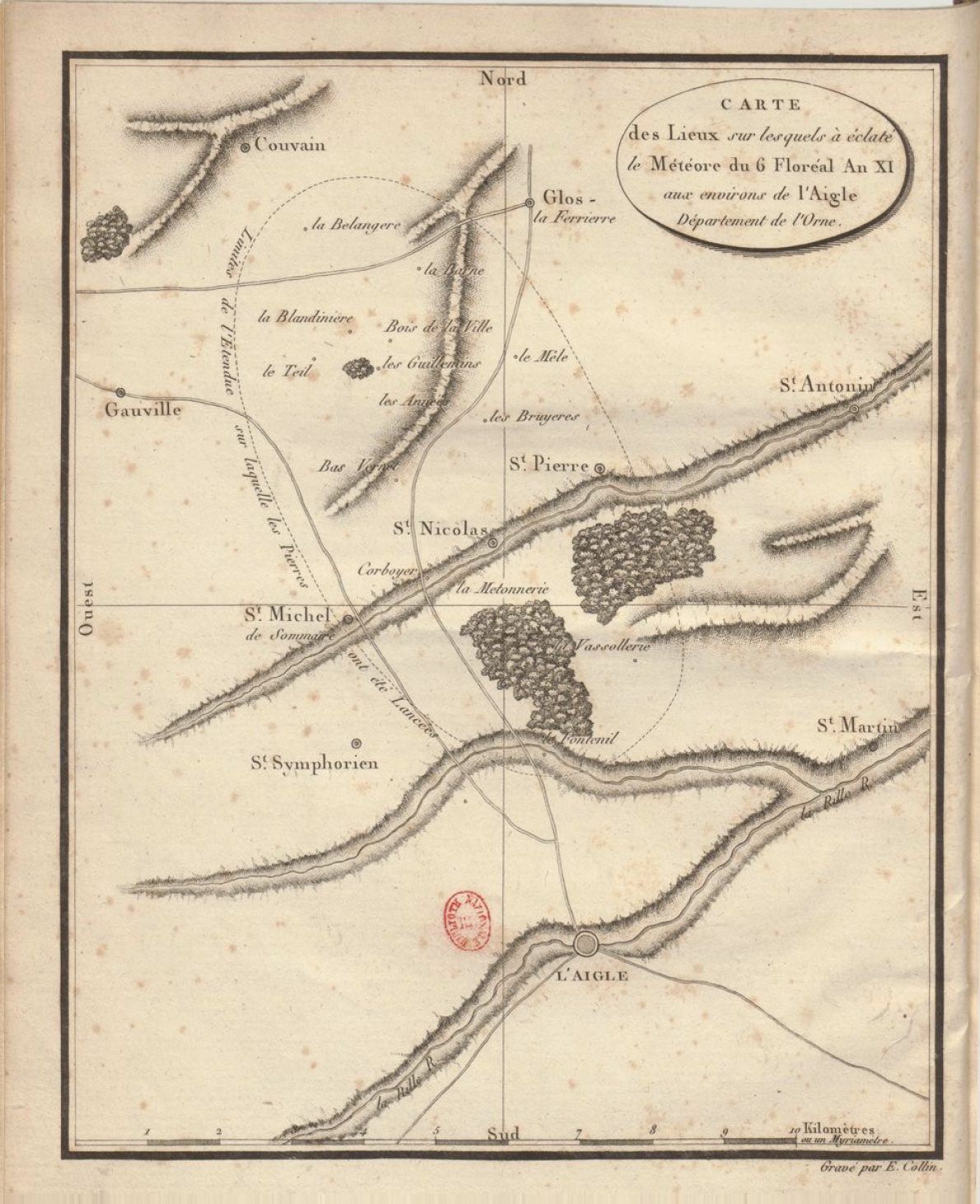
The evidence: Biot's 1803 map of where the stones fell
The Stones That Fell at L'Aigle, 1803: The Day Science Admitted Rocks Fall From the Sky
Last reviewed Next review
We review and update every article weekly. When the record changes, so does the article. How we review
In April 1803 thousands of stones rained on fields near L'Aigle in Normandy. A young physicist walked the villages and proved they came from the sky.
Verdict: Explained: a shower of stony meteorites fell near L'Aigle on 26 April 1803, and Biot's field survey convinced French science that stones really do fall from the sky.
Original sources: Biot, Relation d'un voyage fait dans le département de l'Orne (1803), CC0 transcription on the Internet Archive · Biot's 1803 report, original print scan on Gallica (BnF) · Vasak, 'La météorite de L'Aigle (1803) : un étrange météore élucidé', Géohistoire (2024) · Bischoff et al., 'Saint-Pierre-le-Viger (L5-6) from asteroid 2023 CX1', Meteoritics & Planetary Science (2023)
Sources J.-B. Biot, Relation d'un voyage fait dans le département de l'Orne (Paris, 1803); Vasak, Géohistoire (2024), abstract; Bischoff et al., Meteoritics & Planetary Science (2023), abstract
Around one in the afternoon on Tuesday, 26 April 1803, people across a wide stretch of Normandy heard a long, rolling roar in a clear sky. Near the small town of L’Aigle, in the Orne, stones came down on fields, farmyards and woods. At the time, many educated people in Europe still thought “stones from the sky” was peasant folklore. The government sent the young physicist Jean-Baptiste Biot, a member of the Institut national, to find out what had really happened.
Biot did not start at L’Aigle. He began about fifteen leagues away and worked inward, village by village, asking people what they had heard and when. His report, printed in Paris that same year, sums up the result in plain terms: around L’Aigle, on 6 Floréal year 11 (26 April 1803), at about one in the afternoon, there was “une explosion violente qui a duré pendant cinq ou six minutes, avec un roulement continuel” (a violent explosion lasting five or six minutes, with a continuous rumbling), and it was heard nearly thirty leagues around. People in towns farther off, he wrote, had seen a fast-moving ball of fire in the sky just before.
Then he went looking for the stones. He was told of one weighing 17 and a half livres (8.5 kilograms) that came down at the hamlet of La Vassolerie, about a league north of town, and that villagers had already chipped it down to about 12 and a half livres by the time a local man collected what was left. At the Château du Fontenil, a fifteen-year-old working under a shed said he saw a stone fall about ten paces away. Biot saw the boy, the hole it made in the ground, which was about eighteen inches deep, and the stone itself, about three livres. People agreed that the stones smoked where they landed and smelled so strongly of sulfur that they were carried back out of houses.
Biot mapped where the stones lay. He found them only inside an oval area about two and a half leagues long and one wide, running from southeast to northwest, with the biggest stones at the southeast end and the smallest at the northwest end. He estimated that two or three thousand stones had fallen, from 8.5 kilograms down to a few grams. The map at the top of this page is the one printed with his report; the dotted line is his boundary of the fall.
Modern work looks back on the report as a turning point. In a 2024 paper in the French journal Géohistoire, A. Vasak describes it as a model of scientific method built on a ten-day field trip (26 June to 5 July 1803), and argues that it is where a frightening “rain of stones” stopped being a weather marvel and became a scientific object: rock from outside our atmosphere, as the German physicist Chladni had proposed in 1794. The stones themselves are still studied. A 2023 paper in Meteoritics & Planetary Science by A. Bischoff and colleagues compared L’Aigle with a meteorite that fell in Normandy in February 2023, less than 120 kilometers to the north, and confirmed L’Aigle as an L6 ordinary chondrite breccia, a common kind of stony meteorite.
One of the L’Aigle stones is on display in the mineralogy gallery of the Muséum national d’histoire naturelle in Paris; that stone is the one in the photo at the head of this page. We pin the town of L’Aigle, not any farm or field.
Sources
- Jean-Baptiste Biot, Relation d’un voyage fait dans le département de l’Orne, pour constater la réalité d’un météore observé à l’Aigle, le 6 floréal an 11 (Paris: Baudouin, 1803): CC0 transcription on the Internet Archive (read 28 Oct 2026; quotes and translations are ours, from the French) and the original print on Gallica
- A. Vasak, “La météorite de L’Aigle (1803) : un étrange météore élucidé”, Géohistoire (2024): article on OpenEdition (abstract read 28 Oct 2026; in French, our summary)
- A. Bischoff, M. Patzek, T. Di Rocco, A. Pack, A. Stojic, J. Berndt and S. Peters, “Saint-Pierre-le-Viger (L5-6) from asteroid 2023 CX1 recovered in the Normandy, France, 220 years after the historic fall of L’Aigle (L6 breccia) in the neighborhood”, Meteoritics & Planetary Science (2023): paper on Wiley (abstract read 28 Oct 2026)
Weighing it
This one is settled. Biot’s survey is first-hand: he talked to witnesses within weeks, saw stones and holes himself, and drew the edge of the fall from what he found, not from rumor. The modern papers come at it from two other sides, one as history of science and one as lab work on the stones, and both treat L’Aigle as a real meteorite fall. What stays a little soft are the numbers that rest on witness memory, such as the five or six minutes of noise, which Biot himself warned tends to grow in the telling, and his count of two or three thousand stones, which was an estimate from what people showed him.
Every image on this page is credited where it appears.
Verdict
Explained Explained: a shower of stony meteorites fell near L'Aigle on 26 April 1803, and Biot's field survey convinced French science that stones really do fall from the sky.
Update log
-
We added this case file.
-
Weekly re-check of sources; no change to the record since filing. Next check November 9, 2026.
Discussion
Discuss this case on the on-site Community board — no GitHub account required. Prefer a private tip for the editorial team? Submit a Sighting.
House rules: Community guidelines.