The evidence: Both carved faces of the stone, photographed for Flom's 1910 report
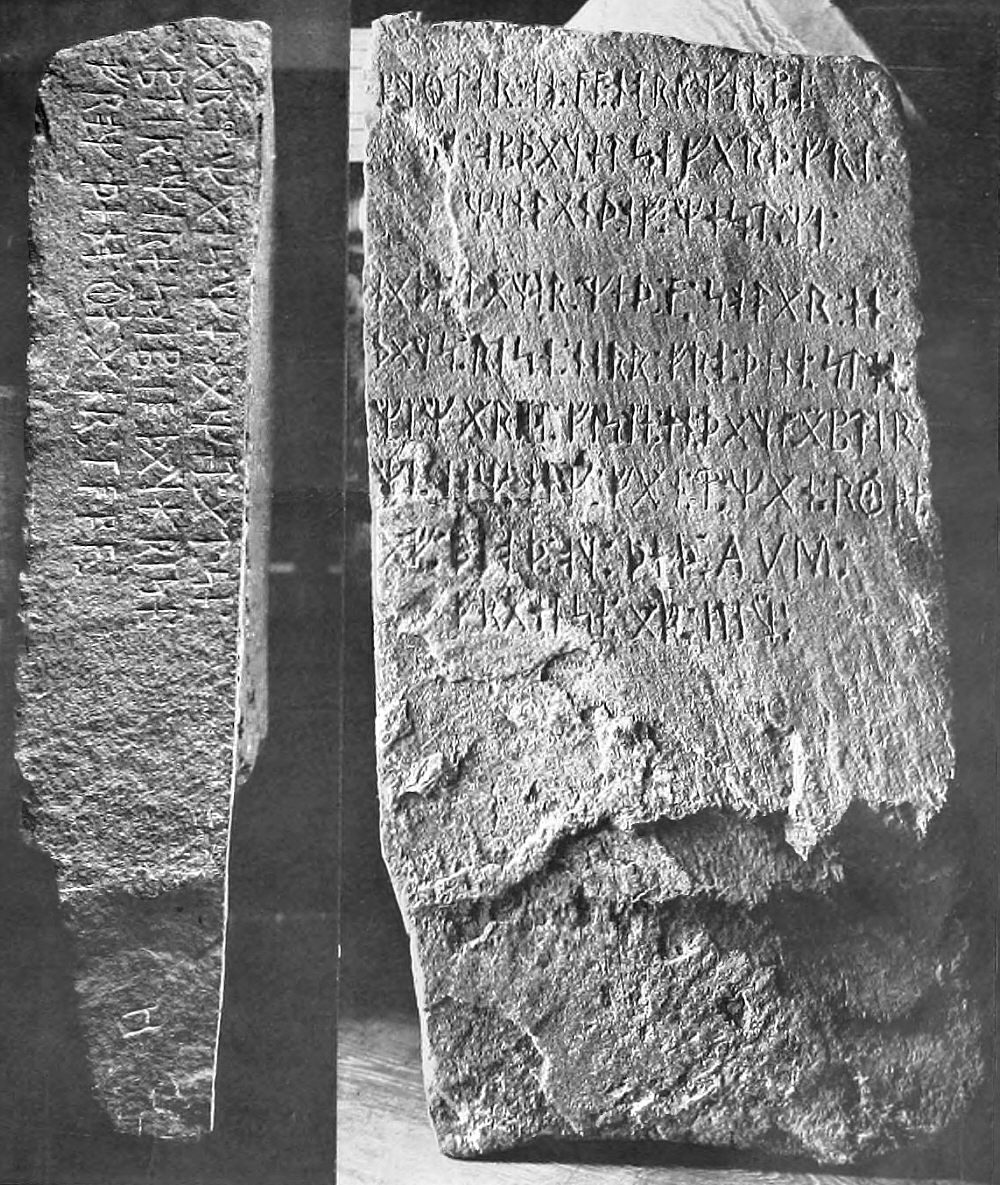
The Kensington Runestone, 1898: A Viking Message in a Minnesota Field?
Last reviewed Next review
We review and update every article weekly. When the record changes, so does the article. How we review
In 1898 a Swedish farmer in Minnesota pulled up a slab carved with runes dated 1362. Scholars have argued over it ever since. Here is where it stands.
Verdict: The inscription was almost certainly carved in the 1800s, not in 1362: its language and its runes match modern Swedish sources, though who carved it, and why, has never been proven.
Original sources: George T. Flom, The Kensington Rune-Stone: an address (1910), full scan on the Internet Archive · Paul Nelson, 'Kensington Runestone', MNopedia, Minnesota Historical Society · Henrik Williams, 'The Kensington Runestone: Fact and Fiction', Swedish-American Historical Quarterly 63:1 (2012) · Magnus Källström, 'Kensingtonrunorna kom från Timrå!', K-blogg, Swedish National Heritage Board (2022, in Swedish)
Sources G. T. Flom, The Kensington Rune-Stone (Illinois State Historical Society, 1910); MNopedia (Minnesota Historical Society); H. Williams, Swedish-American Historical Quarterly 63:1 (2012); M. Källström, Riksantikvarieämbetet K-blogg (2022)
In the fall of 1898 Olof Ohman, a Swedish immigrant who had farmed in Douglas County, Minnesota, since 1879, was clearing trees on his land a little over three miles northeast of the village of Kensington. Under a young aspen he turned up a slab of gray stone, with two of the tree’s roots wrapped around it. When he and his son looked closer, they found rows of strange letters cut into its face and one edge. The letters turned out to be runes, the old Scandinavian alphabet.
The stone is not big. George T. Flom, a professor of Scandinavian languages at the University of Illinois who wrote about it in 1910, gives its size as about thirty inches long, about half as wide and seven inches thick. He counted 211 carved characters: 152 on the face and 59 on the edge. The Minnesota Historical Society’s encyclopedia, MNopedia, gives the generally accepted translation:
“We are 8 Goths [Swedes] and 22 Norwegians on an exploration journey from Vinland through the West. We had camp by a lake with 2 skerries [small rocky islands] one day’s journey north from this stone. We were out and fished one day. After we came home we found 10 of our men red with blood and dead. AVM [Ave Virgo Maria, or Hail, Virgin Mary] save us from evil. We have 10 of our party by the sea to look after our ships, 14 days’ journey from this island. Year 1362.”
If that were true, Norse explorers would have been in the middle of North America 130 years before Columbus. That is why the stone has been fought over for more than a century.
The first verdicts, and the long argument
The fight started fast. According to the Swedish runologist Henrik Williams, Ohman left the stone at a local bank and it was sent to Chicago. In 1899 Professor George Curme in Chicago and Professor Olaus Breda in Minneapolis both judged that the inscription was not medieval. The stone went back to Ohman, who kept it until 1907, when the Norwegian-American writer Hjalmar Holand acquired it and began more than fifty years of arguing that it was real.
In 1910 a committee of the Minnesota Historical Society, led by the archaeologist Newton Winchell, concluded that the inscription was genuine. Flom was alarmed. In an address to the Illinois State Historical Society that May, he noted that no Scandinavian language specialist had sat with the Minnesota committee, and then went through the text word by word. Swedish in 1362, he wrote, said vi varom and vi komom for “we were” and “we came”; the stone says vi var and vi kom, which are modern forms. The word for “exploration journey” is built on a Dutch loanword that, in his reading, did not reach Scandinavian speech until after the Reformation. Saying po fiske for “out fishing” was, again, modern usage. A seven-member committee of the University of Illinois Philological Society, chosen for their knowledge of Old Norse, heard his paper and announced that the inscription “can not be from 1362” and that it was a recent forgery.
The argument did not stop. MNopedia’s timeline shows the stone on display at the Smithsonian in 1948, Erik Moltke of the Danish National Museum calling it a fake in 1950, the scholar Erik Wahlgren and the historian Theodore Blegen reaching the same conclusion in 1958 and 1968, and the stone shipped to the 1965 New York World’s Fair. In 1976 a recorded interview was made public in which Walter Gran said his father had helped carve it. In 2003 the geologist Scott Wolter argued that weathering in the carved grooves showed they were at least 200 years old, a claim MNopedia describes as “highly contested”. Today the stone stands on display in Alexandria, Minnesota, the town we use for the map pin.
What the Swedish archives turned up
The strongest new evidence came from Sweden, in Swedish. Williams, writing in the Swedish-American Historical Quarterly in 2012, describes a find made in 2004 at the dialect and folklore archive in Umeå: two sheets of paper, dated 1883 and 1885, written by two brothers, Carl Emil and Edward Larsson, journeyman tailors from Dalarna. Among other alphabets, the sheets list a set of odd runes that are closely related to the ones on the Kensington stone, the same runes that had no known parallel anywhere before. Williams also points out that Ohman owned the 1891 edition of a popular Swedish home encyclopedia, The Well-Informed Schoolmaster. Within a couple of pages, in a section on the history of the Swedish language, it prints three old-looking words from the stone that had seemed impossible to explain in a nineteenth-century text.
In 2022 Magnus Källström, a runologist at the Swedish National Heritage Board (Riksantikvarieämbetet), took the trail further back. In a post on the Board’s blog, written in Swedish, he describes a memorial board painted in 1868 in Torp, in the province of Medelpad, by a traveling writing teacher named Eric Ström. Its text is written in Kensington-type runes. He then found a copy of Ström’s handwritten writing manual from 1864, which includes a full alphabet of these runes. In our reading of his post, Källström makes two points that matter here. First, this rune alphabet was being taught in northern Sweden decades before 1898. Second, the stone uses a later version of the alphabet than the one the Larsson brothers were still copying in 1885, which he takes as a hint that the stone is no older than that.
Sources
- George T. Flom, The Kensington Rune-Stone: an address (Springfield: Illinois State Historical Society, 1910): full scan on the Internet Archive (read 29 Oct 2026)
- Paul Nelson, “Kensington Runestone”, MNopedia, Minnesota Historical Society (first published 2020): MNopedia entry (read 29 Oct 2026)
- Henrik Williams, “The Kensington Runestone: Fact and Fiction”, Swedish-American Historical Quarterly 63, no. 1 (January 2012), pp. 3 to 22: article at North Park University via CARLI Digital Collections (read 29 Oct 2026)
- Magnus Källström, “Kensingtonrunorna kom från Timrå!”, K-blogg, Riksantikvarieämbetet (Swedish National Heritage Board), 11 December 2022: blog post, in Swedish (read 29 Oct 2026; our summary and translation)
Weighing it
On the date, the record is about as one-sided as these things get. Williams writes that, to his knowledge, every academically trained specialist in Scandinavian, English or German studies who has written on the stone has found the inscription not medieval. A few others, such as the linguist Robert Hall and the geologist Scott Wolter, have defended it. The Swedish archive finds now show its unusual runes in use in Sweden in the 1860s to 1880s. The 1362 story also has no support anywhere else: as MNopedia notes, no other record of such an expedition has been found.
What stays open is the human side. Williams is careful here: he says there is no evidence that Ohman himself carved the stone, that the deathbed-confession rumor does not stand up, and that nothing proves the find story false. He also avoids the word “fake”, because we do not know whether whoever carved it meant to fool anyone. We file it under hoaxes because it was presented as a 1362 record and is not one. But who cut the runes, and why, is still unsolved.
Every image on this page is credited where it appears.
Verdict
Hoax The inscription was almost certainly carved in the 1800s, not in 1362: its language and its runes match modern Swedish sources, though who carved it, and why, has never been proven.
Update log
-
We added this case file.
-
Weekly re-check of sources; no change to the record since filing. Next check November 9, 2026.
Discussion
Discuss this case on the on-site Community board — no GitHub account required. Prefer a private tip for the editorial team? Submit a Sighting.
House rules: Community guidelines.