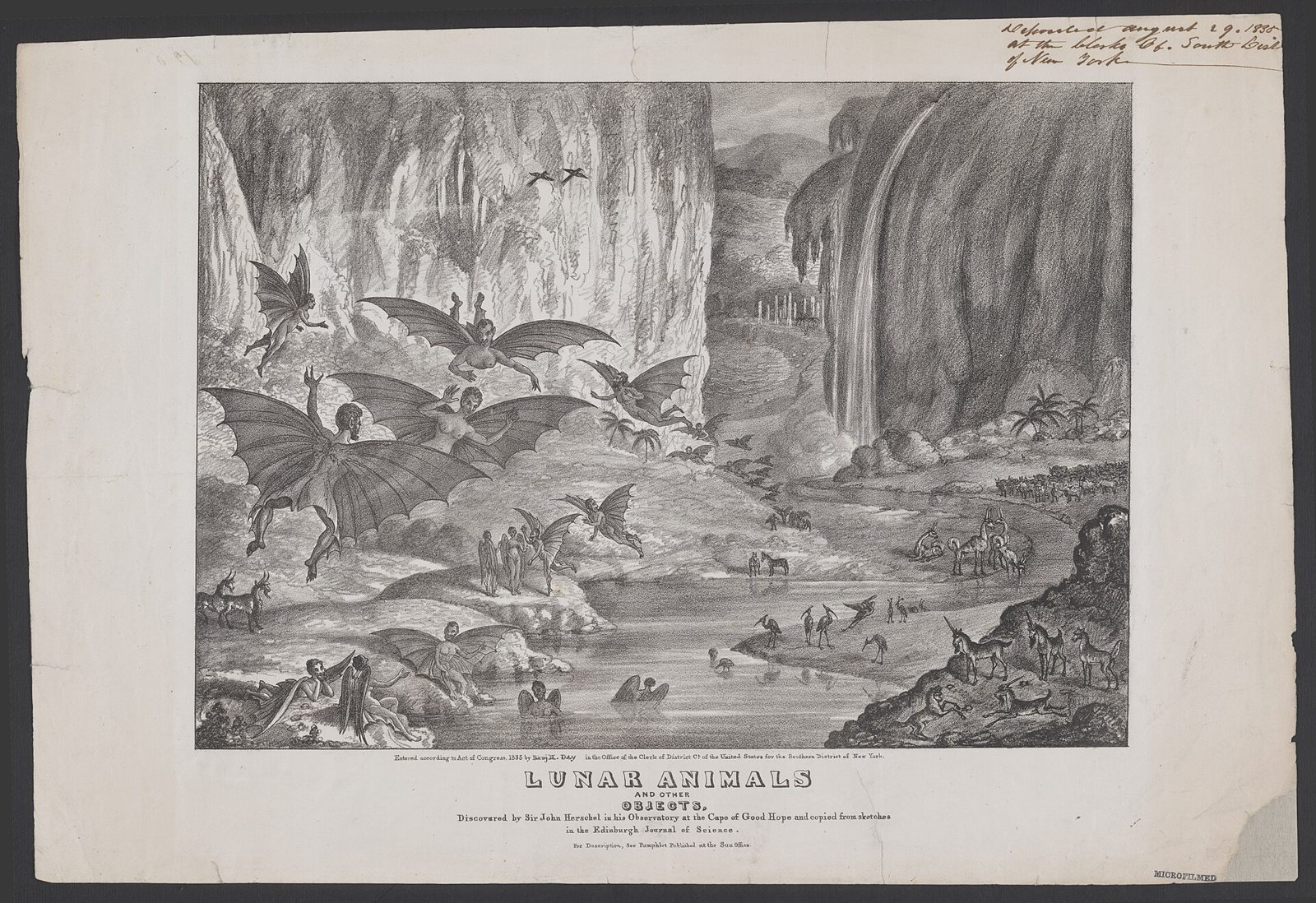
The evidence: Lunar Animals and Other Objects, the print the Sun sold alongside the story
The Great Moon Hoax, 1835: When a New York Paper Found Man-Bats on the Moon
Last reviewed Next review
We review and update every article weekly. When the record changes, so does the article. How we review
In August 1835 the New York Sun reported that Sir John Herschel had seen bat-winged people on the moon. It was invented. Here is how the hoax worked.
Verdict: The moon life was invented: the Sun's editor Richard Adams Locke wrote the story, credited it to John Herschel and to a journal that had already closed, and later admitted it, so this is a hoax, though how many people truly believed it was likely exaggerated.
Original sources: Richard Adams Locke, The Moon Hoax (New York: W. Gowans, 1859), a reprint of the Sun series, transcribed on Wikisource · P. T. Barnum, The Humbugs of the World (New York: Carleton, 1866), chapter 32, 'The Moon-Hoax', on Wikisource · The Museum of Hoaxes, 'The Great Moon Hoax' (history drawn from the 1835 New York papers) · 'Lunar animals and other objects' (1835), Wikimedia Commons file page with the Library of Congress record

Sources The Sun (New York), 25 to 31 August 1835, as reprinted by W. Gowans (1859); P. T. Barnum, The Humbugs of the World (1866), ch. 32; The Museum of Hoaxes, 'The Great Moon Hoax'; Library of Congress Prints and Photographs Division
On Friday, 21 August 1835, a short notice ran on the second page of the Sun, a one-cent New York daily. It said, quoting a paper in Edinburgh, that the British astronomer Sir John Herschel had made “astronomical discoveries of the most wonderful description” at the Cape of Good Hope, using an immense telescope “of an entirely new principle”. The next Tuesday the real story began.
From 25 to 31 August, the Sun printed six long installments, mostly on its front page, under the headline “Great Astronomical Discoveries Lately Made by Sir John Herschel”. The paper said they were extracts from a supplement to the Edinburgh Journal of Science. None of it was true. This was the Great Moon Hoax, and the print at the top of this page is one the Sun itself sold while the story was running.
What the Sun told its readers
We read the whole series in the 1859 reprint published in New York by William Gowans, which says on its title page that it was first published in the Sun in August and September 1835. The Museum of Hoaxes, which has worked through the 1835 newspapers, summarizes it day by day, and we checked its summary against the reprint.
The story was told by a “Dr. Andrew Grant”, said to be Herschel’s assistant. The first part was about the telescope: a lens 24 feet across, helped by a second device the text calls a “hydro-oxygen microscope”, strong enough, it claimed, to study “even the entomology of the moon”. P. T. Barnum, who retold the hoax in 1866, quotes the claim that the view was equal to what the naked eye sees of objects a hundred yards away.
Then came the moon itself. Basalt rock covered in dark red flowers. Herds of brown animals like bison. A bluish creature the size of a goat with a single horn. Beavers that walked on two legs, carried their young and lived in huts with smoke rising from them. On the fourth day came the star turn: beings about four feet tall, covered except on the face with “short and glossy copper-colored hair”, with wings of “a thin membrane”, which the narrator says Herschel named Vespertilio-homo, or man-bat. Later installments added a temple of polished sapphire and a “superior” race of man-bats. The series ended with the telescope’s lens catching the sun and burning down part of the observatory, and with a promise that Herschel’s full report would follow. It never did.
Did everyone fall for it?
The usual story says yes. Barnum wrote that “nearly everybody, the gravest and the wisest, too, was completely taken in at the time”. The publisher’s note in the 1859 reprint says the Sun’s circulation grew fivefold and that 60,000 copies of the pamphlet sold in less than a month. Barnum gives a gain of more than fifty thousand readers.
The Museum of Hoaxes argues that this is overstated, and its evidence comes from the papers of the day. By its count, at least half of New York’s main papers were doubtful from the start. The Journal of Commerce said the article was “manufactured in this country”. The Commercial Advertiser asked how such a telescope could have been built without the British press noticing. The Evening Post, as Barnum also records, joked that it was “quite proper that the ‘Sun’ should be the means of shedding so much light on the Moon.” The circulation boom is shaky too. The Sun claimed 19,360 copies on 28 August, during the hoax, but had boasted of 26,000 two weeks earlier, on 13 August, when a fire had knocked its rival the Herald off the streets. By the paper’s own figures, there was no sudden jump. The Museum of Hoaxes says the real profit came from the pamphlet, put on sale on 31 August, and from prints like the one above.
How it came apart
On 31 August, the day the last part ran, James Gordon Bennett of the rival New York Herald published “The Astronomical Hoax Explained”. He pointed out that the Edinburgh Journal of Science was no longer being published at all; it had merged into another journal years before. He also named the likely author: Richard Adams Locke, a well-educated British writer, recently arrived in America, whom the Sun’s owner Benjamin Day had hired as editor two months before.
Locke denied it at first. According to the Museum of Hoaxes, he later signed an 1836 article “Author of the Moon Hoax” and gave his fullest account in the New World on 16 May 1840, saying he meant it as satire. Barnum also writes that Locke’s aim was to mock the writings of Thomas Dick, a popular Scottish author who argued the planets were full of inhabitants.
Herschel himself was in South Africa mapping the southern sky and knew nothing of it at first. The Museum of Hoaxes quotes a later letter to his aunt Caroline: “I have been pestered from all quarters with that ridiculous hoax about the Moon”, in, as he put it, “English French Italian & German!!” The Italian print at the head of this page, made in Naples in 1835 by the lithographer Salvatore Fergola, shows how far it went.
One more detail fits today’s date. The Museum of Hoaxes reports that when workmen took down the old Brooklyn Institute building in 1891, they found a lead box under the cornerstone, laid on 31 October 1835. Inside, with coins and that day’s newspapers, were two copies of the “Lunar Animals” print.
Weighing it
There is nothing to explain about the moon: no telescope then or now could show animals on it, Herschel never claimed to have seen any, and the journal named as the source had stopped publishing. The open questions are about people. Locke is the author the evidence points to: Bennett named him within a week, and Locke later owned it himself. The harder question is how many readers truly believed it. The famous claims of near-universal belief come from people telling a good story years later, while the 1835 papers themselves show plenty of doubt and jokes. We think the fairest reading is that the hoax was a huge popular sensation that many people enjoyed without fully swallowing.
Verdict
Hoax The moon life was invented: the Sun's editor Richard Adams Locke wrote the story, credited it to John Herschel and to a journal that had already closed, and later admitted it, so this is a hoax, though how many people truly believed it was likely exaggerated.
Update log
-
We added this case file.
-
Weekly re-check of sources; no change to the record since filing. Next check November 9, 2026.
Discussion
Discuss this case on the on-site Community board — no GitHub account required. Prefer a private tip for the editorial team? Submit a Sighting.
House rules: Community guidelines.