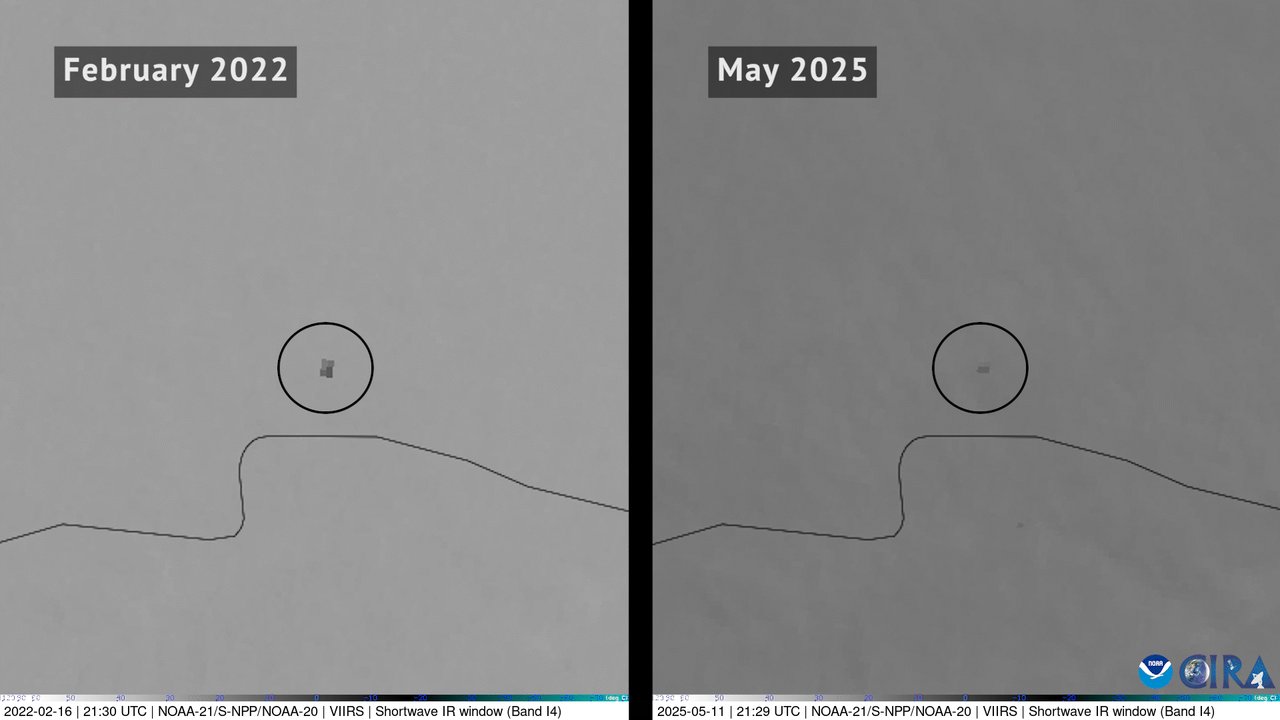
The evidence: The crater's heat seen from orbit, February 2022 and May 2025


The Darvaza Gas Crater: Who Lit Turkmenistan's 'Door to Hell'?
Last reviewed Next review
We review and update every article weekly. When the record changes, so does the article. How we review
A desert crater in Turkmenistan has burned for decades. Everyone says Soviet geologists lit it in 1971, but the records are missing and the dates don't agree.
Verdict: The crater is real and the gas fire is real, but the famous story that Soviet geologists lit it in 1971 is unproven: the collapse date is still 1963 or 1971, and satellite images suggest the fire only started in late 1987 or early 1988.
Original sources: Neftegaz Turkmenistana: 'The mysterious gas crater has its own real history' (Russian, 1 Feb 2022) · Valverde et al., 'Satellite-based assessment of methane emissions from the Darvaza gas crater' (EarthArXiv preprint)
Sources Neftegaz Turkmenistana (oilgas.gov.tm), 1 Feb 2022 (Russian) and 24 Jun 2022 (English); National Geographic, Q&A with George Kourounis (17 Jul 2014); Valverde et al., EarthArXiv preprint (2025, v3 2026); CIRA / NOAA JPSS satellite imagery (May 2025); AFP via France 24 (5 Jun 2025)
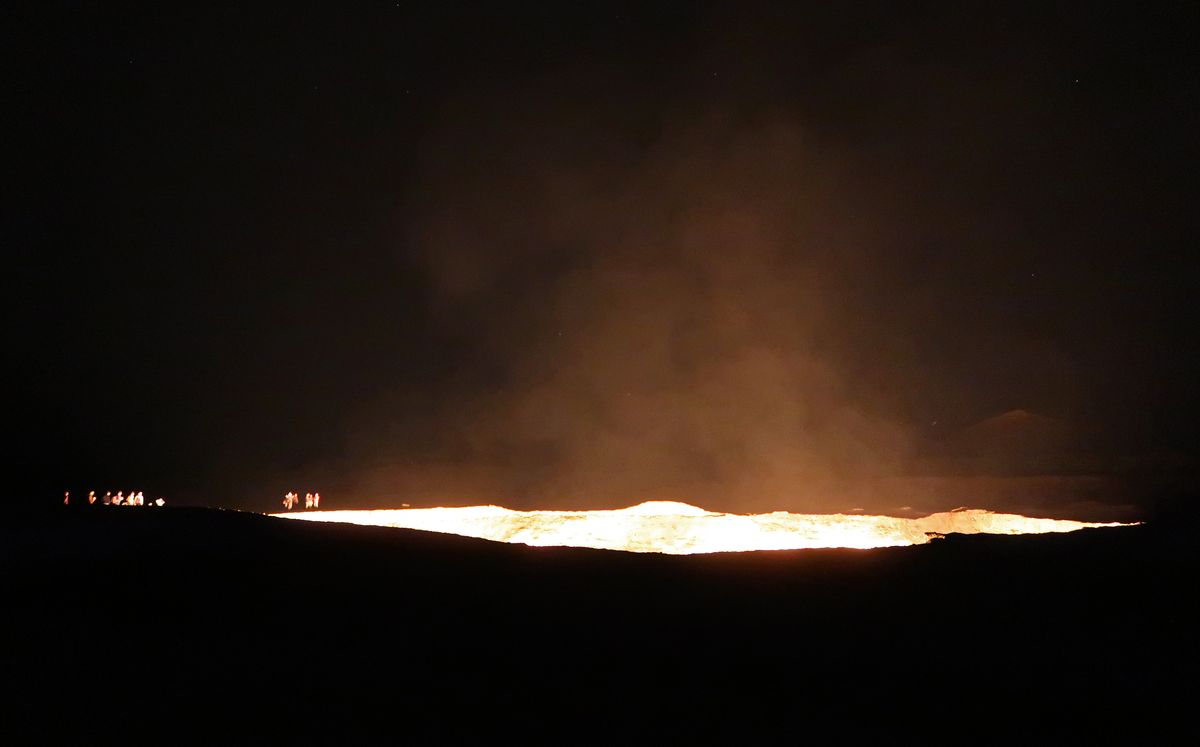
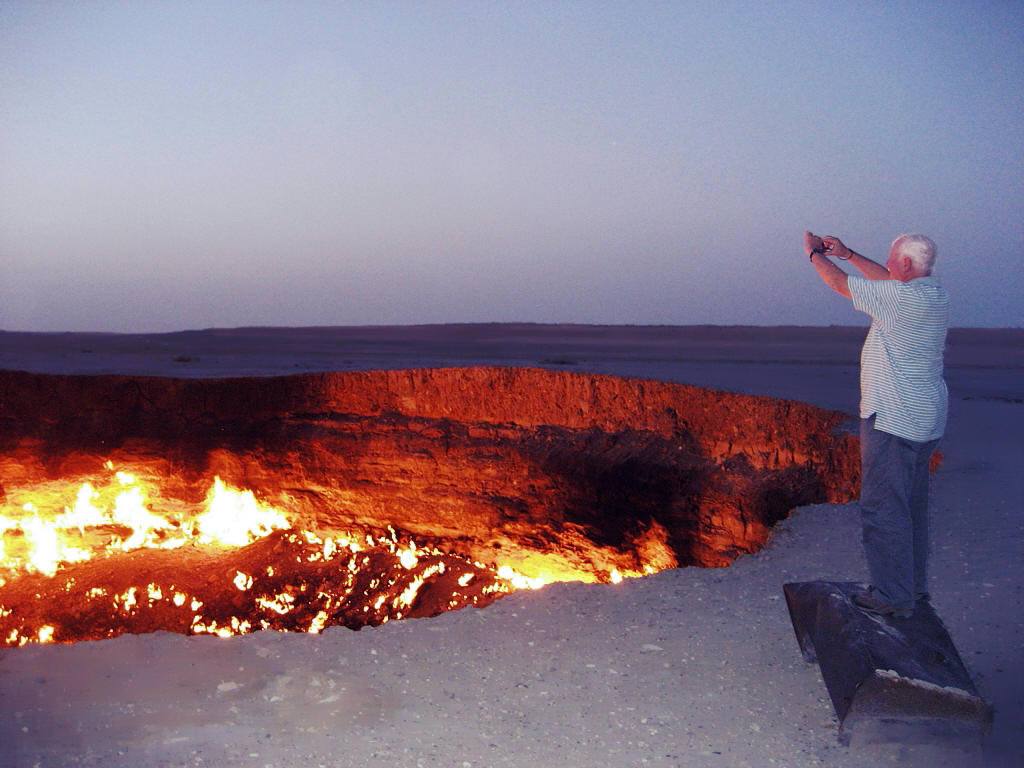
In the Karakum Desert of northern Turkmenistan, about 260 km north of the capital, Ashgabat, there is a pit roughly 60 to 70 meters across and 20 to 30 meters deep. Natural gas leaks through its floor and walls and burns in hundreds of small flames. At night the glow can be seen across the flat desert. Locals and travelers call it the “Door to Hell” or “Gates of Hell.” The government’s official name for it is Garagum ýalkymy, the “Shining of Karakum.” It sits near the old settlement of Darvaza (Derweze), so most people know it as the Darvaza gas crater.
There is nothing supernatural about the fire. What is strange is how little anyone can prove about how it started.
The story everyone tells
The version you will read almost everywhere goes like this. In 1971, Soviet geologists drilling for gas broke into an underground cavern full of gas. The ground gave way, and the drilling rig and its equipment dropped into the hole. Nobody was hurt. Gas began pouring out of the new crater, so to keep it from poisoning people and livestock, the geologists set it on fire. They expected it to burn out in a few days. It never did.
That is not just internet lore. Turkmenistan’s own state oil-and-gas newspaper, Neftegaz Turkmenistana, told the same story in Russian on 1 February 2022, just after President Gurbanguly Berdimuhamedov ordered officials to find a way to put the fire out. “According to available information,” the paper wrote, the history “began in 1971.” Big news agencies repeat it too. When AFP reported in June 2025 that the fire had been reduced, it said the blaze had burned “since 1971, when Soviet scientists accidentally drilled into an underground pocket of gas and then decided to ignite it.”
The same newspaper, a different year
Four months later, the same state newspaper published a different account. On 24 June 2022 it reported a speech by Bayrammyrat Pirniyazov, director of the Natural Gas Research Institute at the state company Turkmengas, at a conference in Ashgabat. According to his account, an exploratory well was drilled in 1963 on the Chaljulba structure of the Central Karakum gas fields. It hit a gas-filled cavity at a shallow depth, the upper layers of soil fell in, and a sinkhole about 60 meters wide and 20 meters deep formed. Then, the paper says, the crater was set on fire to protect people and animals, in the hope that the gas would burn out in a few days or the gas layer would flood, as it had in two other craters 5 to 7 km away, one filled with water and one with mud.
Pirniyazov’s institute also said that specialists later went down into the crater to look for the old well, hoping to cap it, but could not find it, because gas comes out at many points across a radius of about 20 meters. Their plan was to drill new wells nearby to pull the gas away from the crater instead.
So the official Turkmen sources disagree with each other by eight years, and neither cites a document.
“There are no records”
The only person known to have climbed down to the floor of the crater is the Canadian explorer George Kourounis, who went in November 2013 on an expedition partly funded by National Geographic. He wore a heat-reflective suit, carried his own air supply and used a custom Kevlar harness, because an ordinary harness would melt. He was there to collect soil, and he found bacteria living on the crater floor that did not turn up in the soil outside.
He also asked about the crater’s history, and what he heard was different again. “The common urban legend of the place is that it collapsed in 1971 and was set on fire by Soviet scientists shortly afterward,” he told National Geographic. “But I’ve heard from the local Turkmen geologists, who have been there for decades, that the collapse may have happened in the ’60s and that it went unlit until the 1980s.” He added: “There are no records. We tried to find any old incident reports or anything like that, and the department of geology just didn’t have anything that dated back that far.”
What the satellites saw
Satellites have no stake in the story, and they have been watching this desert since 1972. A team led by Adriana Valverde at the Polytechnic University of Valencia in Spain, with researchers from the UN Environment Programme’s methane observatory, Wuhan University and the Environmental Defense Fund, went back through the Landsat archive. Their study is a preprint, which means it has not yet been peer reviewed, and it is now in its third version (July 2026).
They found two things. First, a Landsat 1 image shows the crater was already there on 25 October 1972. That fits both 1963 and 1971 and cannot pick between them. Second, Landsat 5’s thermal band shows no lasting fire at the site from 1984 through 20 September 1987. By 27 February 1988, the crater is hot. In their words, combustion “began between late 1987 and early 1988.”
If that holds up, the most famous part of the story is wrong. The crater may have sat open and leaking gas, unlit, for somewhere between 16 and 24 years before anyone, or anything, set it alight. That is exactly what Kourounis’s unnamed geologists told him in 2013, more than a decade before the satellite study. The study does not say who lit the fire, or why. Nothing we have found does.
The fire is fading
The crater is not just history. The same team counted 44 methane plumes rising from it between 2020 and 2025, at about 0.6 to 3 tonnes of methane an hour, and noted that its flames have been weakening since 2023. They also suggest that a significant part of the gas may escape without burning, through cracks that bypass the flames.
In June 2025, Irina Luryeva, a director at Turkmengas, told a conference in Ashgabat that the fire had been cut “three-fold,” without saying over what period. “Whereas before a huge glow from the blaze was visible from several kilometres away,” she said, “today only a faint source of combustion remains.” She credited wells drilled around the crater to capture the gas. Weather satellites agree that the fire is shrinking. The VIIRS heat images at the top of this page, processed by Colorado State University’s CIRA and NOAA, show the crater’s heat signature in February 2022 and again, much fainter, in May 2025.
Sources
- Neftegaz Turkmenistana (state oil and gas newspaper of Turkmenistan), “У загадочного газового кратера есть своя реальная история” (“The mysterious gas crater has its own real history”), in Russian (1 Feb 2022): oilgas.gov.tm
- Neftegaz Turkmenistana, “Scientists of Turkmenistan have developed a way to take control of the Darvaza crater” (24 Jun 2022): oilgas.gov.tm
- Christina Nunez, “Q&A: The First-Ever Expedition to Turkmenistan’s ‘Door to Hell’”, National Geographic (17 Jul 2014): nationalgeographic.com
- A. Valverde, I. Irakulis-Loitxate, J. Gorroño, Z. Pei and L. Guanter, “Satellite-based assessment of methane emissions from the Darvaza gas crater”, EarthArXiv preprint, not peer reviewed (first posted 20 Jun 2025; version 3, Jul 2026): eartharxiv.org
- CIRA (Colorado State University) and NOAA/NESDIS, “Fires Reduce in the Darvaza Gas Crater”, VIIRS satellite imagery, Feb 2022 to May 2025 (re-read 25 Oct 2026): satlib.cira.colostate.edu
- AFP, “Turkmenistan reduces 50-year fire dubbed ‘Gateway to Hell’”, via France 24 (5 Jun 2025): france24.com
Original text. Images: NOAA/CIRA satellite imagery (public domain) and photographs by Tormod Sandtorv (CC BY-SA 2.0) and John Pavelka (CC BY 2.0), via Wikimedia Commons, self-hosted. Every image on this page is credited where it appears.
Weighing it
The crater and its fire are not in doubt; anyone can stand at the rim. What is in doubt is the origin story. Turkmenistan’s own state press has given both 1963 and 1971 for the collapse, no Soviet drilling record has been published, and the only person to go inside was told the papers don’t exist. The satellite record is the one source with no stake in the story. It shows the crater by October 1972 and no fire until the winter of 1987–88, which matches what local geologists said in 2013. That study is not yet peer reviewed, so we treat it as strong but not final. Our reading: the “lit by Soviet scientists in 1971” story is at best a compression of two separate events, a collapse in the 1960s or early 1970s and an ignition about 16 years later, and nobody has yet shown who struck the match. The map pin sits at the general area of Darvaza, not on the crater rim.
Verdict
Disputed The crater is real and the gas fire is real, but the famous story that Soviet geologists lit it in 1971 is unproven: the collapse date is still 1963 or 1971, and satellite images suggest the fire only started in late 1987 or early 1988.
Evidence ledger
Each claim in this file, the source it rests on, and how well it holds up: 3 corroborated · 1 disputed · 2 unverified. What the labels mean.
| Claim | Source | Type · date | Status |
|---|---|---|---|
| In 1971 Soviet geologists drilling for gas broke into an underground cavity, the rig fell in, and they set the escaping gas on fire, expecting it to burn out in days.The standard story. No Soviet drilling or incident record behind it has been published. | Neftegaz Turkmenistana (1 Feb 2022, Russian); AFP via France 24 (2025) | official · 2022; 2025 | disputed |
| The crater dates to 1963, when an exploratory well on the Chaljulba structure hit a shallow gas cavity and the ground above it collapsed.The same state newspaper gave 1971 four months earlier. | Neftegaz Turkmenistana (24 Jun 2022), reporting Bayrammyrat Pirniyazov, director of Turkmengas's Natural Gas Research Institute | official · 24 Jun 2022 | unverified |
| Local Turkmen geologists said the collapse may have come in the 1960s and the gas went unlit until the 1980s; the geology department had no records going back that far.Second-hand testimony, unnamed geologists. | National Geographic, Q&A with George Kourounis (2014) | press · 17 Jul 2014 | unverified |
| A Landsat 1 image shows the crater already existed on 25 October 1972.Not yet peer reviewed. | Valverde et al., EarthArXiv preprint (2025, v3 2026) | scholarly · 2025–2026 | corroborated |
| Landsat 5 thermal images show no lasting fire from 1984 until 20 Sep 1987, and flames by 27 Feb 1988.Not yet peer reviewed; agrees with the geologists Kourounis spoke to. | Valverde et al., EarthArXiv preprint (2025, v3 2026) | scholarly · 2025–2026 | corroborated |
| The fire has been shrinking since about 2023 as wells drilled nearby draw gas away from the crater. | AFP via France 24 (5 Jun 2025); CIRA / NOAA JPSS imagery (May 2025); Valverde et al. (2025) | official · 2025 | corroborated |
Update log
-
We added this case file.
-
Weekly re-check of sources; no change to the record since filing. Next check November 9, 2026.
Discussion
Discuss this case on the on-site Community board — no GitHub account required. Prefer a private tip for the editorial team? Submit a Sighting.
House rules: Community guidelines.