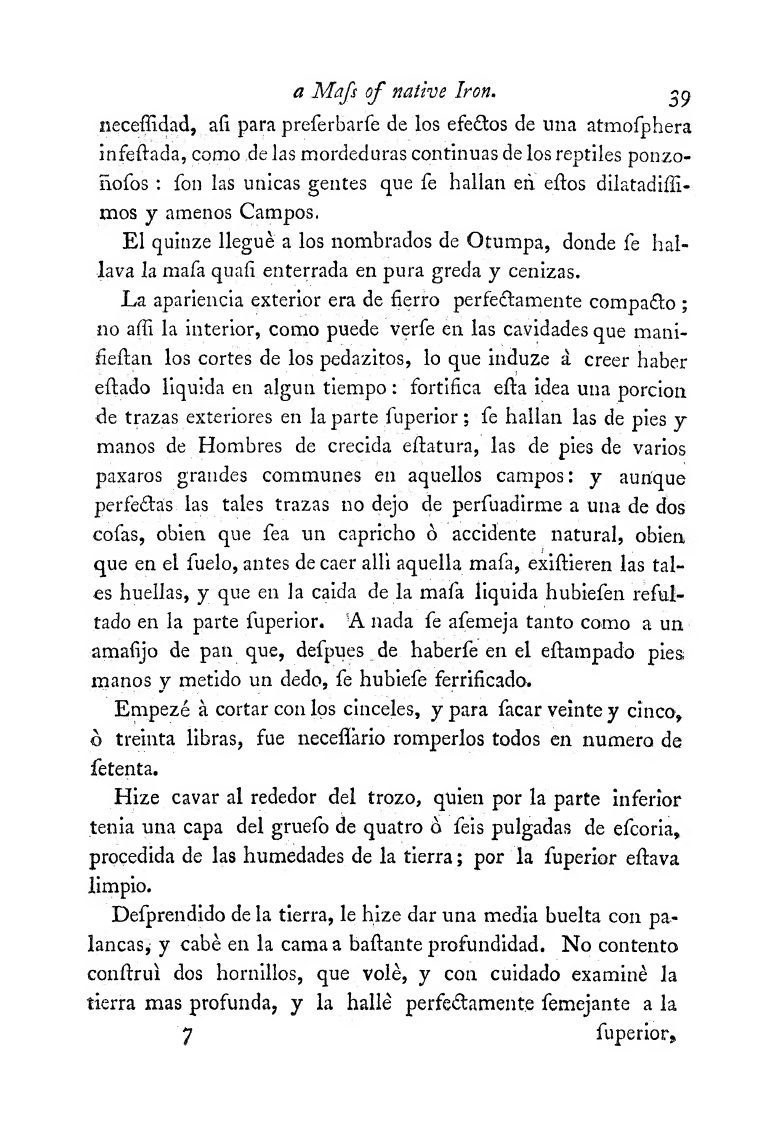
The evidence: Rubín de Celis's own account of reaching the iron mass at Otumpa, page 39 of his letter in the Philosophical Transactions
The Mesón de Fierro, 1783: The Iron Mass of the Chaco That Fell From the Sky
Last reviewed Next review
We review and update every article weekly. When the record changes, so does the article. How we review
In 1783 a Spanish naval officer dug around a huge mass of pure iron on Argentina's Chaco plain and blamed a volcano. It had fallen from the sky.
Verdict: The iron mass Rubín de Celis examined at Otumpa in 1783 was not a mine or a volcanic bomb but part of an iron meteorite shower that fell about 4,000 years ago, although the great mass he saw has never been found again.
Original sources: Miguel Rubín de Celis, 'An Account of a Mass of Native Iron, Found in South-America', Philosophical Transactions 78 (1788), Internet Archive · E. F. F. Chladni, Über den Ursprung der von Pallas gefundenen und anderer ihr ähnlicher Eisenmassen (Riga, 1794), Internet Archive · 'Meteorites of the Gran Chaco', Nature 140, 1006 (1937) · S. P. Wright and others, 'Revisiting the Campo del Cielo, Argentina crater field', Lunar and Planetary Science XXXVII (2006), abstract 1102 · Argentina, 'Campo del Cielo: se impulsa una ley nacional de preservación de meteoritos' (5 July 2022) · Argentina, 'Campo del Cielo: el Estado busca proteger y preservar los meteoritos' (30 March 2023) · Instituto de Turismo del Chaco, 'Campo del Cielo, Reserva Natural Cultural Pigüen N'Onaxá'
Sources Miguel Rubín de Celis, 'An Account of a Mass of Native Iron, Found in South-America', Philosophical Transactions of the Royal Society 78 (1788), pp. 37 to 42, English translation pp. 183 to 189; E. F. F. Chladni, Über den Ursprung der von Pallas gefundenen und anderer ihr ähnlicher Eisenmassen (Riga, 1794); 'Meteorites of the Gran Chaco', Nature 140 (1937); S. P. Wright and others, Lunar and Planetary Science XXXVII (2006), abstract 1102; Government of Argentina news releases (2022 and 2023); Instituto de Turismo del Chaco
For more than thirty years before 1783, people in Spanish South America had heard about a lump of pure iron lying in the open on the Chaco plain, in what is now northern Argentina. There were no mountains and no rocks of any kind for a hundred leagues around. Nobody could explain how it got there. In February 1783 the Viceroy of the Río de la Plata sent a naval officer, Miguel Rubín de Celis, to find out whether it was the top of an iron mine worth settling.
He found the mass, dug around it, blasted beneath it and decided a volcano had thrown it there. He was wrong. What he had found was a meteorite, one of many that fell on the region thousands of years earlier, and his report became part of the argument that iron can fall from the sky. The mass itself, remembered as the Mesón de Fierro (roughly, the Iron Table), has not been located since.
We read Rubín de Celis’s own letter, printed in Spanish with an English translation by the Royal Society of London in 1788, and the 1794 book in which the German physicist Ernst Chladni used it. The page shown at the top of this case is from that letter. Translations from the Spanish and German are ours.
The honey gatherers’ iron
Rubín de Celis begins with the story as he heard it. More than thirty years earlier, a few Indigenous people living under the jurisdiction of Santiago del Estero, whose only work was gathering wild honey and wax in the forests, had come across a piece of metal in the middle of an open field. They called it pure iron. About a foot of it stuck out of the ground on one side, and most of its top was visible.
The find was reported to the viceroys of Peru as a rarity, and Rubín de Celis thought it rightly counted as one. A few private adventurers crossed the Chaco to chip off samples, risking thirst, hunger, hostile groups, wild animals and venomous snakes, and sent pieces to Lima and Madrid. All anyone learned there, he wrote, was that it was very soft, very pure iron. Rumor had it that a vein of iron ran for leagues under the plain. A dig had shown only a crest standing out of the ground, about three varas north to south, two and a half east to west and a third of a vara high (a vara is a little under a meter).
The 1783 expedition
Rubín de Celis left the Río Salado, at the old mission settlement of the Vilela people, at the beginning of February 1783 with an armed escort. The mass lay about seventy leagues away across a flat country of thick forest and open grassland, with no settlement on the way because there was no spring water. He measured the latitude of the site as 27 degrees 28 minutes south.
“On the fifteenth I arrived at the place called Otumpa,” he wrote, “where the mass lay almost buried in pure clay and ashes.”
Outside it looked like perfectly solid iron, but the small pieces they cut off showed cavities inside, which made him think it had once been liquid. The top was covered with marks that looked like the prints of large human feet and hands and of the feet of birds. He decided these were either a natural accident or prints already in the ground when the liquid mass fell on it. The whole thing, he said, looked most like a lump of bread dough that someone had pressed with feet and hands, poked with a finger and then turned to iron.
Cutting it was another matter. To get twenty-five or thirty pounds of metal, his men broke all seventy of their chisels. They dug around the mass and found a crust four to six inches thick on its underside, which he took for rust from the damp ground. They levered it half over and dug well below where it had rested, then set off two explosive charges and examined the deeper soil. It was just like the soil above. There was no root, no vein, nothing to show the iron had grown there.
A volcano that wasn’t
Rubín de Celis reasoned it through. The mass could not have formed on the spot. It could not have been carried there, because there was no iron mine for hundreds of leagues, the iron was useless to anyone and the place was the most waterless part of the Chaco. So, he concluded, it must have been thrown there by a volcano.
He gathered what evidence he could. About two leagues east of the mass was a small brackish spring, the only one in the region, beside a gentle north to south rise in the otherwise flat land. The ground near both was covered in fine ash-colored earth, and the grass there was short and avoided by animals. He suggested a volcano had exploded at the spring and flung the big mass westward. He also repeated a story that somewhere in the forests lay a “tree” of pure iron with branches, seen by many local people and touched by a gentleman from Salta, and guessed it was a smaller, runnier splash from the same eruption. By his measurements the mass weighed more than 300 quintals, roughly 14 tonnes.
He sent his letter from the Isla de León in Spain on 20 June 1786. Sir Joseph Banks laid it before the Royal Society, and it appeared in the Philosophical Transactions in 1788, in Spanish with an English translation.
Chladni’s reading
In 1794 Ernst Chladni published a short book arguing something most scientists then thought absurd: that certain masses of iron, like the one the naturalist Peter Simon Pallas had found in Siberia, had fallen from the sky as fireballs. The Otumpa mass was one of his key examples. He summarized Rubín de Celis’s description, citing the Philosophical Transactions and its reprints in German and French journals, and then went through the possible explanations one by one.
The iron could not have formed in wet ground, he argued, because there was no iron ore anywhere near the South American mass. It could not have been smelted by people and dragged into an uninhabitable plain. And it was not volcanic, because there were no volcanoes nearby, volcanoes produce nothing like it, and a volcano throwing out one huge mass should have scattered many smaller ones around it. Chladni did not know that the Chaco was in fact strewn with smaller pieces. His conclusion was that these masses came from space, and that view is now standard.
What the field turned out to be
The region came to be called Campo del Cielo, the Field of the Sky. A 1937 note in Nature summed up what was known by then. The first Spanish report of iron there went back to 1576. Rubín de Celis’s 1783 account gave weight estimates that later writers put anywhere from about 13 to 45 tons. In 1803 a mass of about a ton was brought to Buenos Aires to be made into arms, and a piece of about 1,400 pounds was given to the British Museum in 1826 by Woodbine Parish. New finds of 4,210 kilograms in 1923 and 732 kilograms in 1925 had shown the field was far from exhausted, and Nature noted that the shallow craters in the area deserved study.
That study came later. In 2006 a team led by the geologist Shawn Wright, writing in the proceedings of the Lunar and Planetary Science Conference, described Campo del Cielo as a field of at least 22 low-angle impact craters formed in soft loess soil about 4,000 years ago. They trenched one crater and recovered the meteorite that made it, weighing 14,850 kilograms, and estimated it had come in at only about 8 degrees from horizontal. The largest known mass, El Chaco, from another crater, was weighed at 33,400 to 36,000 kilograms in the town of Gancedo. Shallow, slanting impacts like these help explain why big irons lay at or just under the surface, exactly as the honey gatherers found one.
The Argentine government now puts the fall at about 4,000 years ago, scattered along a strip some 200 kilometers long on the border of Chaco and Santiago del Estero provinces, with 30 geolocated craters. The Chaco tourism institute says the provincial reserve near Gancedo displays about 300 meteorites.
The lost table
None of this tells us where the Mesón de Fierro is. The government’s 2022 release calls it a mythical mass that has still not been located, and notes that the colonial documents describing the iron go back to the sixteenth century. Rubín de Celis gave a latitude but no reliable longitude, and the Chaco has changed a great deal since 1783. It is possible the mass is still in the ground somewhere in the field, that it was one of the large irons found later and not recognized, or that his size estimate was too generous. We found no evidence that settles it.
The field is not just a scientific site. The same release says Campo del Cielo is sacred to the Moqoit people, and the provincial reserve carries the name Pigüen N’Onaxá. The meteorites are also protected heritage, and the government has worked against people trying to carry them off; the 2022 release describes a 1990 attempt to remove El Chaco itself. Our map pin is on the town of Gancedo, not on any crater, find site or place of Moqoit significance.
Sources
- Miguel Rubín de Celis, “An Account of a Mass of Native Iron, Found in South-America”, letter dated Isla de León, 20 June 1786, Philosophical Transactions of the Royal Society 78 (1788), Spanish text pp. 37 to 42 and English translation in the appendix, pp. 183 to 189: Internet Archive scan and Wikimedia Commons copy (read 4 Nov 2026)
- Ernst Florens Friedrich Chladni, Über den Ursprung der von Pallas gefundenen und anderer ihr ähnlicher Eisenmassen (Riga, 1794), sections 9 to 13: Internet Archive (read 4 Nov 2026)
- “Meteorites of the Gran Chaco”, Nature 140, 1006 (1937): nature.com (read 4 Nov 2026)
- S. P. Wright, M. A. Vesconi, A. Gustin, K. K. Williams, A. C. Ocampo and W. A. Cassidy, “Revisiting the Campo del Cielo, Argentina crater field”, Lunar and Planetary Science XXXVII (2006), abstract 1102: lpi.usra.edu (read 4 Nov 2026)
- Government of Argentina, “Campo del Cielo: se impulsa una ley nacional de preservación de meteoritos”, 5 July 2022: argentina.gob.ar (read 4 Nov 2026)
- Government of Argentina, “Campo del Cielo: el Estado busca proteger y preservar los meteoritos”, 30 March 2023: argentina.gob.ar (read 4 Nov 2026)
- Instituto de Turismo del Chaco, “Campo del Cielo, Reserva Natural Cultural Pigüen N’Onaxá”: turismo.chaco.gob.ar (read 4 Nov 2026)
Weighing it
The 1783 record is first-hand and specific. Rubín de Celis went himself. He gives the date he arrived, the latitude, the size of the excavation, the number of broken chisels and what he found underneath, and he published in a journal that printed his Spanish alongside a translation. We see no reason to doubt that he stood beside a very large mass of nearly pure iron at Otumpa.
His explanation is the part that failed. There was no volcano, and Chladni’s objections in 1794 hold up well. Everything learned since, from the scattered finds to the shallow craters dated to about 4,000 years ago, shows the iron came from a meteorite shower. On what the mass was, the case is explained. What remains open is a smaller, stranger question: which, if any, of the irons known today is the one Rubín de Celis dug around, and where the Mesón de Fierro lies now.
Every image on this page is credited where it appears.
Verdict
Explained The iron mass Rubín de Celis examined at Otumpa in 1783 was not a mine or a volcanic bomb but part of an iron meteorite shower that fell about 4,000 years ago, although the great mass he saw has never been found again.
Update log
-
We added this case file.
-
Weekly re-check of sources; no change to the record since filing. Next check November 9, 2026.
Discussion
Discuss this case on the on-site Community board — no GitHub account required. Prefer a private tip for the editorial team? Submit a Sighting.
House rules: Community guidelines.