The evidence: Blood Falls from the air


Blood Falls: The Antarctic Glacier That Bleeds
Last reviewed Next review
We review and update every article weekly. When the record changes, so does the article. How we review
A glacier in Antarctica's Dry Valleys leaks a blood-red stain. Explorers blamed algae in 1911; the real cause is buried salt water, iron and microbes.
Verdict: The bleeding glacier is real and now explained: iron-rich brine from an ancient, microbe-filled pool under the ice rusts red as soon as it reaches the air.
Sources J. A. Mikucki et al., Annals of Glaciology 39 (2004); Mikucki et al., Science 324 (17 Apr 2009) 397–400; Harvard Gazette (Apr 2009); Mikucki et al., Nature Communications 6, 6831 (2015); Badgeley et al., Journal of Glaciology 63 (2017) 387–400; Sklute et al., Frontiers in Astronomy and Space Sciences (2022); Johns Hopkins Hub (26 Jun 2023)
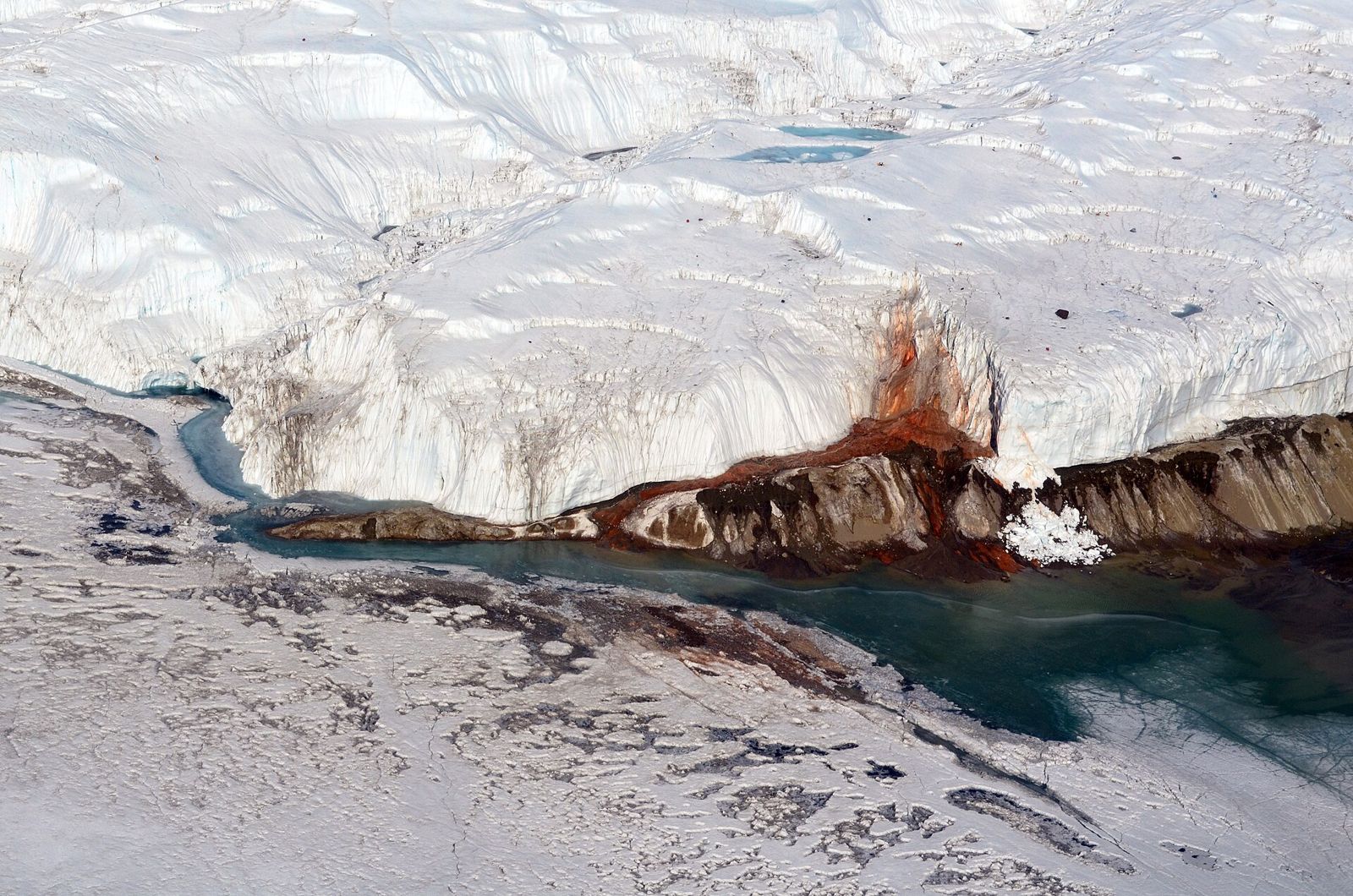
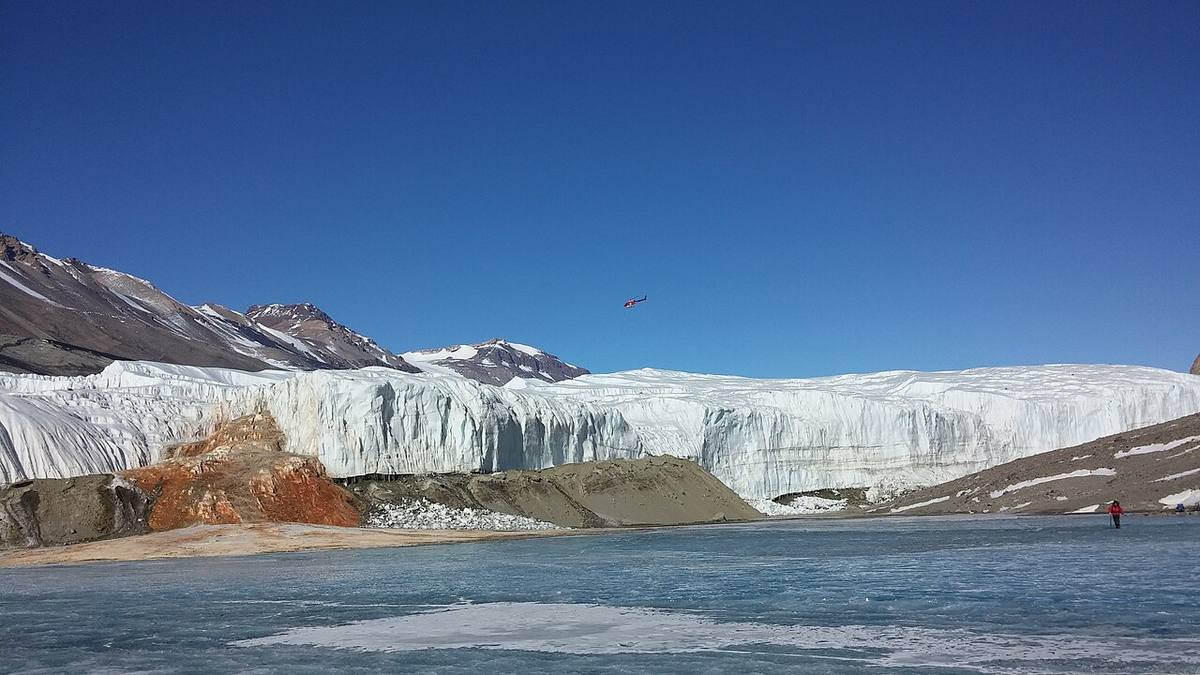
In 1911, during Robert Falcon Scott’s Terra Nova expedition, geologist Griffith Taylor led a party into one of the ice-free McMurdo Dry Valleys. At the end of the glacier that now carries his name, where it meets frozen Lake Bonney, they found the white ice cliff streaked a deep rust red. Taylor later wrote that “bright red alga lent an unusual touch of colour” at the snout of the glacier. The stain was soon known as Blood Falls.
Not algae
Algae was a fair guess in 1911, but it was wrong. When scientists came back in the 1960s they found a very salty, iron-rich liquid seeping out of cracks in the glacier front. By 1979 researchers had noted that fresh outflow carried no red at all. The liquid comes out clear, and only turns rusty once its dissolved iron meets the air. The flow is not steady. It comes in episodes, and the size of the stain changes from year to year.
Life in the dark
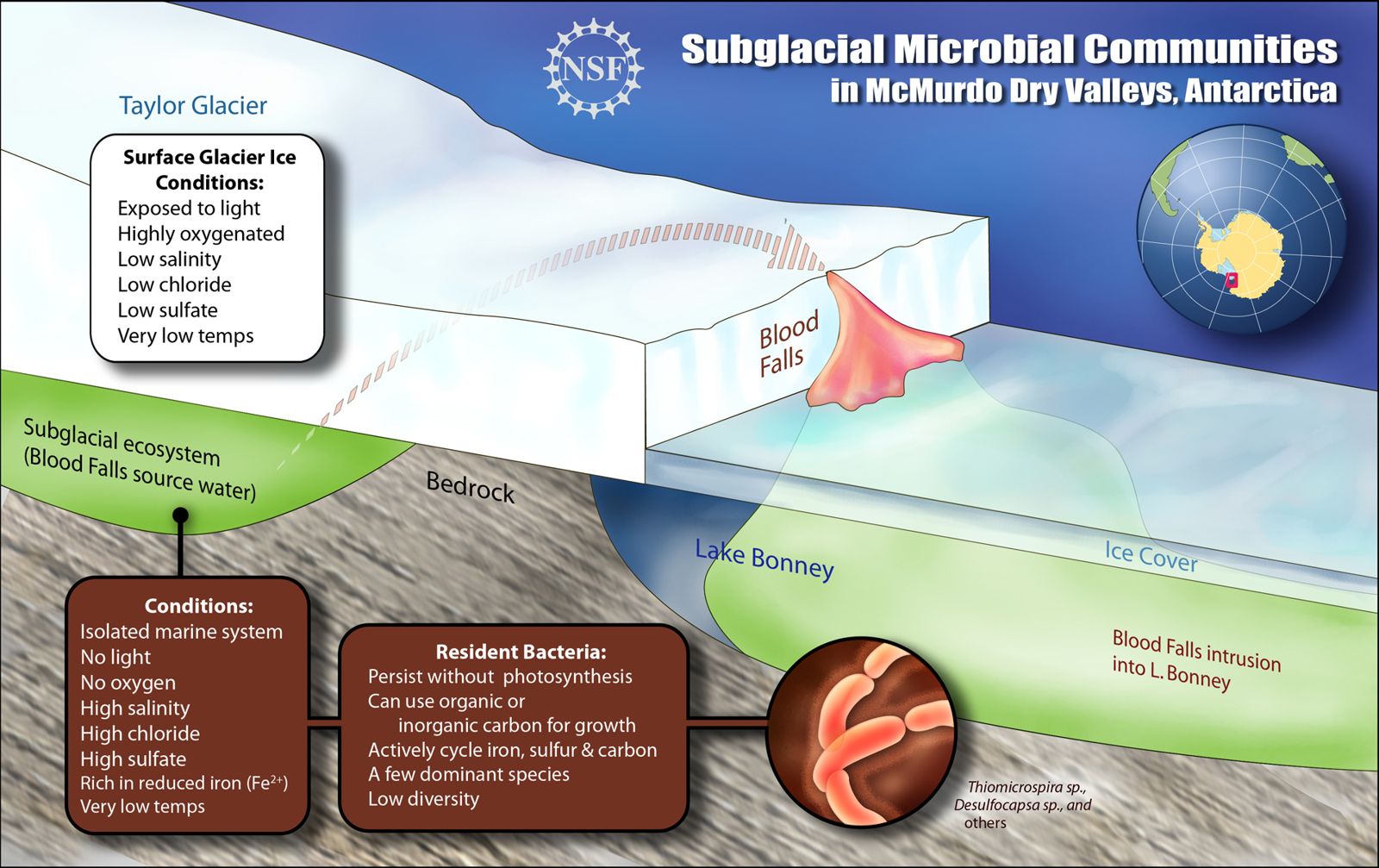
The bigger surprise was what lives in the brine. Jill Mikucki spent several seasons waiting for an outflow before she could catch the liquid as it ran out of a crack. “When I started running the chemical analysis on it, there was no oxygen,” she told the Harvard Gazette. Her team’s 2009 paper in Science described an active community of microbes, related to sea-water bacteria, living in a salty pool under the glacier with no light and no oxygen. They get energy by working iron and sulfur from the bedrock. The team estimated the pool was sealed off when the glacier covered it 1.5 to 2 million years ago. The salt itself points to the sea: the brine has the same ratios of salts as seawater, a leftover from when the valley was a fjord, concentrated as it froze.
How it stays liquid
The average air temperature at the glacier is about −17 °C, far too cold for ordinary meltwater. In 2015 a team flying an electromagnetic sensor under a helicopter mapped brine spreading beneath the glacier and the valley floor, part of a much bigger underground system. In 2017 a radar survey on the glacier itself traced a band of brine running through the ice toward Blood Falls. That study found the brine stays liquid because of its salt and because freezing part of it releases heat that keeps the rest flowing.
The last piece: why red
One question was left. Earlier studies assumed the red came from a rust mineral, but tests kept failing to find one. A 2022 study in Frontiers in Astronomy and Space Sciences, with Johns Hopkins microscopist Ken Livi and Mikucki among the authors, looked at Blood Falls sediment under an electron microscope. They found tiny iron-rich spheres, about a hundredth the size of a human red blood cell, mixed with silicon, calcium, aluminum and sodium. The spheres are not crystals, which is why mineral tests missed them. “As soon as I looked at the microscope images, I noticed that there were these little nanospheres and they were iron-rich,” Livi told the Johns Hopkins Hub in 2023.
Sources
- Mikucki, J. A., et al. (2004), “Saline discharge at the terminus of the Taylor Glacier, Antarctica”, Annals of Glaciology 39: montana.edu (PDF)
- Mikucki, J. A., et al. (2009), “A contemporary microbially maintained subglacial ferrous ‘ocean’”, Science 324, 397–400: doi.org/10.1126/science.1167350
- Harvard Gazette, “Microbes thrive under Antarctic glacier” (Apr 2009): news.harvard.edu
- Mikucki, J. A., et al. (2015), “Deep groundwater and potential subsurface habitats beneath an Antarctic dry valley”, Nature Communications 6, 6831: nature.com
- Badgeley, J. A., et al. (2017), “An englacial hydrologic system of brine within a cold glacier: Blood Falls, McMurdo Dry Valleys, Antarctica”, Journal of Glaciology 63, 387–400: doi.org/10.1017/jog.2017.16
- Sklute, E. C., et al. (2022), “A multi-technique analysis of surface materials from Blood Falls, Antarctica”, Frontiers in Astronomy and Space Sciences: doi.org/10.3389/fspas.2022.843174
- Johns Hopkins Hub, “Seeing red: Researchers uncover the century-old mystery of Blood Falls” (26 Jun 2023): hub.jhu.edu
Original text. Images: U.S. National Science Foundation photographs and diagram (public domain), self-hosted. Every image on this page is credited where it appears.
Weighing it
Nothing here is supernatural, but the real story is stranger than the 1911 guess. A pool of ancient seawater, trapped under a glacier for perhaps two million years, still supports living microbes and leaks out as a red stain. Each step, from iron to microbes to liquid brine in frozen ice to the nanospheres, rests on published, peer-reviewed work. The map pin is at the level of Taylor Valley.
Verdict
Explained The bleeding glacier is real and now explained: iron-rich brine from an ancient, microbe-filled pool under the ice rusts red as soon as it reaches the air.
Evidence ledger
Each claim in this file, the source it rests on, and how well it holds up: 6 corroborated. What the labels mean.
| Claim | Source | Type · date | Status |
|---|---|---|---|
| Geologist Griffith Taylor's party on Scott's Terra Nova expedition saw the red stain at the end of Taylor Glacier in 1911 and put it down to red algae. | Mikucki et al., Annals of Glaciology (2004), quoting Taylor (1922); Johns Hopkins Hub (2023) | scholarly · 2004; 2023 | corroborated |
| The color is not algae but iron: brine that leaves the glacier clear turns red as its dissolved iron meets the air. | Mikucki et al. (2004), citing Black et al. (1965) and Keys (1979); Nature Communications (2015) | scholarly · 1965–2015 | corroborated |
| The brine holds active microbes, related to marine bacteria, that live without light or oxygen by cycling iron and sulfur, sealed off for an estimated 1.5–2 million years.The isolation age is an estimate. | Mikucki et al., Science (2009); Harvard Gazette (2009) | scholarly · 2009 | corroborated |
| Radar mapping shows salty water flowing inside the frozen glacier toward the outlet, kept liquid by its salt and by heat released as some of it freezes. | Badgeley et al., Journal of Glaciology (2017) | scholarly · 2017 | corroborated |
| Helicopter-borne surveys found brine spreading under the glacier and the valley floor, part of a much larger underground system. | Mikucki et al., Nature Communications (2015) | scholarly · 2015 | corroborated |
| The red comes from tiny, non-crystalline iron-rich nanospheres, which is why earlier mineral tests missed it. | Sklute et al., Frontiers in Astronomy and Space Sciences (2022); Johns Hopkins Hub (2023) | scholarly · 2022–2023 | corroborated |
Update log
-
We added this case file.
-
Weekly re-check of sources; no change to the record since filing. Next check November 9, 2026.
Discussion
Discuss this case on the on-site Community board — no GitHub account required. Prefer a private tip for the editorial team? Submit a Sighting.
House rules: Community guidelines.