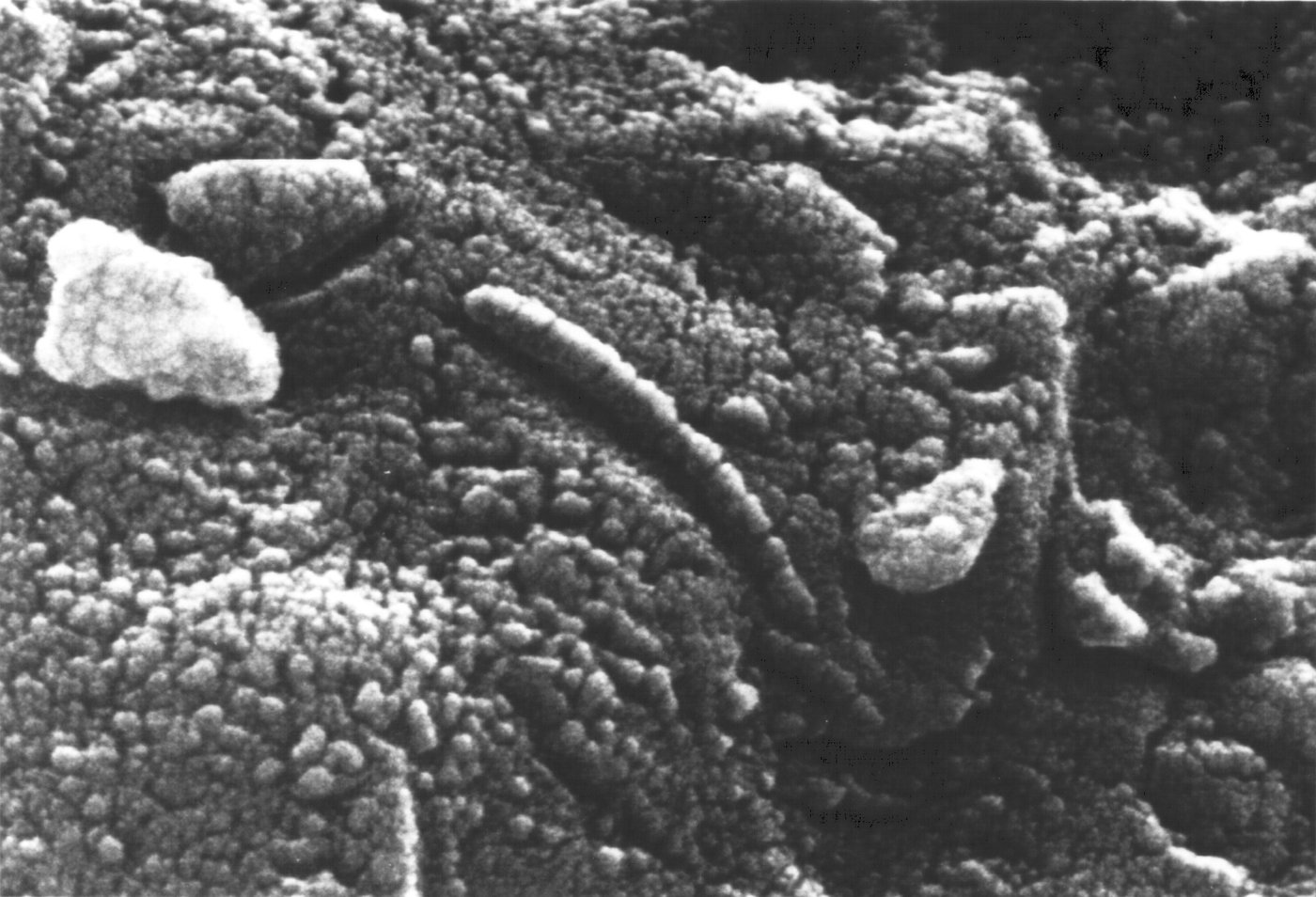
The evidence: The 'worm-like' structure NASA showed in 1996



ALH84001: The Antarctic Rock That Put 'Life on Mars' on Front Pages
Last reviewed Next review
We review and update every article weekly. When the record changes, so does the article. How we review
A meteorite picked up on the Antarctic ice in 1984 turned out to be from Mars.
Verdict: The rock is genuinely Martian, but the 1996 fossil claim has not held up and its organics have a non-living explanation.
Sources C. Meyer, NASA JSC Martian Meteorite Compendium: ALH84001 (2012); D. S. McKay et al., Science 273 (16 Aug 1996) 924–930, PMID 8688069; White House statement, 7 Aug 1996; Deseret News (10 Oct 1996); BBC Science Focus (J. Marchant); A. Steele et al., Science 375 (2022) 172–177, PMID 35025630; Carnegie Science and GFZ Potsdam releases (Jan 2022)
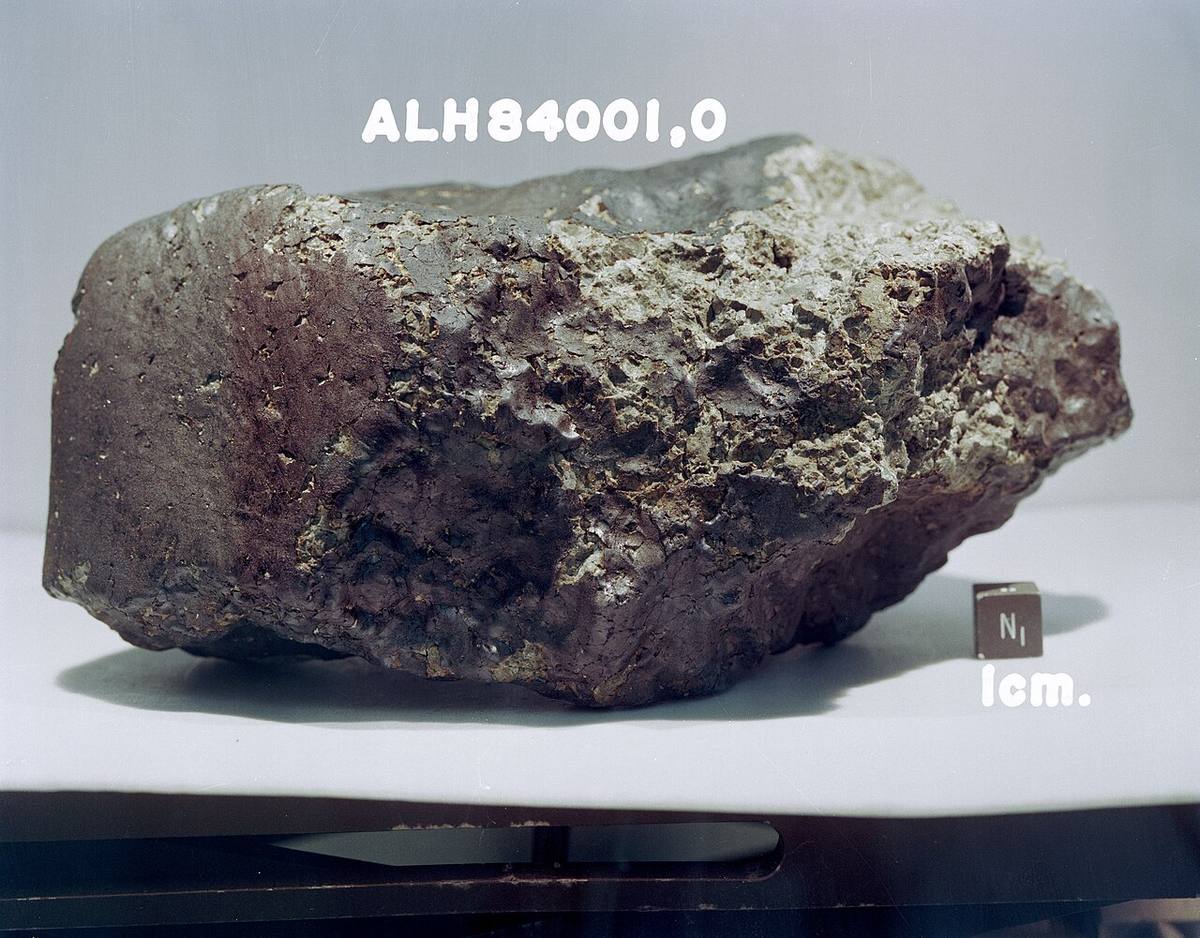
On 27 December 1984 a field team from ANSMET, the US program that collects meteorites from the Antarctic ice, was crossing the Far Western Icefield of the Allan Hills on snowmobiles. Geologist Roberta Score saw a greenish-gray stone against the blue ice. It weighed just under 2 kg. It was logged as sample ALH84001 and shipped to NASA’s meteorite lab in Houston with the rest of the season’s finds. The field notes called it highly shocked and added an excited “Yowza-Yowza”.
A rock from Mars
For years the stone sat in the catalog as a diogenite, a fairly common type of asteroid meteorite. In 1993 David Mittlefehldt, studying diogenites at Johnson Space Center, noticed details that did not fit: its iron-bearing minerals were wrong for that type, and oxygen isotope results matched meteorites known to come from Mars. It was reclassified as Martian. Dating showed it crystallized about 4 billion years ago, older than any other Martian meteorite then known. An impact knocked it off Mars about 15–16 million years ago, and it fell on Antarctica roughly 13,000 years ago.
The rock also held small orange-brown carbonate grains, a fraction of a millimeter across. Carbonates usually form from water, which hinted at a wetter early Mars.
“Possible relic biogenic activity”
A team led by David McKay and Everett Gibson at Johnson Space Center, with chemist Richard Zare’s group at Stanford, studied the carbonates closely. In Science on 16 August 1996 they reported four things found together: the carbonate globules, organic molecules called PAHs on fresh fracture surfaces, very small magnetite crystals like those some Earth bacteria make, and tiny worm-like shapes seen under an electron microscope. They granted that the features could have formed without life, and none was proof on its own. Together, though, they wrote, the features “could thus be fossil remains of a past martian biota”.
NASA held a news conference on 7 August 1996, before the paper appeared. The same afternoon President Bill Clinton spoke on the White House South Lawn. He said the finding must be checked by other scientists and asked NASA to look for more evidence. The story ran worldwide. A Utah paper reported that October that Score’s phone had been ringing nonstop since she was named as the finder.
The pushback
Other researchers soon challenged each clue. The worm-like shapes are far smaller than any known Earth bacterium. PAHs form without life in many places, from soot to interstellar clouds. Magnetite and carbonate can form through heat, shock and plain chemistry. Others raised contamination after the rock reached Earth. NASA’s own meteorite compendium notes how little the research teams agree, and that each team got only a small piece of a rock that varies from spot to spot. Most scientists now accept that the carbonates formed on Mars in water. Whether anything ever lived there is another matter. The original team kept arguing that biology was the best fit.
2022: chemistry, not cells
In January 2022 a team led by Andrew Steele of the Carnegie Institution for Science, with partners including GFZ Potsdam in Germany, NASA and Diamond Light Source in the UK, published new nanoscale analyses in Science. They found organic material sitting next to minerals formed when warm, carbon-dioxide-rich water reacted with the rock (processes called serpentinization and carbonation). They concluded the organics formed there about 4 billion years ago without life. NASA’s astrobiology program summed it up as organic matter that “was not formed biologically”.
Sources
- Meyer, C. (2012), Martian Meteorite Compendium: ALH84001, NASA Johnson Space Center: curator.jsc.nasa.gov (PDF)
- McKay, D. S., et al. (1996), “Search for past life on Mars: possible relic biogenic activity in martian meteorite ALH84001”, Science 273, 924–930: PubMed 8688069
- The White House, remarks by the President on the Mars meteorite, 7 Aug 1996 (archived at NASA JPL): web.archive.org
- Deseret News, “Geologist enjoys a meteoric rise to fame” (10 Oct 1996): deseret.com
- Marchant, J., “Life on Mars: the story of meteorite ALH84001”, BBC Science Focus: sciencefocus.com
- Steele, A., et al. (2022), “Organic synthesis associated with serpentinization and carbonation on early Mars”, Science 375, 172–177: PubMed 35025630
- Carnegie Science, “Martian meteorite’s organic materials origin not biological” (13 Jan 2022): carnegiescience.edu
- GFZ Potsdam, “On the abiotic origin of organic matter on Mars” (Jan 2022): gfz.de
- NASA Astrobiology, “An update from ALH84001” (18 Jan 2022): astrobiology.nasa.gov
Original text. Images: NASA photographs (public domain), self-hosted.
Weighing it
The rock, its Martian origin and its water-formed carbonates are well established. The 1996 microfossil reading has not been accepted, and the 2022 study offers a non-living source for its organics. Life on early Mars is not ruled out; this rock just doesn’t show it. The map pin is at the level of the Allan Hills region.
Verdict
Disputed The rock is genuinely Martian, but the 1996 fossil claim has not held up and its organics have a non-living explanation.
Evidence ledger
Each claim in this file, the source it rests on, and how well it holds up: 5 corroborated · 1 disputed. What the labels mean.
| Claim | Source | Type · date | Status |
|---|---|---|---|
| ALH84001 was found on 27 Dec 1984 in the Far Western Icefield of the Allan Hills, Antarctica, by an ANSMET field team; Roberta Score spotted it. | NASA JSC Martian Meteorite Compendium; Deseret News | official · 1996; 2012 | corroborated |
| It was first cataloged as an ordinary asteroid meteorite (a diogenite) and reclassified as Martian in 1993. | NASA JSC Martian Meteorite Compendium | official · 2012 | corroborated |
| Carbonate globules, organic molecules (PAHs), tiny magnetite grains and worm-like shapes in the rock could be fossil remains of Martian microbes.The authors themselves said inorganic formation was possible; critics argued each feature has a non-biological explanation. | McKay et al., Science (16 Aug 1996) | scholarly · 1996 | disputed |
| NASA announced the findings on 7 Aug 1996 and President Clinton spoke about them the same day. | White House statement, 7 Aug 1996; BBC Science Focus | official · 1996 | corroborated |
| The carbonates and other features formed on Mars, not in Antarctica.Broad agreement, though teams disagree on details. | NASA JSC Compendium; BBC Science Focus | scholarly | corroborated |
| The organic matter formed through water-rock reactions (serpentinization and carbonation) about 4 billion years ago, without life. | Steele et al., Science (2022); Carnegie Science; GFZ Potsdam; NASA Astrobiology | scholarly · 2022 | corroborated |
Update log
-
We added this case file.
-
Weekly re-check of sources; no change to the record since filing. Next check November 9, 2026.
Discussion
Discuss this case on the on-site Community board — no GitHub account required. Prefer a private tip for the editorial team? Submit a Sighting.
House rules: Community guidelines.